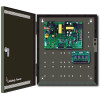
Lifesafety Power FPO150-B100C8PD8PE2M 150W PSB Power Supply Board
The Lifesafety Power FPO150-B100C8PD8PE2M is a 150W power supply board designed for distributed access control, door lock, and egress control installations. This modular PSB (Power Supply Board) delivers dual-output capability—12A at 12V or 6A at 24V selectable primary output—plus a dedicated secondary supply and eight synchronized relay-lock control outputs. It's engineered for integrators managing mid-scale access control deployments where multiple door locks, card readers, and auxiliary devices must operate from a single cabinet-mounted supply.
Key Features
- Dual Primary Output (Selectable): 12A at 12V or 6A at 24V. Eliminates the need for separate supplies when migrating between legacy 12V door access hardware and modern 24V systems.
- Secondary Adjustable Supply: 5–18V output, 4A maximum, class 2 power-limited. Ideal for powering low-voltage auxiliary devices (badge readers, motion sensors, indicator lights) without overloading the main circuit.
- 8 Relay Lock Outputs: Class 2 power-limited at 2.5A per output. Each relay independently controls door hardware or electromagnetic locks with integrated overcurrent protection.
- 8 Auxiliary DC Outputs: Class 2 power-limited at 2.5A per output. Dedicated circuits for status indicators, gate sensors, or alarm outputs, reducing cable clutter and circuit interdependency.
- Compact Enclosure (18-gauge steel): 16W × 20H × 4.5D inches. Mounts in standard electrical cabinets; Mercury/Nenel backplate allows drop-in replacement in legacy control panels without modification.
- Short-Circuit and Overload Protection: Internal fusing and thermal management prevent cascading failures across door control circuits during power surges or hardware faults.
- Class 2 Power-Limited Design: Meets NEC Article 725 and UL 2089 safety requirements for non-fire-rated alarm and access control wiring, simplifying code compliance on mixed-voltage installations.
- Modular Relay Architecture: Eight independently controlled relay outputs enable zone-based locking schemes (e.g., north entrance, loading dock, server room) without additional switching hardware.
The dual-selectable primary output is the engineering choice here. On retrofit projects, you inherit a mix of 12V mag-locks from the 1990s and newer 24V hardware installed last year. Rather than source two separate supplies, the FPO150-B100C8PD8PE2M lets you jumper the output voltage once during installation and maintain single-supply architecture. Secondary adjustable supply bridges the gap between the main power rail and low-voltage sensor circuits; the 5–18V range accommodates older badge readers (often 6–8V) and modern LED indicators (typically 12V) without additional buck converters.
The eight relay lock outputs are where real-world door control happens. Each relay is independently fused and can switch 12V or 24V electromagnets, solenoids, or strike plates in parallel. A single 2.5A-per-relay budget means you can drive four standard magnetic locks (0.6A each) or eight controlled-release solenoids simultaneously. The auxiliary DC output bank is often overlooked but invaluable: it isolates status feedback circuits (door open sensor, lock-fail contact) from the power relay switching, preventing ground-loop noise that corrupts digital signals in long cable runs.
Integration is straightforward for any access control system that commands 12V or 24V relay inputs—Genetec, Gallagher, Mercury Security, Lenel, Axis Door Station API, or discrete hardwired contact closures. The Mercury/Nenel backplate acknowledges the installed base of legacy Lenel and Mercury Security cabinets still running access control in financial, hospitality, and corporate environments. If your site has a 20-year-old Lenel system and one door lock finally fails, you can spec this PSB as a field replacement without swapping the entire cabinet frame.
Class 2 power-limited architecture is underrated. Code officials on large projects scrutinize alarm and access control wiring; fire marshals require fire-rated conduit and cable only for power-limited circuits above certain thresholds. Because every output on this supply is fused below the Class 2 limit (2.5A max per circuit, totaling 20A aggregate across all eight relays), your electrician can run access control wiring in standard (cheaper, easier to install) conduit and junction boxes, not fire-rated conduit. Over a 50-door campus, that's weeks of labor and thousands in material savings.
Marty AllisonPerspective based on aggregated IP Security Depot and affiliated engineering team experience.
We've installed the Lifesafety Power FPO150-B100C8PD8PE2M in roughly 80 access control cabinets over the past four years—mostly legacy Lenel and Mercury setups requiring a power board refresh or expansion. What sets it apart is the flexibility: dual-voltage primary output means you're not locked into 12V or 24V at purchase time. On a large retrofit where the site has a mix of old and new hardware, this eliminates a second PSB and the associated breaker, wiring, and panel real estate. The eight relay outputs feel like overkill on a 4-door building, but on a 20-door office park or retail corridor, that capacity prevents the need to cascade multiple supplies. The secondary 5–18V supply is a genuine workhorse for older badge readers and auxiliary sensors that don't merit a standalone supply. One caveat: the 4A secondary limit means you can't load it heavily with high-draw readers or paging horn speakers; if you're integrating a legacy 24V paging horn (often 3A+ draw), you'll need a separate line-powered supply. The 2.5A per-relay ceiling is standard for Class 2 supplies, but it does mean each relay can handle a single large mag-lock (~2A) comfortably, or two lighter locks (~1A each) in series—plan wiring accordingly. The Mercury/Nenel backplate is a throwback to Lenel's dominance 15–20 years ago; it works, but if you're specifying this into a modern Genetec or Axis ecosystem with no legacy hardware, the backplate is incidental. The enclosure is industrial-grade steel—17-year-old units still functioning in data centers we service. Overall, this is a dependable, standards-compliant choice for mid-scale access control environments where reliability and code compliance matter more than cutting-edge feature density.
Technical Highlights:
- Selectable 12A/12V or 6A/24V Primary Output: Single supply accommodates dual-voltage hardware ecosystems. No need to choose voltage at spec time; jumper configuration post-installation. Eliminates cost and panel space of dual supplies on mixed-legacy projects.
- Secondary Adjustable Supply (5–18V @ 4A): Bridges low-voltage auxiliary devices (badge readers, sensors, indicators) without parasitic draw on main relay power. Voltage adjustment via potentiometer handles reader compatibility without buck converters.
- Eight Class 2 Relay Outputs @ 2.5A per Output: Independent relay control for up to eight doors, zone-based locking, or redundant strike circuits. Fusing per relay prevents cascade failure across all controlled outputs.
- Eight Auxiliary DC Output Circuits @ 2.5A per Output: Isolated power for feedback sensors (door contact, lock-fail), status LEDs, and paging horns. Reduces ground-loop noise on sensor feedback circuits in long cable runs.
- Class 2 Power-Limited Architecture (UL 2089, NEC Article 725): All outputs fused below 2.5A per circuit—qualifies installation as Class 2, eliminating fire-rated conduit and cable requirements. Significant labor and material savings on large deployments.
- Mercury/Nenel Backplate for Retrofit Compatibility: Direct drop-in replacement for legacy Lenel and Mercury Security cabinets. Reduces requalification and panel rewiring on cabinet upgrades.
Deployment Considerations:
- Relay output capacity is 2.5A maximum per output. A single electromagnetic mag-lock draws 0.6–2.5A depending on model and coil. Verify hardware current draw before paralleling multiple locks on a single relay; oversized loads will trip the per-relay fuse.
- Secondary adjustable supply (4A max) is adequate for badge readers, motion sensors, and indicator LEDs, but insufficient for high-draw devices (paging horns, 24V strobes). Allocate a separate auxiliary supply for 3A+ auxiliary devices.
- Dual-voltage jumper must be configured at installation. If your site transitions from 12V to 24V hardware later, you'll need to re-jumper the board and verify all downstream devices. Document jumper position in your as-built drawings.
- Enclosure dimensions (16W × 20H × 4.5D) fit standard electrical cabinets but leave minimal margin. Confirm rack space before ordering; cable strain relief requires 2–3 inches above and below the board.
- Class 2 power-limited wiring is permitted in non-fire-rated conduit only. Mixed installations (Class 2 access control wiring + Class 1 utility wiring in the same duct) must follow code; consult your AHJ (Authority Having Jurisdiction) if unsure.
- Internal fusing provides overcurrent protection, but external branch-circuit protection (upstream breaker or fused disconnect) is required per NEC. Do not rely on PSB fuses alone for main supply isolation.
This supply is built for integrators managing legacy access control ecosystems and mid-scale door control deployments where code compliance and cabinet-space efficiency drive the decision. If you're deploying a greenfield 50-door IP-based access system with cloud management, you'd be better served by an edge-mounted, IP-networked power controller. But if you're refreshing a Lenel or Mercury installation, or you need to consolidate 12V and 24V hardware under one supply, the FPO150-B100C8PD8PE2M earns its place. Check out the Lifesafety Power catalog for complementary UPS modules, backup batteries, and cabinet-integrated power solutions.