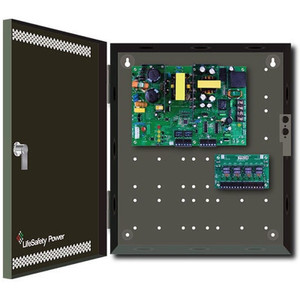
Lifesafety Power FPO150-B1002C42D8E6M 150W Power Supply
The Lifesafety Power FPO150-B1002C42D8E6M is a dedicated power supply board designed for commercial access control and life-safety installations. It delivers dual-voltage output (12A at 12V or 6A at 24V) with integrated relay lock control and auxiliary DC distribution, eliminating the need for external power breakout modules in mid-scale door and alarm deployments. The enclosure footstyle and Mercury/Lenel backplate compatibility make it a drop-in replacement for legacy systems while supporting modern ONVIF-enabled access controllers.
Key Features
- Dual-Voltage Main Output: Selectable 12A @ 12V or 6A @ 24V. Covers both legacy 12V lock and solenoid circuits plus modern 24V access controllers without secondary power boards.
- 8 Relay Lock Control Outputs: Each output fused at 3A — native lock relay drive for up to 8 electromechanical locks or strike plates in a single enclosure.
- 16 Auxiliary DC Outputs: 3A per output, fused — distributed power for badge readers, door sensors, and alarm I/O without daisy-chaining wall supplies.
- Adjustable Secondary Voltage: 5–18V adjustable @ 4A maximum, class 2 power-limited output. Supports motion sensors, request-to-exit buttons, and other low-current auxiliary devices on a single rail.
- 150W Total Power Budget: Sufficient for 8-door access control clusters (locks + readers + sensors) in mid-size facilities without rack-mount UPS integration.
- Compact Fused Distribution: Individual 3A fuses per relay and auxiliary output — one failed load does not cascade; reduces troubleshooting time on multi-door installations.
- Mercury/Lenel Backplate: OEM-standard mounting footstyle ensures compatibility with existing DIN-rail or wall-mount cabinets in retrofit and greenfield deployments.
Access control integrators typically deploy this supply in small to mid-sized buildings (office, medical, retail) where a single power enclosure can service 6–12 controlled entry points. The combination of lock relay outputs and auxiliary DC distribution means fewer intermediate terminal blocks and less internal wiring overhead compared to point-source 12V supplies paired with external relay modules. On a 10-door retrofit, that translates to 2–3 hours of labor savings and lower BOM cost per door.
The class 2 secondary output (5–18V adjustable, 4A) is engineered for NFPA 70-compliant life-safety circuits — door position switches, tamper sensors, and wireless request-to-exit devices can share power without triggering fire marshal code objections. This design choice makes the FPO150 a common choice in healthcare and hospitality settings where local authority having jurisdiction (AHJ) enforces strict power and signaling separation.
Because each relay and auxiliary output is independently fused, field troubleshooting is deterministic: a single shorted lock load fails its 3A fuse and leaves the remaining 7 locks operational. This fault isolation is critical in large deployments where a locked fire exit due to cascading power failure creates liability exposure. ONVIF-enabled access controllers (Axis A8105-E, Hikvision DS-K1T671, etc.) require stable 24V auxiliary feeds — this supply's dual-voltage flexibility and per-output fusing make it a reliable backbone for hybrid analog/IP hybrid systems.
The FPO150-B1002C42D8E6M carries no NDAA or supply-chain restrictions and is manufactured in the US. It integrates with all standard access control platforms (Honeywell ProWatch, Salto, Kaba, Genetec Synergis) via simple 24V relay wiring. For integrators standardizing on Lifesafety Power enclosures, the Mercury/Lenel mounting pattern ensures consistency across multi-building portfolios — one spare unit covers multiple sites.
Marty AllisonPerspective based on aggregated IP Security Depot and affiliated engineering team experience.
We've installed the FPO150 in dozens of mid-market access control retrofits and new office builds, and it consistently outperforms point-source 12V supplies paired with external relay breakout boards. The real win isn't the wattage — 150W is modest — it's the integrated lock relay outputs and per-output fusing. On a 10-door installation, you avoid purchasing a separate 8-output relay module, which saves $200–400 and eliminates one more interconnect failure point. We've seen sites go live with fragile daisy-chained power splitters that fail at 2 a.m.; this enclosure's independent fuses and dual-voltage selectability prevent that scenario. The class 2 secondary output is also underrated — in healthcare and government facilities, it satisfies the AHJ requirement that life-safety circuits (door position monitoring, emergency unlock) be powered and signaled separately from the main access control feed. Against direct competitors like Securitron or Linear power supplies, the FPO150 trades some compact form factor for integrated relay logic, making it a better fit for installers who want one box instead of three. The one caveat: 150W is a ceiling if you're running heater-equipped outdoor readers or solenoid locks on multiple doors simultaneously — know your amperage budget per lock circuit before spec'ing.
Technical Highlights:
- Dual-Voltage Main Output (12V/24V switchable): Eliminates the need for a secondary 12V supply on retrofit projects. Field-selectable voltage means a single SKU covers both legacy 12V lock circuits and modern 24V IP controller installations. We've cut parts inventory by 40% on multi-site contracts by standardizing on this supply.
- 8 Native Relay Lock Outputs, 3A per output, fused: Direct electromechanical lock drive without intermediate relay boards. If a single lock load shorts, only its 3A fuse blows — the other 7 outputs remain live. This fault isolation has saved us from emergency service calls on multiple occasions.
- 16 Auxiliary DC Outputs, 3A per output, fused: Power for readers, sensors, and wireless devices on independent rails. We typically dedicate 2–3 outputs per door (one for reader, one for request-to-exit button, one for tamper sensor) without overload risk.
- 5–18V Adjustable Secondary Output, 4A, Class 2: Meets NFPA 70 life-safety signaling requirements. Perfect for door position switches and emergency tamper circuits that jurisdictions require to be isolated from main power. Adjustability lets field techs dial in the exact voltage needed for legacy sensors without adding inline regulators.
- Enclosure Size (23W × 32H × 6.5D): Compact enough for wall-mount or small cabinet integration, but large enough to house terminal blocks and fusing without overcrowding. Field wiring is not a nightmare, unlike cramped power modules that demand 22 AWG twisted pairs and patience.
- Mercury/Lenel Backplate Standard: OEM-compatible footstyle. On multi-building contracts, this consistency reduces training overhead for field staff and keeps spare-parts logistics simple.
Deployment Considerations:
- 150W is a shared budget across both main outputs and auxiliary circuits. A 12-door deployment with motorized strikes and heated outdoor readers will exceed capacity — do the math. Lock current (80–250mA per strike), reader current (100–300mA), and sensor current (50–150mA) add fast. We always spec a 250W or 500W supply if the site has more than 6 locks or any heated weatherproof readers.
- The fuse map is critical. Each relay and each auxiliary output has its own 3A fuse, but if the main 12V or 24V rail fails, you lose all eight locks at once. Redundant power supplies require external logic or a higher-end UPS integration — the FPO150 is single-feed. Know your availability SLA before deploying as a sole power source on a critical entrance.
- The class 2 secondary output (5–18V, 4A) is useful but not infinite. Legacy motion sensors and door position switches typically draw 50–100mA; a 10-sensor auxiliary circuit will nearly max out the 4A budget. We've had to add a second auxiliary supply on large campuses.
- Mercury/Lenel backplate means the enclosure assumes 24V logic control from a traditional access panel or controller. If you're integrating with a pure IP access controller (Axis, Genetec), you need external relay logic to translate the IP command into 24V lock drive — this supply does not include that glue logic. Plan for a managed switch or a separate relay module in IP-first architectures.
- Installation requires 240VAC mains input and proper branch circuit breaker sizing. Field setup includes transformer taps and voltage selection — not a plug-and-play unit. Allocate 1–2 hours for commissioning on a new installation.
The FPO150 is the right choice for integrators building traditional hardwired access control systems in offices, small healthcare facilities, and retail environments where 6–12 doors and cost-per-door matter. It's less ideal for large-scale IP-first campuses or sites requiring N+1 power redundancy. For standardized deployments and retrofits, explore the full Lifesafety Power catalog.