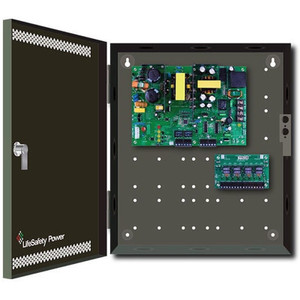
Lifesafety Power FPO150-B100C82D8PE6M Power Supply Board
Overview
The Lifesafety Power FPO150-B100C82D8PE6M is a 150W centralized power supply board designed for distributed access control and security systems. This is a secondary voltage supply rated for 12A at 12VDC or 6A at 24VDC — capacity sufficient to power door locks, readers, and control panels in small-to-medium facility deployments. The board includes both high-power relay outputs for strike locks and lower-amperage class 2 auxiliary outputs for mixed loads, eliminating the need for separate power conditioning blocks throughout your installation.
The FPO150-B100C82D8PE6M mounts into a compact 23W × 32H × 6.5D enclosure with Mercury/Lenel backplate compatibility, meaning it slots into existing frames or cabinet rails used in legacy and modern access control designs. Its mixed output architecture — 8 relay-controlled lock circuits plus 16 low-power auxiliary circuits — addresses the reality that access control racks power both high-inrush loads (solenoid locks) and sensitive analog/digital sensors simultaneously.
Key Features
- Primary Output: 150W total capacity at 12A/12V or 6A/24V. This allows you to run multiple door locks or a combination of locks and readers from one board without daisy-chaining separate supplies — reducing wiring complexity and single points of failure in smaller deployments.
- 8 Relay Lock Control Outputs: Each fused at 3A, providing galvanic isolation between strike lock circuits and the control logic. Relay outputs prevent voltage transients from lock solenoids affecting reader or panel circuits — a common cause of reader failures in under-engineered systems.
- 16 Auxiliary Class 2 Outputs: Limited to 2.5A each at 5–18V adjustable. These low-voltage outputs power wireless keypads, exit sensors, and request-to-exit buttons without consuming high-current capacity reserved for locks. The 5–18V adjustability handles legacy 12V readers and newer 24V systems from the same supply.
- Adjustable Secondary Supply: The 5–18V auxiliary output at 4A maximum lets you configure mixed-voltage reader networks (12V and 24V readers, for example) on a single board. This reduces the number of supplies and power conditioning modules needed in your cabinet.
- Fused Architecture: 3A per relay lock output means a stuck solenoid or short in one lock circuit won't blackout the entire supply — only that output fuses, protecting the rest of the system. Pair this with a 24-hour power monitoring system and you'll catch a failed lock before occupants notice.
- Mercury/Lenel Backplate: Drop-in compatibility with standard access control frames. If you're retrofitting or expanding a system already running Mercury or Lenel controllers, the physical and electrical interface is pre-defined — no custom mounting or adaptation needed.
Integration & Compatibility
The FPO150-B100C82D8PE6M is designed as a general-purpose secondary voltage supply, not a dedicated controller. It integrates into access control systems by providing monitored, fused power to door locks, card readers, and exit devices. It works downstream of your primary AC power conditioning and typically sits between a UPS or supervised battery backup and your distributed lock/reader network. Relay outputs can be supervised through simple current-loop monitoring; auxiliary outputs are class 2 power-limited, so they meet low-voltage code requirements in most jurisdictions without additional isolation transformers.
Why This Model
Choose the FPO150-B100C82D8PE6M if you need centralized power distribution for a single access control frame with mixed 12V and 24V loads. The 150W capacity and 8 independent relay circuits handle typical single-door or small multi-door (2–4 openings) access control racks. If your facility requires more than 8 independently switched locks or exceeds 150W across all loads, consider a higher-capacity supply in the same family or multiple boards daisy-chained through a supervisor module.
The adjustable auxiliary output is valuable in brownfield installations where reader voltage standards vary across phases of renovation. The Lenel backplate means minimal mounting work if your existing frame already accepts that standard.
When to Choose a Different Model
If you need more than 8 relay-controlled outputs, require integrated battery backup supervision, or are building a system from scratch without legacy frame constraints, evaluate higher-capacity or modular power supply options in the Lifesafety Power catalog. For deployments with more than 6–8 doors, a distributed power architecture (smaller supplies mounted near each reader/lock pair) often yields better maintainability and fault isolation than a single central board.
Frequently Asked Questions
Q: Can the FPO150-B100C82D8PE6M power multiple door strikes simultaneously?
A: Yes. At 12A/12V total capacity, you can run up to 4 typical solenoid strikes (3A each via the relay outputs) simultaneously, or mix strikes with other 12V loads like readers or sensors up to the 12A total limit. The 8 individual relay outputs let you stagger lock release in a sequence to avoid inrush current spikes that might trip facility power.
Q: What's the difference between the relay outputs and the auxiliary outputs?
A: Relay outputs (8 total, 3A each) are galvanically isolated and rated for high-inrush solenoid loads — typical for door strikes and access control solenoids. Auxiliary outputs (16 total, 2.5A each) are class 2 power-limited and designed for lower-power, longer-runtime devices like wireless keypads, exit sensors, and indicator lights. Relay outputs are supervised via current loop; auxiliary outputs are inherently low-energy.
Q: Does the FPO150-B100C82D8PE6M require a separate UPS or battery backup?
A: The board itself does not include internal battery backup. You provide supervised 12VDC or 24VDC input from your facility's UPS or dedicated battery backup system. The supply then distributes that power to locks and readers. Many integrators pair this board with a 24-hour backup battery module to maintain access control during mains power loss.
Q: Is the FPO150-B100C82D8PE6M compatible with modern IP access control readers?
A: This supply provides DC voltage for traditional hardwired readers and solenoid locks. If your readers are networked (IP-based with PoE), they draw power from the network switch, not this supply. However, the FPO150-B100C82D8PE6M is often used in hybrid deployments where some readers are hardwired legacy devices and others are networked — the supply handles the hardwired subset.
Q: What is the enclosure size and does it mount in a standard access control cabinet?
A: The enclosure measures 23W × 32H × 6.5D inches with a Mercury/Lenel backplate. It is designed to mount into standard access control frames and DIN rails. Confirm your existing frame or cabinet accepts the Lenel backplate standard before ordering if you are retrofitting.
The FPO150-B100C82D8PE6M fills a specific gap in access control rack design: you need to power mixed loads (strike locks at 3A + readers at 0.5A + wireless keypads at 0.2A) from a single supervised input, and you need the flexibility to allocate outputs dynamically without rewiring. At 150W total, this board is right-sized for a single Mercury/Lenel frame running 2–4 doors with distributed readers.
Technical Highlights:
- 8 Relay Lock Outputs at 3A Each: Galvanic isolation means a short in one lock circuit (stuck solenoid, wiring fault) will blow only that output's 3A fuse, leaving the other 7 locks and all reader power intact. Compare this to a non-fused 150W supply where a single fault kills the entire rack.
- 16 Auxiliary Outputs at 2.5A Each: Class 2 power-limited design eliminates the need for a separate low-voltage isolation transformer for sensors, exit buttons, and wireless devices. Saves cabinet real estate and simplifies supervision logic.
- 5–18V Adjustable Auxiliary: In brownfield upgrades, you often encounter 12V readers installed 10 years ago alongside new 24V systems. This board lets you set one auxiliary output to 12V for legacy readers and another to 24V for new hardware — no separate conditioning supplies required.
Deployment Considerations:
- The 12A/12V capacity is the practical limit for 4 simultaneous strike releases. If you need to release 6+ strikes in parallel, you'll exceed the supply headroom and risk nuisance fuse blows during high-traffic periods. Plan lock release sequencing through your access control panel to stagger opens.
- The enclosure dimensions (23W × 32H × 6.5D) are tight for a 150W supply with 24 output terminals. Internal wiring becomes dense. Allow 30–45 minutes for initial termination and testing if you're not familiar with Lenel backplate wiring conventions.
- Battery backup supervision requires external monitoring — this board itself has no integrated battery charger or low-voltage alarm relay. Pair it with a supervised 24-hour backup battery (external) and wire the backup input to the supply's supervised DC input terminals.
This is the correct choice for a single-frame Mercury/Lenel access control system with 2–4 doors, mixed reader voltages, and a requirement for independent per-lock fault isolation. It's also the right fit if you're expanding a legacy frame and need to add auxiliary outputs without replacing the entire distribution subsystem. Do not force this onto a multi-cabinet system — at that scale, a distributed power architecture with smaller supplies mounted near each cabinet will yield better maintainability and cleaner fault detection.