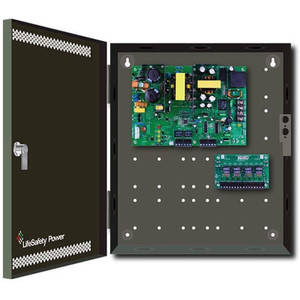
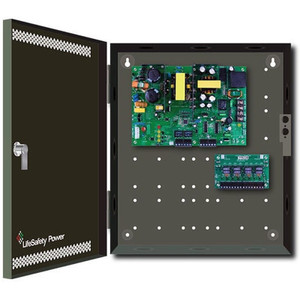
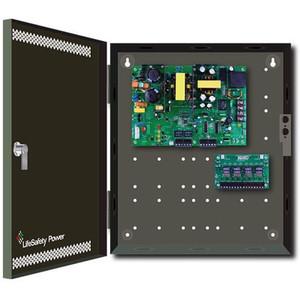
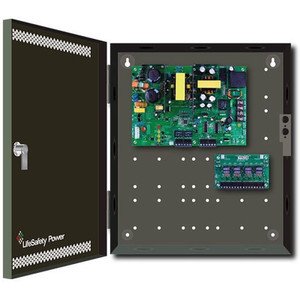
Lifesafety Power FPO150-3D8PE8M2 150W Access Control Power Supply Board
The Lifesafety Power FPO150-3D8PE8M2 is a 150W power distribution board designed for mid-scale access control and life-safety installations requiring multiple circuit board control and distributed auxiliary power. It delivers a configurable primary output of either 12A at 12V or 6A at 24V, plus 24 independent class 2 auxiliary DC outputs rated at 2.5A each—sufficient to power door strikes, electric locks, request-to-exit buttons, magnetic sensors, and other low-voltage field devices across a single equipment room or distributed cabinet. The board mounts in a compact 30W × 36H × 4.5D enclosure with an integrated backplate capable of hosting up to eight Mercury or Lenel compatible control boards, making it the power backbone for multi-door, multi-zone access systems without requiring separate auxiliary power supplies.
Key Features
- Dual Primary Output Modes: 12A @ 12V or 6A @ 24V from a single incoming feed. Select voltage at terminal block to match your control boards and field devices.
- 24 Independent Auxiliary Outputs: 2.5A per output, class 2 power-limited. Each output is individually protected; load distribution prevents nuisance shutdowns on high-draw strikes.
- Mercury & Lenel Board Compatibility: Integrated backplate holds up to eight control boards in a single enclosure. Reduces cabinet footprint and simplifies wiring vs. discrete power supplies per board.
- Compact Footprint: 30W × 36H × 4.5D enclosure fits standard access control cabinets or wall-mounted installations. Integrated backplate eliminates need for external DIN rails or mounting hardware.
- Class 2 Power-Limited Design: Auxiliary outputs meet code requirements for low-voltage circuits. No additional fusing required on field devices rated for class 2 power.
- High Auxiliary Density: 24 outputs from a single board vs. multiple standalone supplies. Simplifies scheduling and load planning across lock strikes, sensors, and pushbuttons.
The FPO150-3D8PE8M2 is engineered around Mercury and Lenel board ecosystem compatibility, which remain prevalent in legacy and modern access control deployments across commercial, institutional, and industrial facilities. The 150W total capacity is sufficient for 8–16 door zones with auxiliary strikes and motion sensors; larger deployments (24+ doors) typically use multiple boards or upgrade to higher-wattage supplies. Incoming power is terminated via standard screw terminals; primary voltage selection (12V or 24V) is set at the board and does not change during operation.
Auxiliary output distribution is critical to system reliability. Each of the 24 outputs is independently current-limited to 2.5A, meaning a failed or shorted lock strike on one output will not cascade to others. Best practice is to map strike amperage across outputs during design—a typical electric strike draws 0.6–1.2A, so a single 150W supply can safely support 18–20 simultaneous strikes if no single output exceeds 2.5A. Request-to-exit buttons, status indicators, and motion sensors draw <0.1A and can be ganged on shared outputs. Consult the Mercury or Lenel board manual for recommended terminal gauge and torque; 16 AWG solid or stranded wire is standard for auxiliary connections at typical torque of 25–35 inch-pounds.
Thermal and mechanical robustness are often overlooked in board-level power supplies. The FPO150-3D8PE8M2 relies on passive convection in the enclosure; ensure the mounted backplate does not obstruct airflow, and maintain at least 2 inches of clearance above and below the supply for convection. In high-ambient installations (>90°F continuous), derate the supply by 10–15% or add a small 24V DC fan to the enclosure. The board itself is inherently protected against overload via current limiting on all outputs; however, repeated load cycling (e.g., frequent lock actuation) will generate heat. In environments with frequent door traffic or high solenoid duty cycles, monitor enclosure temperature during commissioning—sustained operation above 140°F will shorten capacitor life.
Integration with modern VMS and access control platforms depends entirely on the control boards plugged into the backplate. The Lifesafety Power supply itself does not expose network, API, or management interfaces; it is a passive power distribution resource. Mercury and Lenel boards handle all logic, communications, and audit logging. Verify your specific board models (e.g., Mercury 4×4 Rev 3, Lenel 3000 Series) are physically compatible with the backplate before procurement—the enclosure supports boards within a nominal footprint, but unusual form factors or older revisions may require adapter plates or mounting modifications.
Marty AllisonPerspective based on aggregated IP Security Depot and affiliated engineering team experience.
We've deployed the FPO150-3D8PE8M2 across office parks, healthcare facilities, and multi-building campuses where access control was already standardized on Mercury or Lenel boards. The real value is density and simplification—rather than sourcing a separate 12V or 24V auxiliary supply for every two or three control boards, you consolidate everything into one compact board with integrated backplate. On a 12-door system with strikes, mag-locks, and request-to-exit sensors, this supply eliminates three or four discrete power supplies, reduces terminal block congestion, and cuts troubleshooting time because field technicians know exactly where the power feed enters and which outputs feed which zones. That operational clarity pays dividends over the lifetime of the system.
The 24 auxiliary outputs are not all created equal—understanding load distribution prevents frustration during commissioning. A typical electric strike draws 0.8A; a mag-lock can draw 1.5A. If you gang a mag-lock and two strikes on one output, you've already consumed 3.8A—above the 2.5A limit. The board will shut down that output, the locks will de-energize, and the alarms will fire. We've seen integrators discover this limitation in the field rather than on the design bench. Pre-plan your output map during the bid phase, identify which devices get which outputs, and validate total amp-draw per output. Use a simple spreadsheet; it takes 10 minutes and prevents service calls.
Technical Highlights:
- Configurable Primary Output (12V/24V): Select voltage at terminal block to match your control board ecosystem and field device requirements. No jumper swaps or firmware changes—terminal selection is physical and immediate. Simplifies inventory management if you support both 12V and 24V sites from the same spare-parts bin.
- Independent Output Protection: Each of the 24 auxiliary outputs is individually current-limited to 2.5A. A shorted strike on output 15 will not affect outputs 1–14 or 16–24. Field service is isolated and faster because you don't have to troubleshoot cross-circuit interference.
- Class 2 Power-Limited Compliance: Auxiliary outputs meet NEC class 2 power-limited circuit requirements. No additional fusing is required on low-voltage field devices. Simplifies code compliance documentation and reduces bill of materials for auxiliary circuits.
- Backplate Capacity Up to 8 Boards: Integrate Mercury and Lenel control boards directly into the backplate without external DIN rails or mounting shelves. Reduces equipment room footprint and eliminates cross-cabinet wiring. Verify your specific board models fit the physical geometry before ordering.
- Passive Convection Design: No fans or active cooling. Lower reliability risk in dusty or high-vibration environments. Requires adequate enclosure airflow and thermal margin at high continuous load (150W dissipation over 4.5-inch depth means density). Not recommended for outdoor or unventilated cabinets without supplementary cooling.
Deployment Considerations:
- Pre-populate your load distribution spreadsheet during design. List all devices (strikes, sensors, indicators) and assign each to a specific auxiliary output, totaling amp-draw per output. Do not exceed 2.5A per output, and leave 20% headroom for inrush current on solenoids. Validate before ordering enclosure and boards.
- Confirm your specific Mercury or Lenel board model numbers and revision levels fit the backplate geometry. Older revision boards or non-standard form factors may require custom mounting adapters or a different enclosure. Contact the board manufacturer or Lifesafety Power technical support if you're unsure.
- Incoming primary feed must be sized for 12A @ 12V or 6A @ 24V depending on selected output voltage. Use appropriately rated breakers (15A breaker for 12V, 10A breaker for 24V minimum). Undersized incoming power will cause nuisance shutdowns under full auxiliary load.
- Enclosure thermal margin is limited at full 150W load. In environments exceeding 85–90°F ambient or with frequent lock actuation cycles, add a small 24V DC fan to the enclosure or derate the supply by 10–15%. Monitor enclosure temperature during commissioning to confirm adequate cooling.
- Class 2 designation applies only to auxiliary outputs. Primary 12V or 24V feed is not class 2 and must be wired per NEC article 300 or equivalent. Segregate primary wiring from auxiliary and low-voltage signal cables to avoid cross-interference and code violations.
This supply is the right choice for integrators and end-user teams standardizing on Mercury or Lenel boards and needing consolidated, field-serviceable power distribution in a compact form factor. If your deployment is multi-vendor or relies on non-compatible control boards, you'll need a different supply architecture. For fleets of similar access control systems across a portfolio of buildings, the FPO150-3D8PE8M2 becomes a standard BOM item—streamlined procurement, predictable spare-parts strategy, and faster onsite diagnosis. Explore the full Lifesafety Power catalog for complementary power distribution and backup solutions.