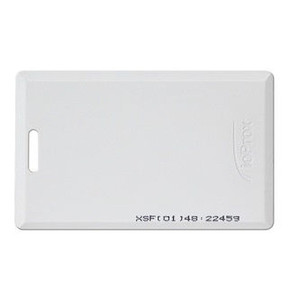
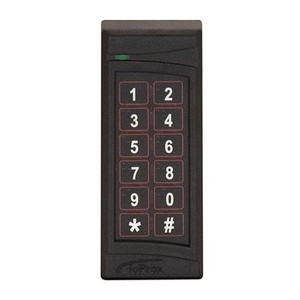
Kantech P10SHL ioProx Standard Clamshell Access Card
The P10SHL is a proximity access card engineered for credential-based facility entry across commercial, institutional, and industrial deployments. It implements the 26-bit Wiegand protocol—a long-standing standard in access control infrastructure—ensuring compatibility with a broad installed base of reader hardware. The clamshell form factor distinguishes this card from standard flat designs, offering measurable durability advantages in high-traffic environments where cards experience repeated insertion and wear.
Key Features
- Clamshell Form Factor: The hinged plastic construction protects the magnetic stripe and embedded proximity elements from accidental damage during daily handling and insertion into readers. In environments where staff turnover is high or access points see 500+ transactions per day, this translates to lower replacement rates and reduced credential lifecycle costs compared to standard card formats.
- 26-bit Wiegand Protocol: This encoding format is the de-facto standard across thousands of installed reader systems. Choosing Wiegand compatibility means you can integrate the P10SHL into existing infrastructure without firmware upgrades, controller modifications, or reader replacement—a significant cost and downtime advantage in retrofit or mixed-technology deployments.
- ioProx Reader Integration: The P10SHL pairs directly with Kantech ioProx reader systems and compatible access control platforms. This tight integration ensures reliable reads at standard operating distances (typically 3–6 inches) with minimal error rates, avoiding the frustration of failed badge swipes that plague poorly matched card-reader pairs.
- Indoor Deployment Suitability: Rated for indoor use, the P10SHL is optimized for office lobbies, secured corridors, data centers, and warehouse entry points. If your deployment requires outdoor weather resistance (rain, humidity, temperature swings), you'll need to evaluate weatherproofed reader enclosures rather than upgrading the card itself.
- Minimum Order Quantity of 50 Cards: Procurement in 50-card increments means you'll order 50, 100, 150, etc. This approach suits organizations with established credential management workflows and sufficient user populations to justify bulk purchasing. For pilot programs or very small facilities, this minimum may be a constraint; verify your roll-out timeline aligns with the 50-card increment model.
- Standard Credential Format for Access Control Systems: The card integrates with enterprise access control platforms that manage user provisioning, access schedules, and audit logs centrally. This assumes you have (or plan to deploy) a controller infrastructure; the card itself is the physical token, not a standalone authentication device.
Integration and Deployment Context
The P10SHL is most effective in organizations already standardized on Kantech or compatible ioProx infrastructure. If your facility operates multiple reader brands or protocols (HID iClass, MIFARE, Bluetooth BLE), you may need to evaluate mixed-technology readers or consolidate to a single platform. When planning a new access control deployment, consider the full reader-to-controller-to-credential lifecycle—the card is one component of a larger system. Audit your reader population and control panel capabilities before committing to a clamshell card order.
When to Consider Alternatives
If your facility requires outdoor proximity access or needs contactless smart card features (encryption, multi-factor integration), explore higher-security card variants or iClass-based credentials within the Kantech ecosystem. For organizations mid-transition between older magnetic stripe systems and modern mobile credentialing, a phased approach using dual-technology readers may be more practical than a direct P10SHL deployment.
Frequently Asked Questions
Q: Is the P10SHL compatible with non-Kantech readers?
A: The P10SHL uses the 26-bit Wiegand protocol, which is supported by many third-party readers. However, compatibility is not guaranteed across all brands or models. Verify your reader's Wiegand support and operating distance specifications before ordering in bulk.
Q: Can I order fewer than 50 cards?
A: No. The P10SHL is sold in increments of 50 cards per order. If you need a smaller initial quantity, contact the supplier to discuss options or consider a phased rollout aligned with the 50-card minimum.
Q: What is the expected lifespan of a P10SHL card?
A: The clamshell design and embedded proximity elements are engineered for multi-year use in typical office environments. Lifespan depends on usage frequency and physical handling. High-traffic environments (500+ swipes per day) may see cards lasting 3–5 years; light-use areas may exceed 7 years. Manufacturer documentation does not specify an official MTTF (mean time to failure).
Q: Does the P10SHL work with mobile access credentials or smartphone-based entry?
A: No. The P10SHL is a passive proximity card only. If your organization is transitioning to mobile credentialing, you'll need readers and controllers that support Bluetooth or NFC. The P10SHL can coexist in a dual-credential environment, but it does not natively support smartphone integration.
Q: What environment ratings does the P10SHL have?
A: The P10SHL is rated for indoor use only. It is not IP-rated for water submersion or outdoor weather exposure. For outdoor access points, deploy weatherproof reader enclosures and site the card distribution indoors.
Ted PerryPerspective based on aggregated IP Security Depot and affiliated engineering team experience.
The P10SHL is a straightforward commodity card—no surprises, no hidden gotchas—but that predictability is exactly why it works in mature access control deployments. The 26-bit Wiegand protocol has been the industry standard for 20+ years, and the clamshell form factor meaningfully extends card lifespan in environments where credentials cycle through readers dozens of times per day.
Technical Highlights:
- 26-bit Wiegand Encoding: Ensures interoperability across thousands of legacy and current-generation readers from multiple vendors. You're not locked into proprietary formats; Wiegand is a known quantity with predictable behavior across infrastructure boundaries.
- Clamshell Durability: Hinged design shields the proximity element and reduces stress on the card during insertion cycles. In high-traffic facilities (hospital corridors, warehouse entry gates), this translates to measurably fewer premature card failures compared to flat card designs.
- Minimum 50-Card Order Quantity: A constraint, yes—but it enforces discipline in credential lifecycle management. You won't over-provision cards to small user bases, and bulk ordering reduces per-card costs significantly compared to one-off replacements.
Deployment Considerations:
- Audit your installed reader base before committing to a large P10SHL order. If you operate mixed-protocol readers (iClass, MIFARE, contactless smart cards), ensure all access points support standard Wiegand 26-bit input. A single incompatible reader will create support friction.
- The P10SHL is passive—it carries no power or encryption. If your regulatory environment requires multi-factor authentication or encrypted credential exchange, this card alone will not meet that requirement. Plan controller-level security controls independently.
The P10SHL is the right choice for office parks, mid-market educational institutions, and industrial facilities with stable, established access control infrastructure. It's not a solution for organizations actively migrating to mobile credentials or evaluating next-generation reader technologies. For retrofit or greenfield deployments where 26-bit Wiegand compatibility is already confirmed across your reader population, the P10SHL delivers reliable, cost-effective facility access at scale.