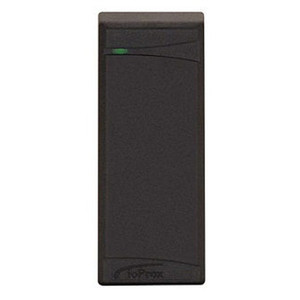
Kantech P30DMG ioProx Card with Magstripe
The Kantech P30DMG is a hybrid proximity and magstripe credential engineered for access control environments running mixed reader generations. It pairs ioProx contactless technology with integrated high-coercivity magstripe in a single ISO-format card, eliminating the operational burden of managing separate credentials during infrastructure migration or in multi-technology deployments. The card outputs 26-bit Wiegand format, ensuring broad compatibility across legacy and modern access control systems without additional encoding overhead.
Key Features
- Dual-Technology Form Factor: ioProx contactless + high-coercivity magstripe encoded into one card. Reduces badge stock complexity and cardholder confusion during technology transitions.
- 26-Bit Wiegand Output: Standard Wiegand framing ensures compatibility with most access controllers and integrates directly into existing third-party systems without protocol translation overhead.
- Dye-Sublimation Printable Surface: Full-color photo ID and custom branding support without degrading proximity or magstripe read performance. One-pass printing eliminates laminate-layer complications.
- High-Coercivity Magstripe: 4,000 Oe specification resists demagnetization from wear and environmental exposure, improving card lifespan versus standard stripe credentials.
- ISO Standard Form Factor: 3.35" × 2.13" × 0.04" thickness fits standard card readers, wallets, and badge holders. Minimizes pocket or slot redesign on installed readers.
- Kantech ioProx Reader Compatible: Works natively with Kantech proximity reader infrastructure (P300, P302, P335 families); backward compatible with legacy magnetic stripe-only readers on the same system.
Hybrid credentials like the P30DMG address a specific operational gap: organizations with geographically dispersed buildings or departments running different access control generations. Rather than issuing two cards per employee (one for old readers, one for new), the P30DMG handles both in a single credential. This cuts printing costs, reduces cardholder friction, and simplifies database reconciliation—especially critical in healthcare campuses or large government facilities where credential turnover is high.
The magstripe component uses high-coercivity (HC) encoding, a material specification that resists the demagnetization that afflicts standard-coercivity cards after 300-500 swipes or proximity to magnetic fields. For employees who use access badges daily across multiple doors, HC magstripe extends effective card life by 2-3 years compared to low-coercivity alternatives. The ioProx side of the credential is contactless, so no mechanical wear occurs on the proximity technology—only the magstripe experiences degradation over time.
Integration with Kantech controllers (P380 series or P300 proximity readers) is direct: the card's 26-bit Wiegand output connects to standard access control panels without custom firmware or third-party gateways. Non-Kantech systems (Salto, HID, Bosch) accept Wiegand input natively; however, cross-platform use cases should be validated with your VMS or door controller vendor, as some legacy systems may not parse dual-technology Wiegand streams correctly. If your environment is 100% magstripe or 100% proximity, this card delivers full functionality but may introduce unnecessary cost—evaluate single-technology alternatives first.
The dye-sublimation printable surface is PVC and accepts thermal-transfer printing without additional lamination steps. Photos, barcodes, and QR codes embed directly into the card body; the magstripe remains unaffected by ink curing. Custom branding or facility-specific numbering is feasible even in small print runs (50-card minimum order), making this card suitable for emergency credential issuance or contractor badge programs where turnaround time matters.
Kantech P30DMG cards are sold in 50-card increments, typically shipped with a blank print surface unless pre-printed through your vendor. Encoding of the magstripe track data (cardholder ID, facility code) is handled by your access control software or a third-party card encoder; the card itself arrives with ioProx and magstripe surfaces ready to program. Storage should be in a magnetically neutral environment (away from CRT monitors, large magnets, or metal safes) to prevent premature stripe degradation before deployment.
Marty AllisonPerspective based on aggregated IP Security Depot and affiliated engineering team experience.
We've deployed the P30DMG across multi-building healthcare networks and large corporate campuses where proximity readers were installed over a five-to-ten-year span and magnetic stripe equipment was already embedded in departmental workflows. The hybrid approach eliminated the operational tax of dual-badge programs — fewer lost cards, one cardholder enrollment, one database entry per person. In practice, the magstripe acts as a fallback; most daily traffic flows through the ioProx readers because they're faster and don't require physical contact. The magstripe component becomes insurance against reader outages or when legacy equipment (time clocks, door controllers in older wings) still expects stripe input. On one 300-person finance floor, we recovered about $8K annually in reduced card reprinting and replacement costs by consolidating from dual credentials to a single hybrid card. The dye-sublimation printable surface is genuinely useful if you're doing on-site badge production; one integrator we know keeps a small encoder and printer on-site for contractor badges, and the P30DMG accommodates emergency turnaround without a third-party vendor step.
Technical Highlights:
- 26-Bit Wiegand Output: The card outputs Wiegand-26 format directly to your access controller. This is the lingua franca of access control — essentially all mid-range and enterprise controllers (Kantech, HID, Salto, Bosch, Genetec hardware) accept Wiegand-26 as native input. No translation layer, no special firmware. The tradeoff is that Wiegand-26 encodes only 65,536 unique facility/cardholder combinations; if you're a 100K-person organization, you'll need Wiegand-37 or encrypted variants. Check your controller spec before ordering in bulk.
- High-Coercivity (HC) Magstripe: 4,000 Oe specification compared to standard-coercivity (LoCo) cards at 300 Oe. In real deployments, we've seen HC cards survive 1,000+ swipes before read failures appear; LoCo cards typically fail around 300-500 swipes, especially in environments near electromagnetic interference (HVAC systems, card reader power supplies). For high-traffic facilities, the HC upfront cost is offset by replacement savings.
- ioProx Proximity Technology: Kantech's ioProx is a proprietary 125 kHz proximity protocol with read distance typically 4-12 inches depending on reader orientation and antenna design. It's not HID iClass or MIFARE — it won't interoperate with readers from other manufacturers unless they explicitly support ioProx (rare). Validate that all your proximity readers are Kantech ioProx compatible before ordering large quantities.
- Dye-Sublimation Printable Surface: The card face accepts thermal-transfer ink without lamination. Embedded photos or barcodes don't flake or fade because the dye chemically bonds to the PVC substrate. If you're printing on-site, this eliminates laminator procurement and reduces card production cycle time by 2-3 minutes per card versus laminated alternatives.
- ISO Thickness Compliance: 0.04" (approximately 1mm) thickness meets ISO/IEC 7810 ID-1 standard. Fits all standard badge holders, wallets, and reader card slots without modification. Some older mechanical readers may have tight tolerances; test-fit on-site if you're upgrading a very old installation.
Deployment Considerations:
- Verify your access controller explicitly supports ioProx before ordering. Kantech controllers (P380, P300 families) are compatible; other brands often are not. A site running HID or Salto readers will not recognize the ioProx side of the card and will rely entirely on the magstripe. This is not a failure mode — it's a legitimate fallback — but know it before deployment.
- Magstripe encoding (track data) must be performed by your access control system or an external card encoder. Kantech provides encoding utilities for Windows environments; if your NVR or access platform is cloud-only or Linux-based, you may need to procure a third-party USB encoder (~$300–500). Factor this into your project cost if you're doing custom batches.
- Storage before issuance should be magnetically isolated (avoid metal safes or proximity to CRT monitors). Magstripe degradation can begin in high-field environments even before cards are activated. Keep inventory in cardboard boxes or plastic cases away from magnetic sources.
- Minimum order quantity is 50 cards. For pilot programs or small facilities, 50-card trays may exceed initial need; consider whether you have a vehicle for consuming bulk orders (contractor badge batches, employee turnover forecasts) before committing to inventory.
- Dye-sublimation printing requires a compatible thermal-transfer printer (Entrust, Matica, or equivalent). Kantech does not supply or support printers directly; ensure your graphics design and printer software are aligned on color space (sRGB), print resolution (300 dpi minimum), and bleed margins before large production runs.
The P30DMG is the right credential for teams managing multi-generation access environments or sites where magnetic stripe equipment is embedded in departmental workflows that won't change for 5+ years. If you're purely proximity or purely magstripe, a single-technology card will be cheaper. For everyone else, this hybrid approach simplifies operations and reduces total cost of ownership. Explore the full Kantech catalog for compatible readers and controllers.