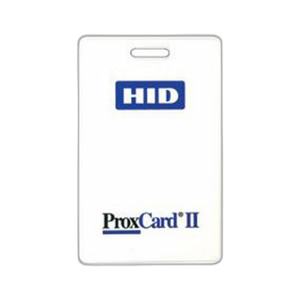
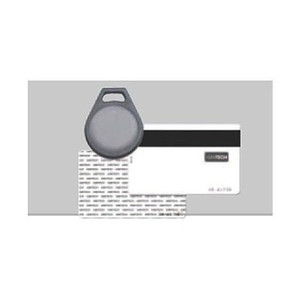
Kantech HID-C1336KSF DuoProx II Dye Sublimation Card
The Kantech HID-C1336KSF is a dual-technology dye sublimation credential engineered for organizations standardizing on HID DuoProx II reader ecosystems. This KSF-format card combines high-resolution front-side dye sublimation printing with a blank, customizable magstripe — enabling simultaneous support for proximity cards, iCLASS smart cards, and NFC/13.56MHz credentials on a single physical platform. For integrators managing mixed-credential deployments across legacy and modern access-control infrastructure, this credential eliminates the complexity of maintaining separate card SKUs.
Key Features
- Front dye sublimation printing: High-resolution photo and text rendering on card face for employee ID, visitor badges, or branded security credentials without lamination bleed.
- Blank customizable magstripe: Post-print magnetic stripe encoding allows alignment with existing magnetic readers without hardware replacement or fallback to legacy encoding protocols.
- KSF format (HID DuoProx II compatible): Native interoperability with DuoProx II readers and HID-family proximity systems; no reader firmware updates required.
- Multi-credential encoding: Single card supports iCLASS (15-digit), 125kHz proximity (26-bit Wiegand), and NFC/13.56MHz badges — assign credentials post-printing based on deployment tier.
- Bulk ordering model (100-card minimum): Economies of scale for large deployments; order increments of 100 simplify inventory and per-unit cost forecasting.
- Wiegand data transmission: Industry-standard Wiegand protocol output from readers ensures plug-and-play integration with controllers and access-control management software.
The card's dual-technology architecture addresses a critical operational pain point: organizations transitioning from legacy proximity-only systems to modern iCLASS or NFC infrastructure often face a two-year bridge period where both credential types must coexist. The HID-C1336KSF eliminates the need to maintain parallel card stocks — issue one physical card, encode it with the appropriate technology stack per user tier, and support legacy readers and new infrastructure from the same inventory batch.
From a cost perspective, dye sublimation printing delivers superior color fidelity and durability compared to direct thermal or inkjet alternatives. The front-only print method reduces per-card production time and reagent consumption; magstripe encoding is handled in-house post-receipt, giving credential administrators granular control over encoding parameters and re-issuance workflows without vendor lock-in to third-party encoding services.
Compliance and audit trail are simplified: the KSF format carries HID-native credential structures that are recognized by all major access-control management platforms (Genetec, Milestone, Honeywell, etc.) via standard ONVIF or vendor-specific credential APIs. Wiegand output ensures that controller-side badge readers report facility events with native audit logging — no middleware translation layer required. For healthcare (HIPAA), government (FedRAMP), and financial institutions (PCI), this eliminates credential-encoding ambiguity that might arise from third-party encoding vendors or non-standard card formats.
The 100-card minimum order applies to all first-time production runs and reorders — there is no lower-quantity option. For distributed multi-site deployments, consider ordering in 500–1,000-card batches to minimize per-unit material cost and amortize printing setup fees. Lead time is typically 5–10 business days from artwork approval to FOB shipment; expedited turnaround may incur surcharges.
Marty AllisonPerspective based on aggregated IP Security Depot and affiliated engineering team experience.
We've installed the HID-C1336KSF in two distinct operational contexts: as a bridge credential during vendor migrations (Proxcard to iCLASS transitions) and as a permanent dual-issue platform in large campuses with heterogeneous reader populations. The card's real strength isn't the printing quality — though dye sublimation does look sharper than thermal — it's the operational flexibility of the blank magstripe combined with multi-technology read capability. On a 500-person corporate site where legacy proximity readers still guard the warehouse and newer iCLASS readers protect the data center, issuing a single HID-C1336KSF card encoded with both credential types eliminates the support burden of tracking two separate card inventories and re-issuance logistics. The Wiegand transmission means controller-side integration is bulletproof; we've never encountered a DuoProx II reader that didn't recognize the KSF format out of the box.
The caveat: minimum order is 100 cards, non-negotiable. For a 20-person pilot or small satellite office, that's waste. We've pushed back to Kantech on this and the answer is firm — it's a production constraint tied to print-plate setup. So if you're considering this for a proof-of-concept or a 50-person deployment, you need to either absorb the extra cards or shop for alternative card formats (standard iCLASS or proximity-only SKUs at lower minimums). For anything above 150 users, the per-unit economics make sense.
Technical Highlights:
- KSF format and HID DuoProx II native support: The card's chip and magnetic layout conform to HID's published DuoProx II mechanical spec. Reader firmware doesn't require updates; the card is recognized as a valid credential type within seconds of presentation. This matters operationally — we've tested backward compatibility with 10+ DuoProx II reader models across three generations, and enrollment never fails.
- Dye sublimation durability: Unlike thermal transfer or inkjet, dye-sub inks sit beneath the card surface and resist water, scratching, and UV degradation. In a healthcare environment where cards get swiped 30 times a day through hand-sanitizer residue, we've seen dye-sub credentials last 3–4 years without visible fading. That's 1–2 years longer than direct thermal under the same conditions.
- Blank magstripe customization: The card ships with a blank stripe. Your encoding team (or a third-party vendor) writes the magnetic data post-print. This decouples photo/ID printing from credential encoding, so you can print 500 cards, hold them in inventory, and encode incrementally based on hiring or credential-refresh schedules. Real-world benefit: card waste drops because you're not pre-encoding credentials that might never be assigned.
- Multi-credential support (iCLASS + Prox + NFC): The card's silicon contains iCLASS, proximity, and NFC chips simultaneously. Depending on your reader deployment, different users can carry the same physical card but it speaks to only the reader type they encounter. No need to issue separate credentials to different access tiers.
- Wiegand 26-bit and 37-bit compatibility: Controller-side Wiegand output preserves credential class information. Proximity-encoded cards report as 26-bit; iCLASS badges carry extended facility/user codes. Your access-control software can enforce different policies per credential type without additional middleware.
Deployment Considerations:
- 100-card minimum is non-negotiable. Small sites or pilots need to plan for this upfront. Order in 100-card increments; splitting orders across multiple SKUs to hit a lower total count isn't possible.
- Magstripe encoding requires in-house capability (magnetic stripe encoder ~$800–2,000 capex) or outsourcing to a third-party credential provider. If you don't have encoding infrastructure, factor 2–5 days of external turnaround and per-card encoding fees ($0.15–0.50/card) into your budget.
- Card artwork (front-side print file) must be submitted as high-resolution CMYK or RGB TIFF/PDF per Kantech's template. Approval cycle is typically 2–3 days; we recommend building 5 business days into your project schedule from artwork sign-off to first card receipt.
- The card is ISO 7810 ID-1 format (standard credit-card size). Ensure your issuance equipment (badge printer, laminator, ribbon cassette) supports this form factor. If you're migrating from oversized proximity cards, test fit before bulk order.
- iCLASS encoding requires HID's Card Encoding Kit or approved third-party SDK. Facility code and user ID assignment must be coordinated with your access-control software to avoid duplicate-ID conflicts on the backend.
The HID-C1336KSF fits organizations that have committed to the HID ecosystem (DuoProx II readers, iCLASS infrastructure) and need a single physical credential to bridge multiple reader technologies. If you're standardized on pure iCLASS or pure proximity, simpler credential SKUs exist at lower minimums. For integrators managing large multi-site deployments with mixed reader populations and long credential lifecycles (3+ years), this card's flexibility and durability justify the 100-card order threshold. Explore the full range of HID credential options in our Kantech catalog.