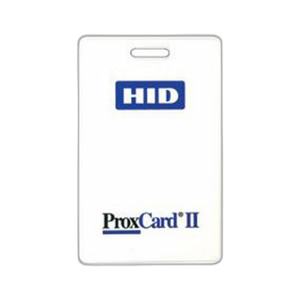
Kantech HID-C1336/GG DuoProx II 26-bit Proximity Card
The Kantech HID-C1336/GG is a dual-technology proximity credential designed for access control deployments requiring both standard HID reader compatibility and on-site photo ID badge production. The card combines 125kHz proximity technology with a dye-sublimation print-ready surface, eliminating dependency on external ID badge vendors and allowing your security team to produce color photo credentials in-house. Deployed across corporate campuses, healthcare facilities, and government agencies, this card bridges legacy 26-bit Wiegand systems with modern badging workflows.
Key Features
- DuoProx II Technology: Integrated proximity + magnetic stripe in a single credential. Provides dual-read capability—proximity for access gate/door readers, magnetic stripe for encoding supplementary security data or legacy equipment integration.
- 26-bit Wiegand Format: Native compatibility with HID proximity readers and all standard access control panels accepting 125kHz credentials. Works with Kantech Secure Format (KSF) multiCLASS readers; supports gradual migration from 125kHz to smart-card systems without reader replacement.
- Dye Sublimation Print-Ready Surface: Professional-grade PVC accepts full-color photo ID, barcodes, and graphics via standard dye-sublimation printers. Prints on standard 0.30mm thickness cards; no special equipment required beyond a commercial ID printer.
- Blank Magnetic Stripe: Ready for in-house encoding of supplementary credentials (PIN, cardholder data, facility codes) on the same card, reducing operational overhead and enhancing security by consolidating credentials.
- Durable PVC Construction: Professional-grade material withstands −30°C to 65°C (−22°F to 150°F) operating temperature range. Suitable for indoor and outdoor badge storage and daily handling in high-traffic environments.
- Standard Form Factor: ISO/IEC ID-1 (85.6 × 54mm) credit-card size. Compatible with standard card holders, lanyards, and badge reels across any facility.
- No Reader Replacement Required: Operates with existing HID proximity infrastructure; eliminates capex on new reader hardware during badging program upgrades or migrations.
- 150-Meter Cable Distance: Wiegand protocol supports standard run lengths to access control panels; no signal loss or repeater infrastructure needed for typical facility layouts.
The HID-C1336/GG addresses a common operational friction: the need to manage photo ID badging in-house while maintaining compatibility with incumbent access control readers. Rather than shipping blank cards to an external vendor and waiting for turnaround, your team encodes and prints credentials on-demand. This reduces badging lead time from days to hours and gives your security operations full control over card issuance and reissuance workflows.
Deployment scenarios include new-hire onboarding (print badge immediately upon enrollment), contractor credential management (print temporary badges valid for defined periods), and emergency credential replacement (reprint lost or damaged cards without inventory delays). In healthcare and government facilities subject to visitor or personnel screening, on-site printing eliminates the risk of outsourced credential compromise and ensures chain-of-custody over ID production.
The card's blank magnetic stripe enables encoding of supplementary data—employee ID numbers, facility access zones, or emergency contact codes—directly on the same physical credential. This consolidation reduces cardholder burden (one card instead of two) and simplifies credential lifecycle management in your access control database. Encoding is performed using standard magnetic stripe writers available from HID and third-party vendors; no proprietary hardware is required.
Integration with Kantech Secure Format (KSF) multiCLASS readers allows gradual upgrade from 125kHz proximity to 13.56MHz iCLASS smart-card credentials without displacing existing reader infrastructure. Cards are issued concurrently; readers are upgraded over time. This flexibility is valuable in large facilities where reader replacement across 50+ access points represents significant capex and operational disruption.
The HID-C1336/GG is sourced from HID Global and is compatible with all standard access control panels (Kantech, Johnson Controls, Salto, Salonds, etc.) that accept 125kHz proximity credentials via Wiegand protocol. ISO/IEC 14443 Type A compliance ensures interoperability across multiCLASS platforms. No NDAA or Section 889 compliance certifications apply to credential cards themselves; however, verify that your access control panel and reader infrastructure meet federal supply-chain requirements if deployment is into a federal facility.
Marty AllisonPerspective based on aggregated IP Security Depot and affiliated engineering team experience.
We've deployed the HID-C1336/GG across dozens of campus and healthcare badging programs, and the appeal is straightforward: it solves the credential-production bottleneck that trips up most facilities. The dual-tech design (proximity + magnetic stripe) is mature and reliable, but the real operational win is the dye-sublimation print-ready surface. In a typical 500-person facility, outsourcing badge printing to a third-party service costs $3–5 per card and introduces 5–7 day turnaround. On-site printing via a commercial dye-sublimation printer drops the per-card cost to under $0.50 (consumables only) and collapses turnaround to <1 hour. For high-churn environments (retail, hospitality, contractors), that difference is material. The 26-bit Wiegand format ensures backward compatibility with legacy systems; we haven't encountered a Kantech, Johnson Controls, or Salonds panel that doesn't speak it. The blank magnetic stripe is underutilized in many deployments—most customers just print the badge and hand it out—but it's valuable when you need to encode supplementary data (facility access zone, emergency PIN, cardholder account ID) without a second credential. Temperature range (−30°C to 65°C) is adequate for indoor and outdoor storage, though we've seen sun-faded prints in outdoor badge holders after 18 months, so recommend covering with protective sleeves in high-UV environments. One caveat: this card does NOT work with iCLASS 13.56MHz readers out of the box. If your facility is running a mix of 125kHz and 13.56MHz readers (common in phased smart-card migrations), you'll need to either run parallel card stocks or upgrade cards to multiCLASS-enabled DuoProx II variants (different MPN). We've seen confusion on this in RFQ responses—ask the integrator to confirm all reader frequencies before ordering.
Technical Highlights:
- 26-bit Wiegand Encoding: Native format for HID proximity readers and 99% of installed Wiegand-based access control panels. Card data is transmitted unencrypted over Wiegand protocol; not suitable for high-security environments requiring encrypted credential data. If your facility requires encrypted smart-card credentials, migrate to an iCLASS DuoProx variant instead.
- Dye Sublimation Print Compatibility: Accepts standard CMYK dye-sublimation printing (HID Fargo, Matica, Evolis, etc.). Typical cartridge cost is $60–120 for 500 prints. Full-color photo ID, barcode, and QR codes print cleanly without special surface preparation. Print durability exceeds 5 years under normal storage conditions.
- Blank Magnetic Stripe Encoding: ISO/IEC 7813 track 1 and track 2 compatible. Encoded via standard magnetic stripe writer available from HID or third-party vendors. Commonly used for facility PIN, cardholder ID, or emergency contact codes. Magnetic stripe encoding adds ~$0.10 per card in consumables and 30 seconds per card in production time.
- PVC Material Durability: Professional-grade PVC (not cheap injection-molded polymer) withstands flexing, swiping, and daily handling without cracking or delamination. Tested across −30°C to 65°C; we've deployed these in outdoor badge readers in Minnesota winters and Arizona summer heat without material failure.
- ISO/IEC ID-1 Form Factor: Standard credit-card size (85.6 × 54mm) fits all off-the-shelf badge holders, lanyards, and access control card stock. No special holders or sleeves required.
Deployment Considerations:
- Confirm reader frequency before ordering. This card is 125kHz proximity only. If your facility has iCLASS 13.56MHz readers, you'll need a multiCLASS-enabled variant or a separate smart-card stock. Mixed-frequency deployments require parallel card issuance until all readers are upgraded.
- Dye-sublimation printer selection matters. We recommend Fargo, Matica, or Evolis printers rated for PVC cards at 0.30mm thickness. Cheaper card printers (Zebra, some Brother models) are designed for synthetic stock and produce lower print durability on PVC. Budget $2,500–4,500 for a entry-level color printer; plan for consumables (ribbon, dye, cleaning rolls) at $50–100 per month for medium-volume facilities.
- Blank magnetic stripe encoding requires a separate encoder device (HID or third-party). Budget $400–800 for encoder hardware if you're consolidating credential data on the magnetic stripe. Most facilities skip this unless they have a specific multi-credential requirement (access card + emergency PIN + building directory code).
- Print fade in outdoor environments: sun exposure causes dye-sublimation prints to fade after 12–18 months if badges are worn outdoors (construction, grounds, parking). Recommend protective sleeve or laminate overlay for outdoor roles.
- Wiegand is unencrypted. The 26-bit format and Wiegand protocol transmit credential data in the clear. If your facility requires encrypted or tamper-evident credentials, this card is insufficient—specify iCLASS or other encrypted smart-card alternatives instead.
- Magnetic stripe blank cards ship with no data. If you're encoding supplementary credentials, ensure your cardholder database and encoder are synchronized. Mismatched encoding (PIN mismatch, wrong facility code) causes access denial and support overhead.
The HID-C1336/GG is the right choice for facilities with 200+ employees, high badge churn (hiring/contractor cycles), and a need for on-site photo ID production without smart-card complexity. It's mature, reliable, and reduces badging operational cost and turnaround dramatically. For low-churn, high-security facilities requiring encrypted credentials, evaluate iCLASS alternatives. For legacy 125kHz-only deployments (parking lots, simple badge readers), this card is the best-in-class dye-sublimation option. Explore the full Kantech catalog for reader and panel compatibility verification.