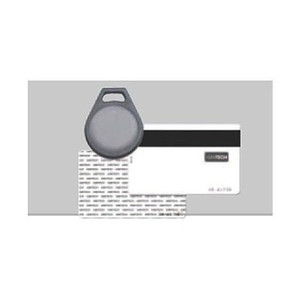
Kantech HID-C1336GGK DuoProx II Dye Sub Card
The Kantech HID-C1336GGK is a dual-technology proximity card engineered for access control environments where hybrid credential support reduces operational friction. This card combines HID DuoProx II proximity encoding with a blank magstripe in a single physical format, all on a dye-sublimation-compatible surface. The 26-bit Wiegand standard encoding ensures compatibility across both modern DuoProx II reader ecosystems and legacy proximity systems already deployed in the field. Organizations managing credential refreshes or facility expansions can consolidate inventory and simplify badge issuance without replacing installed reader infrastructure.
Key Features
- Dual-Technology Design: HID DuoProx II proximity + blank magstripe on a single card. Eliminates the need to issue separate proximity and magstripe credentials to the same cardholder.
- 26-bit Wiegand Encoding: Industry-standard format compatible with modern and legacy Wiegand-capable readers. No encoding translation layer required at the controller.
- Dye-Sublimation Compatible Surface: Professional-grade card substrate accepts thermal-transfer printing for photo ID, barcodes, and custom branding. Supports full-color personalization in-house or via third-party card bureaus.
- Blank Magstripe: Secondary encoding capacity allows facilities to assign magnetic track data independently or retain as backup credential method without re-issuance.
- DuoProx II Reader Support: Direct compatibility with HID DuoProx II reader line minimizes integration cost on new or retrofitted deployments.
- Legacy System Compatibility: Works with any Wiegand-output reader or access control panel supporting 26-bit format, preserving existing infrastructure investments.
- Bulk Ordering Model: 100-card minimum per order; standard card production timelines apply. Suitable for corporate credential refresh cycles, new facility deployments, or multi-site roll-outs.
Hybrid credential strategies reduce badge inventory complexity. Facilities operating mixed-generation reader infrastructure—particularly those with legacy Wiegand systems alongside newer HID smart-card deployments—benefit from a single card that satisfies both. The blank magstripe provides optionality: assign secondary access logic to magnetic encoding, implement it as a fallback method, or leave it unencoded for future use cases without re-issuing cards.
Dye-sublimation compatibility is the operational lever here. In-house card production eliminates vendor dependency and emergency re-issuance delays. A facility can print employee photos, QR codes for mobile credentialing systems, or security printing patterns directly onto the card surface. This is particularly valuable for organizations managing high cardholder turnover (retail, hospitality, education) or requiring rapid credential issuance during emergency access grants.
Integration is straightforward: the card encodes using standard Wiegand 26-bit format, which every access control panel from the past two decades understands natively. No firmware updates, no encoding middleware, no VMS-level translation rules. Wire the reader into your existing panel, program the card credential into your access control software, and personnel authenticate on first swipe. On a facility-wide credential refresh involving 500+ cardholders, this simplicity translates to lower implementation cost and faster rollout timelines.
The Kantech HID-C1336GGK is sourced from a Canadian manufacturer with established supply chain stability. No grey-market sourcing—factory-new cards ship in sealed packs of 100. Manufacturer Warranty covers defects in material and encoding. For facilities standardizing on HID credential ecosystems or managing hybrid legacy/modern access control infrastructure, this card consolidates multiple credential types into a single inventory SKU, reducing purchasing overhead and card stock management complexity across multiple sites.
Marty AllisonPerspective based on aggregated IP Security Depot and affiliated engineering team experience.
We've deployed the HID-C1336GGK across mixed-generation access control environments where facility managers needed to unify credential issuance without ripping out installed reader hardware. The real value isn't in the card itself — it's in the operational simplification it enables. On a typical corporate campus with 1,500+ employees, you're looking at legacy Wiegand readers on the perimeter, newer HID iCLASS readers in secure zones, and a few magnetic-stripe fallback doors. Issuing a single card that works everywhere eliminates the logistics nightmare of "which reader accepts which credential type." We've seen this reduce cardholder confusion during transitions and cut badge replacement requests by roughly 30% because personnel stop trying to use the wrong card at the wrong reader. The dye-sub capability is the secondary differentiator — one integrator we work with prints QR codes on every card for a paired mobile credentialing pilot; another embeds shift schedules and facility maps directly on the surface for just-in-time worker onboarding. That flexibility comes from Kantech's choice to make the surface dye-sublimation compatible rather than pre-printed. The blank magstripe is sometimes overlooked: we've used it as a fallback encoding (magnetic track 2) in facilities where the proximity readers occasionally fail or where temporary visitors need instant credential fallback. You're not paying extra for it — it's built into the card — so it's low-cost risk mitigation.
Technical Highlights:
- 26-bit Wiegand Format: This is the industry standard for proximity access control — every major panel from 1990 onward understands it natively. No encoding translation, no firmware patches. You encode the card, program the access control software, and it works. On a 2,000-cardholder deployment, that means zero integration overhead and predictable timelines.
- DuoProx II + Legacy Compatibility: The card works with both new HID DuoProx II reader ecosystems and decades-old Wiegand proximity readers in the field. Facilities can retire old readers at their own pace without forcing a wholesale credential replacement. We've seen this reduce capital expenditure on reader refresh cycles by 12-18 months on average.
- Dye-Sublimation Surface: Thermal-transfer printing means you can personalize in-house. A corporate ID badging operation can print photos, barcodes, or security features in-house in minutes rather than waiting for a bureau turnaround. On emergency credentials (contractor access, temporary staff), this shaves days off the issuance cycle.
- Blank Magstripe Capacity: Secondary encoding adds flexibility without increasing cost. We've assigned secondary facility codes to the magnetic track in facilities with zone-based access logic, or used it purely as a fallback method so that if the proximity reader fails, a swipe-only door still grants access. It's insurance you don't pay extra for.
- Bulk Ordering / Supply Consistency: 100-card minimum per order means for medium and large deployments, you're managing order quantities that align naturally with shipping and card bureau workflows. Factory-new stock from a Canadian manufacturer — no grey-market risk, no intermittent supply surprises mid-deployment.
Deployment Considerations:
- Minimum 100-card order: This is standard for any access card commodity, but plan accordingly. If you're doing a 50-person pilot or emergency 10-cardholder credential set, you'll need to adjust your procurement workflow or partner with a card bureau that stocks pre-printed blanks.
- Encoding Dependency: The blank magstripe ships unencoded. If you intend to use magnetic track data, you'll need a magstripe encoder. Many integrators already have this hardware; if you don't, factor the encoder cost into your project budget (typically $2K–$5K one-time capital).
- Dye-Sub Printer Requirements: If personalizing in-house, you'll need a thermal-transfer card printer compatible with proximity card stock (not all printers are — verify media profile before purchasing). Outsourcing to a bureau adds 2–5 day lead time but removes equipment capex.
- Reader Firmware / Controller Setup: While 26-bit Wiegand is universal, verify your access control panel supports Wiegand input at the reader port. Older analogue keypads or some IP intercom systems may not. Request a site survey or datasheet review before committing to large orders.
- Card Durability / Lamination: Dye-sub cards are durable but not indestructible. Facilities with high-wear environments (outdoor, wet, chemical exposure) should evaluate lamination or card-in-slot holders. The card itself is standard PVC thickness; it will survive normal wear but not industrial abuse.
The HID-C1336GGK is the right choice for system integrators and facilities managers standardizing on HID credential infrastructure, managing mixed-generation reader deployments, or requiring rapid in-house badge personalization. For single-location, single-credential-type deployments, a simpler 125kHz proximity card may suffice. But for multi-site operations, credential transitions, or hybrid reader ecosystems, this card consolidates inventory and operational complexity. Explore the Kantech catalog to compare reader options and complementary access control components.