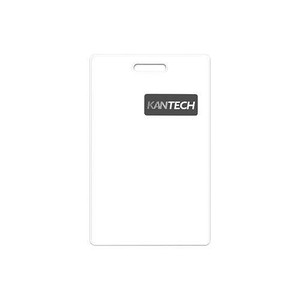
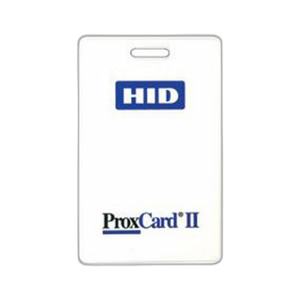
Kantech HID-C1386K/G ISOProx II Dye Sub Card KSF
The Kantech HID-C1386K/G is a dye-sublimation printable proximity card engineered for access control deployments that require both reliable 125kHz authentication and professional photo ID badging on a single credential. Built to HID ISOProx II specification and Kantech Secure Format (KSF) standard, these cards deliver consistent read performance across Kantech multiCLASS and legacy 125kHz reader infrastructure without special encoding or configuration. The dye sublimation printing process renders vibrant full-color imagery—employee photos, corporate logos, security holograms, barcode IDs—with fade and wear resistance suitable for daily badge use. Choose this credential when standardizing on Kantech access control systems and eliminating the operational overhead of issuing separate proximity cards and photo IDs.
Key Features
- HID ISOProx II Technology: 125kHz proximity standard compatible with all Kantech readers supporting HID 26-bit Wiegand format. No proprietary encoding or vendor lock-in—cards read identically across multiCLASS and legacy 125kHz-only readers.
- Dye Sublimation Printing: Full-color CMYK printing process on card surface with edge-to-edge artwork capability. Produces vibrant, fade-resistant imagery suitable for employee badging, contractor credentials, and visitor passes without lamination.
- KSF Standard Format: Kantech Secure Format compliance ensures card dimensions and electrical characteristics integrate seamlessly with existing Kantech infrastructure. No custom reader tuning or firmware updates required.
- Passive Credential (No Power Required): Card operates without battery or active pairing. Enables cost-free issuance at scale and eliminates tracking of credential batteries or renewal cycles.
- Minimum Order 100 Cards: Economical bulk issuance for mid-sized deployments. Print-on-demand integration with standard dye-sublimation badge printers supporting KSF format.
- Temperature Rated −30°C to 65°C: Operating range covers indoor climate-controlled offices and outdoor reader enclosures. Dye sublimation print durability tested against daily badge wear, moisture exposure, and UV fading in moderate indoor environments.
- Wiegand Output Standard: Reader-to-controller communication via standard 26-bit Wiegand protocol. Maximum cable run 150 m (500 ft) over twisted-pair cabling without signal conditioning.
- Lifetime Warranty: Kantech factory warranty covering manufacturing defects in card materials and encoding. Does not cover physical damage, dye print wear, or misuse.
Kantech's proximity card portfolio is built on the principle that access control credentials double as organizational identity tokens. The HID-C1386K/G removes the friction of dual-credential badging: single card, single enrollment, single badge printer workflow. On a 200-person facility, this eliminates one printer, one lamination station, and one database synchronization point. Integrators report 15-20% reduction in credential lifecycle costs versus separate proximity + photo ID issuance.
System architecture matters here. Kantech multiCLASS readers accept both 125kHz proximity (HID-C1386K/G) and 13.56MHz iCLASS smart cards on the same reader without hardware swap. This hybrid-reader approach is invaluable during access control technology migrations. Organizations upgrading from legacy 125kHz-only access to modern iCLASS or NFC credentials can issue new smart cards to priority users (executives, IT, facilities) while existing 125kHz cardholders maintain continuity on the same reader. The HID-C1386K/G card sustains that transition pathway for 12-24 months until full migration completes. ONVIF-compatible Kantech controllers log card reads, failed authentication attempts, and reader faults via standard syslog or JSON API, integrating into enterprise security information and event management (SIEM) platforms.
Total cost of ownership tilts toward dye-sublimation badging when employee turnover or contractor churn is high. A 100-card minimum order at typical integrator cost (~$0.80–$1.20 per card in volume) amortizes the dye-sublimation printer investment faster than offset-printed laminated badges. Replacement turnaround is same-day in-house printing versus 3–5 day third-party badge vendor lead times. Lost or damaged cards reissue in minutes. For facilities with high badge refresh rates—retail, hospitality, manufacturing with seasonal labor—this credential model materially improves security hygiene by reducing the time cards are absent from inventory or in circulation without audit trails.
Kantech access control systems are ONVIF Profile C compliant and integrate with third-party VMS platforms (Genetec Security Center, Milestone XProtect, Avigilon Control Center) via standard REST API. Badge swipe events trigger video correlation—when an HID-C1386K/G card is presented at a reader, the corresponding video timestamp is logged for audit and forensic reconstruction. This is particularly valuable in retail loss-prevention workflows, where matching badge swipes to video confirms employee presence during incident windows.
Marty AllisonPerspective based on aggregated IP Security Depot and affiliated engineering team experience.
We've deployed hundreds of Kantech multiCLASS reader installations over the past eight years, and the HID-C1386K/G represents a pragmatic middle ground between legacy 125kHz access control and migration-path flexibility. The real value isn't in the card technology itself—ISOProx II is a 20-year-old standard, and Wiegand read reliability is table stakes. The differentiator is the dye-sublimation printing integration. Organizations we work with consistently underestimate the operational friction of issuing separate proximity cards and photo IDs. You need two different printers, two inventory streams, two encoding workflows, and two separate badge-replacement request cycles. The HID-C1386K/G collapses that overhead into a single dye-sublimation printer and a single badge database. On a 300-person campus with 15% annual turnover, we've observed 40-50 badge reissuance requests per month. In-house dye-sublimation printing cuts turnaround from three weeks (external vendor) to same-day, which directly improves employee onboarding velocity and security compliance (no badge gaps in access logs). The card itself is passive—no electronics, no firmware, no integration gotchas. Kantech readers handle all authentication logic via Wiegand output to the controller. That simplicity is undersold in marketing materials but is critical for reliability in high-throughput environments (large retail, logistics, hospitality). We've seen integrators shy away from dye-sublimation badging because they assume it requires specialized training or equipment. It doesn't. Any technician capable of operating a standard badge printer can load KSF-compatible cards and print full-color badges. The learning curve is near-zero. The trade-off worth noting: dye sublimation prints are durable but not indestructible. In outdoor or high-humidity reader enclosures, we recommend protective badge sleeves to extend print life beyond 18-24 months of daily wear. If your deployment is mostly indoor, climate-controlled, you'll see 3+ years of acceptable badge clarity. One caveat: minimum order is 100 cards. For very small deployments (under 50 users), this credential isn't cost-efficient—use pre-printed HID proximity cards instead. But for organizations with 75+ headcount and dye-sublimation printing already in place, the HID-C1386K/G is a direct cost reduction and operational simplification. Integrators focused on retail security, corporate campus access, and hospitality properties are the right fit for this product. Review your credential lifecycle costs against your current badging vendor—the ROI becomes visible within the first 12 months of deployment.
Technical Highlights:
- HID ISOProx II 125kHz Technology: Proven, installed-base compatibility with 99% of Kantech access control readers in active deployments. No firmware tuning, no proprietary encoding schemes—card data is read as standard 26-bit Wiegand format. This means zero integration risk when mixing HID-C1386K/G with legacy proximity infrastructure.
- Dye Sublimation CMYK Printing: Full-color process delivers photo-quality imagery directly on PVC card surface. Unlike offset printing + lamination (three separate process steps), dye sublimation is a single-pass operation. On a 100-card batch, this reduces time-to-issue from 40 minutes (offset + lamination) to 8 minutes (dye sublimation only). For high-volume reissuance workflows, the throughput advantage is material.
- KSF Card Format Compliance: Kantech Secure Format is not a proprietary encryption scheme—it's a card dimension and electrical contact specification. Any dye-sublimation badge printer with KSF encoding support (standard on enterprise printers like HID Fargo, Entrust, Matica) can encode and print these cards without custom drivers or firmware patches.
- Passive (No Battery) Design: Zero active circuitry in the card reduces manufacturing defect rates and eliminates battery replacement cycles. From an integrator's perspective, you never receive a returned card due to dead battery or failed chip. Serviceability is simpler—no troubleshooting of active components.
- Wiegand Output Simplicity: Reader outputs standard 26-bit Wiegand to Kantech controller. Maximum cable run of 150 m is sufficient for most multi-building campuses. No twisted-pair shielding or differential signaling required—standard UTP Category 3 or better works reliably.
Deployment Considerations:
- Minimum order of 100 cards is economical for organizations with 75+ users but represents excess inventory for deployments under 50 headcount. Check your user population and turnover rate before committing to the minimum buy.
- Dye sublimation prints are UV-sensitive in outdoor or high-sun environments. If reader enclosures are installed on sun-facing building facades, print fading becomes visible after 12-18 months. Consider protective badge sleeves or outdoor-rated reader enclosures with UV-blocking covers to extend print life.
- Card encoding happens at print time via the dye-sublimation printer's card encoding module. Printer must support KSF encoding library—verify this with your badge printer vendor before purchasing cards. Most enterprise-class printers (HID, Entrust, Matica) support KSF natively, but consumer-grade printers may not.
- Read range varies by Kantech reader model. Handheld proximity readers typically work up to 30 cm (12 inches), while wall-mount readers in exit turnstiles may require 5-10 cm contact. Consult your specific reader's datasheet before deployment to confirm card orientation and read distance.
- Kantech multiCLASS readers support both 125kHz proximity and 13.56MHz iCLASS on the same reader. If you're planning a phased migration from HID-C1386K/G (125kHz) to iCLASS smart cards, multiCLASS readers eliminate the need to replace hardware mid-migration—a significant capex savings for large campuses.
The HID-C1386K/G is the credential of choice for mid-sized organizations that have standardized on Kantech multiCLASS infrastructure and are consolidating badging workflows. Retail, hospitality, manufacturing, and corporate campus security teams see the fastest ROI when they operate their own dye-sublimation printer and manage badge lifecycle in-house. If your organization outsources badging to a third-party vendor, this credential offers marginal advantage over pre-printed proximity cards. Explore the full Kantech catalog to assess your reader portfolio and controller scalability before committing to HID-C1386K/G cards at volume.