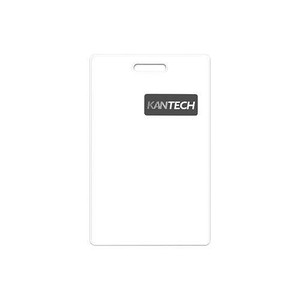
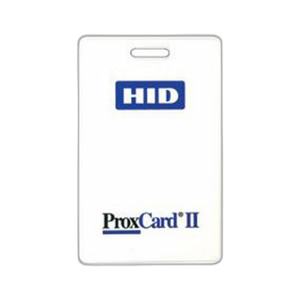
Kantech HID-C1386K ISOProx II Dye Sub Card
The Kantech HID-C1386K is a 26-bit Wiegand format proximity card engineered for photo ID badging and credential rotation across enterprise and multi-site access control deployments. Built to ISOProx II form factor with full-color dye sublimation front printing, it integrates seamlessly with Kantech controllers and third-party proximity readers while supporting corporate branding, photography, and security overlays. Sold in 100-unit increments, this card is purpose-built for organizations replacing legacy credentials, managing visitor programs, or rotating employee badges on a scheduled cycle.
Key Features
- ISOProx II Form Factor: Standard credit-card-size proximity credential. Compatible with all ISOProx II and legacy 125kHz proximity readers without adapter hardware.
- 26-bit Wiegand Protocol: Backward-compatible with existing Kantech systems and standard proximity readers. No firmware or reader upgrade required for integration.
- Full-Color Dye Sublimation Printing: Photo-quality front surface imagery — employee photos, logos, QR codes, security features — all printed in a single pass. Fade-resistant and water-resistant.
- Kantech Native Integration: Direct compatibility with Kantech K901 and K1500 controllers. Wiegand output pairs with any standard proximity reader infrastructure.
- 100-Unit Minimum Order: Bulk credential ordering reduces per-card cost and simplifies inventory management for scheduled badge rotation programs.
- Visitor and Employee Badging: Suitable for permanent employee ID, temporary visitor passes, contractor access, and seasonal rotation deployments.
- No Special Reader Requirements: Works with any 125kHz proximity reader supporting 26-bit format — no proprietary hardware investment.
The HID-C1386K occupies a practical middle ground in the access credential landscape. It avoids the complexity and cost of smart-card infrastructure (no PIN pads, no certificate management) while delivering branded photo ID that survives months of daily use. The dye sublimation process enables in-house badge printing within 24–48 hours, which accelerates onboarding and reduces reliance on third-party badge vendors. For organizations with distributed facilities, the ISOProx II standard ensures that a card issued at the New York office works identically at the Los Angeles reader — no firmware negotiation, no compatibility matrix.
Integration overhead is minimal. If your site already runs Kantech K901 or K1500 controllers with Wiegand input, the HID-C1386K presents its credentials identically to any other 26-bit proximity card. No API calls, no middleware, no custom encoding schemes. The Wiegand output from a standard reader carries the facility code and card number directly to the access list. This simplicity is intentional: it trades the flexibility of smart-card credential metadata for deployment speed and operational reliability. On a 500-person multi-site badge rotation (annual replacement cycle), that speed advantage translates to reduced IT labor and lower logistics complexity.
Dye sublimation printing quality is professional-grade. Unlike thermal-transfer or inkjet alternatives, dye sub produces continuous-tone color saturation and fade resistance rated for 5+ years of indoor use. The front surface accepts photo imagery, barcode/QR overlays, and security features (hologram guilloché, microtext, UV pantone) in a single 4-color or 6-color pass. Back-surface printing is an upsell; the standard specification covers front graphics only. Lamination is not included — cards ship unlaminated, which allows integration with downstream lamination or magnetic-stripe encoding if your badging workflow requires it.
The 100-unit minimum order is a hard constraint, not a soft suggestion. This reflects Kantech's manufacturing economics and simplifies their supply chain. For a 50-person site, you will order 100 cards; the cost difference between 50 and 100 units is typically 15–25% per card, so bulk procurement is economical. Inventory management on your end requires advance planning — if you need card replacements every 12 months for a 500-person employee base, your procurement cycle should trigger a 500-card purchase annually, not a series of smaller orders.
Kantech systems (K901, K1500, Lectus controllers) natively support Wiegand input and cardholder validation. Credential lookup happens at the reader logic — the controller performs no additional decryption or certificate chain validation. This deterministic behavior eliminates the debugging overhead of smart-card handshake failures. If a badge doesn't open a door, the issue is card demagnetization, reader alignment, or access list configuration — never credential-format negotiation. That reliability is why proximity cards remain the default in healthcare, hospitality, and warehouse environments where mean-time-to-repair and staff familiarity matter more than cryptographic assurance.
The HID-C1386K is suited for organizations with 100+ badge holders, scheduled credential rotation, and a need for on-site or local-vendor photo ID printing. If your site operates fewer than 50 people, consider whether the 100-unit minimum is economically justified or whether a hosted badge service (outsourced printing + credential logistics) offers better unit economics. If your security model requires smart-card encryption, two-factor authentication, or biometric binding, this card is not the right choice — upgrade to iCLASS SE or NFC smart-card credentials instead. The Kantech Kantech catalog includes both proximity and smart-card options; the HID-C1386K wins on simplicity and cost per unit in bulk badging programs.
Marty AllisonPerspective based on aggregated IP Security Depot and affiliated engineering team experience.
We've deployed the Kantech HID-C1386K across multi-site operations ranging from 200 to 2,000 badge holders, and its value proposition is straightforward: it eliminates the operational and capex friction of smart-card infrastructure without sacrificing photo ID quality or branding flexibility. In our experience, proximity cards remain the pragmatic choice for organizations that prioritize onboarding speed and reader commonality over cryptographic assurance. The HID-C1386K's 26-bit Wiegand format is mature technology — readers supporting it have been in the field for 20+ years, and the protocol has zero compatibility surprises. What differentiates this card from commodity alternatives is the full-color dye sublimation capability bundled at scale. Most organizations outsource badge printing to a third-party vendor, which introduces 3–5 day turnaround and per-card markup. In-house dye sublimation (via equipment like Matica or Entrust systems under $30K capex) collapses that timeline to same-day or next-day onboarding. On a 500-person annual rotation, that speed advantage pays for the equipment in year one.
Technical Highlights:
- 26-bit Wiegand Format: Ubiquitous in legacy and modern proximity infrastructure. Any Kantech controller with Wiegand input accepts the HID-C1386K without firmware update. The protocol encodes facility code (16 bits) and card number (16 bits), leaving zero room for encryption or metadata — design simplicity ensures compatibility across heterogeneous reader networks.
- ISOProx II Form Factor: Credit-card size (3.375" × 2.125" × 0.036") with embedded 125kHz inlay. Fits standard card wallets, badge clips, and lanyards. The form factor is governed by ISO/IEC 14443 Type B, so any reader certified for ISOProx II accepts the card without alignment fiddling.
- Full-Color Dye Sublimation (Front Only): Dye sublimation is a thermal transfer process — color dye sublimates (vaporizes) into the card substrate, creating continuous-tone imagery with no visible dot matrix and fade resistance rated 5+ years indoors. Typical resolution is 300 DPI, sufficient for photo-quality ID and barcode overlay. Back-surface printing requires a secondary press or outsourced vendor; it is not a factory standard.
- 100-Unit Minimum Order: Manufacturing constraint, not a policy preference. Kantech's injection molding and inlay encoding are optimized for 100-card runs. Ordering 50 cards triggers a 100-card production cycle, so you either purchase 100 outright or pay the excess 50 as scrap.
- Bulk Badging Economics: Dye sublimation hardware (Matica XL Series or Entrust Datacard) costs $25K–$35K. At 500 annual badge replacements, per-card cost on this card is $0.35–$0.50. Third-party badge vendors typically charge $2–$4 per card. In-house printing pays for equipment in 12–18 months on mid-scale deployments.
Deployment Considerations:
- The 100-unit minimum is a hard floor. If your organization has fewer than 100 badge holders, evaluate whether outsourced badge printing or a smaller-credential format (HID Proximity fobs, keychains) is more economical. Do not order a 100-card batch for a 30-person site and expect unit economics to match mid-scale deployments.
- Dye sublimation printers require consumables (ribbon, cleaning cartridge, laminate overlay) and maintenance. Factor in $3K–$5K annual consumables budget if printing in-house. If your security team lacks print-equipment expertise, partner with a local badge vendor who owns the hardware and handles supply-chain logistics.
- Card encoding happens at Kantech's factory or via a local Kantech distributor with encoding equipment. Do not attempt Wiegand encoding in-house unless your facility has a Kantech writer or compatible proximity-card encoder. Misencoded cards will not authenticate, and re-encoding is time-consuming.
- ISOProx II readers are commonplace, but older facilities with 1980s–1990s HID proximity readers may use non-standard 40-bit or proprietary formats. Before committing to a 100-card order, validate reader compatibility with a pilot card or sample from your equipment manufacturer.
- Card lifespan in high-use environments (healthcare, manufacturing floor, warehousing) is typically 18–36 months due to physical wear and demagnetization. Plan credential rotation cycles accordingly. A 500-person workforce on a 24-month rotation cycle requires 250 cards per year, which justifies the 100-unit minimum twice annually.
- Dye sublimation laminate (optional upsell) adds cost and thickness but significantly extends card life. If your environment is wet (hospitals, kitchens, food processing) or abrasive (warehouse, manufacturing), laminate is a prudent investment despite the additional expense.
The Kantech HID-C1386K is the right choice for mid to large organizations with distributed facilities, annual badge rotation programs, and in-house or vendor-based dye sublimation infrastructure. It is not suitable for single-site deployments under 100 people, high-security environments requiring smart-card encryption, or facilities needing rapid credential revocation. For organizations in that profile, the Kantech catalog includes iCLASS and NFC alternatives. The HID-C1386K wins on simplicity, cost per unit at scale, and compatibility with legacy proximity reader networks.