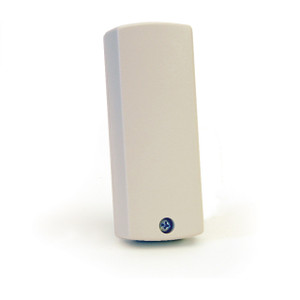
Inovonics EN1210 EchoStream Single Input Universal Transmitter
Overview
The Inovonics EN1210 is a single-input universal transmitter engineered for wireless security and monitoring applications in distributed system architectures. Operating in the 902–928 MHz license-free ISM band, the EN1210 eliminates the regulatory licensing overhead that limits deployment flexibility on many commercial radio frequencies. This transmitter accepts input from a wide range of sensor and monitoring devices, reducing the number of SKUs you must stock and inventory across multiple sites. The EchoStream proprietary wireless protocol delivers predictable signal reliability within Inovonics-compatible system ecosystems, making it a practical choice for integrators consolidating mixed sensor types into a single coherent monitoring network.
Key Features
- Single Input Universal Design: Accepts analog and digital sensor inputs without requiring separate transmitter models for different device types — simplifies logistics and reduces per-site configuration labor compared to maintaining multiple specialized transmitters.
- 902–928 MHz ISM Band Operation: License-free frequency eliminates FCC licensing delays and costs, accelerates site commissioning, and removes ongoing regulatory compliance obligations that apply to commercial radio services.
- EchoStream Wireless Protocol: Proprietary protocol engineered within the Inovonics ecosystem for consistent performance in standard RF environments; verify receiver and panel compatibility before deployment to ensure end-to-end signal integrity.
- Compact Form Factor: Designed for tight mounting spaces and retrofit installations where dimensional constraints are critical; discreet profile allows integration into existing facility infrastructure without substantial reconstruction.
- Operating Temperature Range –4°F to 140°F (–20°C to 60°C): Supports climate-controlled indoor spaces and semi-outdoor or seasonal installations; verify final environment temperature stability during design phase to avoid edge-case degradation at temperature extremes.
- Wireless Connectivity: Eliminates hardwired sensor runs between devices and receivers — reduces installation labor, enables rapid repositioning or network expansion, and simplifies retrofit projects where running conduit is economically infeasible.
Integration & Compatibility
The EN1210 integrates exclusively with Inovonics EchoStream-compatible receivers and control panels. As a universal single-input transmitter, it functions as a flexible edge device in distributed monitoring systems, allowing you to consolidate mixed sensor types without purchasing multiple transmitter variants. Before deployment, verify that your receiver equipment and control panel support the EchoStream protocol — incompatible equipment will not communicate with the EN1210, and no fallback or bridging protocol is available. Consult Inovonics product compatibility matrices and your system architect to confirm all components operate within the same EchoStream ecosystem.
Deployment Considerations
The 902–928 MHz ISM band is unlicensed but shared with cordless phones, medical telemetry equipment, and some industrial devices. In dense urban environments or multi-tenant buildings, channel congestion or interference can degrade transmission reliability. Conduct site RF surveys and propagation testing before final placement, particularly if the transmitter will operate across multiple floors, through metal framing, or near high-density wireless installations. The operating temperature specification supports standard HVAC-controlled indoor spaces and lightly insulated semi-outdoor areas; do not deploy in uninsulated or fully outdoor locations without thermal enclosure verification. Integration with existing Inovonics panels and receivers is mandatory — third-party or legacy equipment cannot bridge to the EN1210 without manufacturer-provided adapters, which are not standard accessories.
Frequently Asked Questions
Q: Can the EN1210 transmit to non-Inovonics EchoStream receivers?
A: No. The EN1210 uses the EchoStream proprietary protocol and will only communicate with Inovonics EchoStream-compatible receivers and panels. Verify receiver compatibility with Inovonics before purchase.
Q: What types of sensors can the EN1210 accept as input?
A: The EN1210 is designed as a universal single-input transmitter and accepts input from a wide range of sensor and monitoring devices. Consult the product datasheet or Inovonics integration documentation for specific sensor types and signal requirements supported at your installation.
Q: Is the EN1210 suitable for outdoor deployment?
A: The EN1210 operates from –4°F to 140°F (–20°C to 60°C) and is designed for discreet indoor and semi-outdoor installation. For full outdoor exposure, verify thermal and environmental protection measures with the manufacturer or your system integrator — no environmental rating (IP/IK) is provided in standard specifications.
Q: Will other devices on the 902–928 MHz band interfere with the EN1210?
A: The ISM band is shared with cordless phones, medical telemetry, and industrial equipment. Site survey and RF testing are recommended to identify channel congestion and ensure reliable transmission paths, particularly in dense urban or multi-tenant environments.
Q: How far can the EN1210 transmit?
A: Transmission range depends on RF propagation, antenna placement, obstructions, and interference in the 902–928 MHz band. Conduct site RF propagation testing before deployment to confirm adequate coverage between the transmitter and your Inovonics receiver.
Q: What power supply does the EN1210 require?
A: Consult the EN1210 product datasheet for specific power supply requirements and connector specifications. Power requirements are available from Inovonics technical documentation.
Ted PerryPerspective based on aggregated IP Security Depot and affiliated engineering team experience.
From a systems engineering perspective, the Inovonics EN1210 fills a legitimate role in distributed wireless monitoring where a single-input, multi-purpose transmitter reduces bill-of-materials overhead and simplifies site inventory. I've specified the EN1210 in retrofit security applications where hardwired sensor runs to a central panel were cost-prohibitive — the wireless architecture made a material difference in project economics. The EchoStream protocol is mature within the Inovonics ecosystem and delivers predictable performance in standard RF environments. The critical constraint is ecosystem lock-in: the EN1210 communicates exclusively with Inovonics EchoStream receivers and panels. If your site includes legacy or third-party equipment, you'll either need to replace receivers or deploy separate bridging infrastructure, which erodes the cost advantage.
Technical Highlights:
- ISM Band Operation (902–928 MHz): License-free frequency eliminates FCC licensing cycles and ongoing regulatory compliance costs — meaningful advantage on multi-site deployments where licensing delays can extend project timelines by weeks.
- Universal Single Input Design: Reduces transmitter SKU count and on-site configuration complexity — fewer models to stock, train on, and troubleshoot translates to lower deployment labor and faster site activation.
- Operating Temperature –4°F to 140°F: Covers climate-controlled indoor spaces and semi-outdoor seasonal installations; verify your final installation environment against the lower and upper temperature extremes — lightly insulated or fully outdoor locations require thermal protection or alternative solutions.
Deployment Considerations:
- Ecosystem Lock-In: The EN1210 operates only with EchoStream-compatible Inovonics receivers and panels. Verify all receiver and panel models in your system support EchoStream before purchase — incompatible equipment cannot be retrofitted or bridged without replacement.
- ISM Band Congestion: The 902–928 MHz band is shared with cordless phones, medical telemetry, and industrial devices. In dense urban or multi-tenant environments, pre-deployment RF site survey is mandatory to identify channel congestion and ensure reliable transmission paths; don't assume adequate coverage without testing.
- No Environmental Rating: The EN1210 carries no published IP or IK environmental rating. Semi-outdoor deployments require verification of thermal stability and protection from direct moisture exposure — full outdoor use is not recommended without thermal enclosure or housing.
Deploy the EN1210 in single-ecosystem Inovonics installations where equipment consolidation and wireless architecture justify the ecosystem commitment. Conduct site RF propagation testing early and verify all receiver and panel equipment against Inovonics EchoStream compatibility matrices before finalizing your bill of materials.