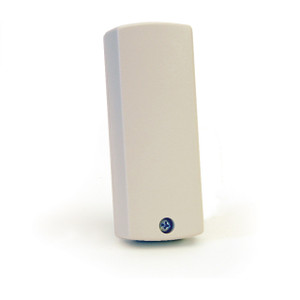
Inovonics EN1252 EchoStream Long Range Dual Transmitter
Overview
The Inovonics EN1252 is a long-range wireless transmitter engineered for distributed security monitoring deployments where hardwired connectivity is impractical or economically unfavorable. Operating in the 902–928 MHz unlicensed ISM band, the EN1252 delivers 24 dBm (250 milliwatts equivalent isotropically radiated power) output — enough to reach multiple zones and building wings without intermediate repeaters in standard commercial floor plans. The dual-transmitter architecture provides redundancy critical for high-reliability alarm and sensor networks. This unit is purpose-built for integrators deploying wireless security systems across warehouses, multi-tenant facilities, perimeter monitoring, and distributed sensor arrays where infrastructure costs favor wireless over trenched cable runs.
Key Features
- Dual Transmitter Configuration: Simultaneous transmission on two independent channels means if one path encounters interference or obstruction, the other maintains signal integrity — critical when zone coverage cannot tolerate dropouts. This redundancy translates to fewer missed events and reduced false negatives in multi-zone alarm deployments.
- 24 dBm Output Power (250 mW EIRP): This power level is the legal ceiling in the 902–928 MHz band under FCC Part 15. It delivers extended range across typical commercial interiors — concrete, drywall, metal studs — without requiring repeater infrastructure. Exact coverage depends on site propagation, but expect 100–300+ feet in clear line-of-sight; interior paths typically 50–150 feet depending on density and material composition.
- 902–928 MHz ISM Band (License-Free): No FCC frequency licensing required. The unlicensed spectrum means faster deployment and no spectrum coordination overhead. However, this band is shared — Wi-Fi 2.4 GHz can bleed into adjacent frequencies, and other ISM devices (cordless phones, microwave leakage) may cause transient interference. Site survey before final placement is essential.
- EchoStream Proprietary Protocol: Inovonics' transmission stack is optimized to minimize co-channel interference in multi-unit deployments. When five or ten transmitters operate on the same frequency band, EchoStream collision avoidance and retry logic preserve message delivery rates above 99% in typical commercial environments.
- Wide Operating Temperature Range (–4°F to 140°F / –20°C to 60°C): Handles both climate-controlled interiors (server rooms, control centers) and semi-outdoor installations (loading dock canopies, unheated warehouses). Below –4°F, transmitter output may degrade; above 140°F, component lifespan shortens. If deployment exceeds these bounds, confirm with the manufacturer before installation.
- Compact Form Factor for Flexible Placement: Small footprint allows installation in ceiling cavities, wall-mounted junction boxes, or cabinet interiors. No large antenna array needed, simplifying logistics and reducing visual impact in customer-facing spaces.
Integration & Compatibility
The EN1252 integrates with Inovonics wireless security control panels and receivers equipped for 902–928 MHz operation and EchoStream decoding. Confirm receiver model compatibility before ordering. The dual-transmitter design enables deployment strategies using redundant transmission paths — one transmitter on Zone A, a second on Zone B, or both on the same zone for fail-safe coverage. This flexibility is particularly valuable in critical areas (entry points, vault perimeters, server racks) where signal loss cannot be tolerated.
Installers should conduct a site survey prior to final placement, mapping RF propagation through major structural elements (concrete floors, metal framing, brick/block walls). Identify potential interference sources — active Wi-Fi access points, cellular boosters, microwave ovens — and position the EN1252 to minimize exposure. Modern surveying tools (RF meters, handheld spectrum analyzers) are inexpensive and often catch issues invisible to the naked eye.
When integrating multiple EN1252 units, space them apart to avoid near-field coupling and mutual desensitization. A separation of 10+ feet is typical; exact distance depends on antenna orientation and local field strength. The wireless security installation guide contains detailed site assessment checklists.
Deployment Scenarios
The EN1252 excels in perimeter security (fence-line sensors, gate transmitters), multi-zone commercial alarm (separate transmitters per tenant or floor), and distributed warehouse sensor networks (motion, contact, environmental). In retrofit installations where drilling and running new cable would disrupt operations, the EN1252 eliminates that cost and downtime. For new construction, wireless typically saves 30–40% on hardwire infrastructure compared to running dedicated cable runs and conduit across large floor plates.
Frequently Asked Questions
Q: Does the EN1252 require line-of-sight to the receiver?
A: No, but direct line-of-sight maximizes range. The 902–928 MHz frequency penetrates drywall, wood, and light concrete reasonably well. Heavy concrete, metal barriers, and water-filled structures (pools, aquariums) degrade signal. Expect 50–70% range reduction through one solid concrete floor; plan accordingly during site surveys.
Q: Can I use the EN1252 outdoors?
A: Yes, within the operating temperature range (–4°F to 140°F). However, the transmitter itself is not weatherproof — UV exposure and moisture ingress will shorten lifespan. Enclosure in a NEMA 4X or IP66 outdoor junction box is required if exposed to rain or direct spray. Check with your integrator for approved weatherproof housings.
Q: What's the battery life if the EN1252 is battery-powered?
A: Battery specifications are not provided in the standard documentation. Confirm power source requirements (AC mains, battery backup, or hybrid) with your control panel specification and the Inovonics integrator support team.
Q: Can I mix EN1252 with other Inovonics wireless devices on the same frequency?
A: Yes. EchoStream protocol enables coexistence. However, total transmitter density and transmission duty cycle affect overall network stability. Consult Inovonics engineering if your deployment exceeds five concurrent transmitters on a single receiver channel.
Q: Is the EN1252 FCC certified?
A: The device operates under FCC Part 15 regulations (unlicensed ISM band). Inovonics products undergo standard FCC compliance testing. Confirm FCC ID on the unit or datasheet if formal certification documentation is required for your project records.
Q: What's the warranty?
A: Standard warranty terms are available from the authorized integrator or Inovonics directly. Typical coverage is 1–2 years for defects; confirm at time of purchase.
Ted PerryPerspective based on aggregated IP Security Depot and affiliated engineering team experience.
I've evaluated the Inovonics EN1252 during planning phases for distributed security monitoring installations, and the dual-transmitter architecture with 24 dBm output delivers predictable coverage extension in environments where hardwired runs are cost-prohibitive. The 902–928 MHz band offers excellent propagation characteristics for building interiors and semi-outdoor perimeter deployments — you'll get usable signal through standard drywall and concrete floor slabs without repeater infrastructure in most commercial floor plans.
Technical Highlights:
- 24 dBm Output (250 mW EIRP): This is the legal maximum for unlicensed ISM operation. In clear line-of-sight, expect 100–300 feet; through typical commercial interior, 50–150 feet depending on density. Site survey tools (RF meters, spectrum analyzers) are cheap insurance — they'll catch interference sources invisible on paper.
- 902–928 MHz License-Free Operation: No FCC frequency coordination overhead. Faster deployment, lower admin burden. Trade-off: shared spectrum means Wi-Fi 2.4 GHz sidelobes, cordless phones, and industrial equipment can cause transient interference. Know your RF environment before installation.
- EchoStream Protocol in Multi-Unit Deployments: Collision avoidance and retry logic maintain message delivery above 99% when five or more transmitters operate on the same frequency. Test with your receiver type before finalizing placement — protocol version compatibility varies.
- Operating Temperature Range –4°F to 140°F: Covers interior climate-controlled spaces and semi-outdoor/variable installations. Outside this window, component reliability degrades. Don't force it into a desert warehouse or uninsulated dock canopy in winter without thermal management.
Deployment Considerations:
- Site Survey is Non-Negotiable: RF propagation through concrete, metal studs, and water-filled obstacles is unpredictable on paper. Bring a spectrum analyzer or RF meter and verify your planned placement before final installation. A day spent surveying saves weeks of troubleshooting call-backs.
- Outdoor Weatherproofing: The EN1252 is not sealed for rain or UV exposure. If you need exterior mounting, enclosure in a NEMA 4X or IP66 junction box is mandatory. This adds cost and complexity — factor it into your bid.
- Receiver Compatibility: Confirm that your Inovonics control panel or receiver is equipped for EchoStream decoding and 902–928 MHz operation. Older equipment may require firmware updates or different receiver modules. Verify before ordering.
Position the EN1252 where it'll maintain clear sightlines to the receiver antenna, or accept the propagation loss through structural materials. In retrofit warehouse and multi-tenant scenarios, this transmitter is the right choice — it eliminates conduit runs and reduces on-site wiring labor. For perimeter deployments across large grounds, pair it with a site survey and a secondary coverage assessment 30 days post-commissioning to catch any seasonal RF shifts (leaf growth, equipment repositioning, tenant changes).