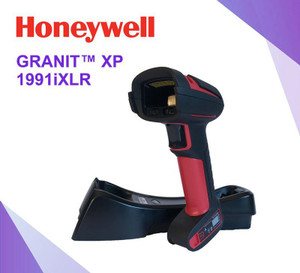
Honeywell 1991IXLR-3-N B1 Area Imager Barcode Scanner
The Honeywell 1991IXLR-3-N B1 is a fixed-position area imager scanner engineered for retail checkout, warehouse receiving, and logistics operations where durability and decode breadth matter. Unlike single-mode laser scanners, the area imager optical engine captures image frames of barcodes, then decodes both 1D and 2D symbologies in software — delivering faster first-pass read accuracy and broader format support in a single device. Wired RS-232/USB connectivity eliminates battery management overhead and integrates directly into legacy POS terminals and modern warehouse management systems without pairing delays or sync complexity.
Key Features
- Area Imager 1D/2D Engine: Captures and decodes EAN, UPC, Code 128, QR Code, Data Matrix, and PDF417 in one optical path — removes the need to stock separate laser and imager units, cutting procurement complexity and training burden across multi-location networks.
- IP65 Ingress Protection: Dust and spilled liquids won't degrade optical performance or trigger field replacements in retail checkout areas, warehouse receiving docks, or outdoor loading bays where humidity and particulate exposure are continuous — directly reduces unplanned downtime and repair costs.
- 2.0 m (6.5 ft) Drop Rating: Survives accidental drops onto concrete and metal surfaces common in busy facilities — a concrete tester: most consumer barcode readers fail at 1.0 m or below, making the 1991IXLR-3-N B1 meaningful insurance against downtime and field replacement labor in high-traffic environments.
- Close-Range Working Distance (5–80 cm / 1.6–2.6 ft): Optimized for point-of-sale counter scanning and tabletop inventory operations — operators don't need to hold codes at awkward distances or adjust positioning repeatedly, reducing scan fatigue and transaction time during peak retail hours.
- Wired RS-232/USB Connectivity: Direct integration to legacy POS terminals and modern USB-enabled systems without Bluetooth pairing delays, wireless dropouts, or battery depletion — delivers guaranteed uptime across 24/7 retail and warehouse operations where cordless convenience trades against availability risk.
- Multi-Symbology Support: Handles legacy barcodes (UPC, EAN) and modern formats (QR, Data Matrix, PDF417) without firmware updates — simplifies inventory system transitions and maintains compatibility with supply chain partners still using older barcode standards.
- Consistent First-Pass Read Accuracy: Area imager architecture minimizes misreads under variable lighting conditions and inconsistent barcode print quality — reduces manual re-scans and transaction delays during peak retail hours, lowering per-item processing cost and improving customer throughput.
Integration & Deployment Contexts
The 1991IXLR-3-N B1 integrates via standard RS-232 or USB into POS platforms (Square, Lightspeed, Shopify hardware), warehouse management systems (SAP, Oracle), and legacy retail terminals without custom drivers or middleware. Fixed mounting at checkout counters, receiving tables, or quality-control stations provides consistent scanning geometry — no operator training on distance or angle variability needed.
Typical deployments include retail checkout lines, warehouse receiving docks, manufacturing assembly and traceability workflows, shipping and proof-of-delivery operations, and fixed-asset inventory cycles. For retailers and third-party logistics providers operating multi-location networks, the Honeywell barcode scanner line offers proven reliability across thousands of retail and logistics installations over multiple hardware generations.
In environments subject to regulatory compliance (healthcare, food traceability, pharmaceutical lot tracking), the 1991IXLR-3-N B1's consistent decode performance and wired audit trail (no wireless interference or battery-related gaps) support audit and chain-of-custody documentation without additional logging overhead.
When to Choose a Different Model
If your deployment requires wireless mobility across a large facility (mobile inventory, pick-to-light workflows), consider a cordless barcode scanner from the Granit XP line — the trade-off is battery management overhead. If you need longer working distances (beyond 80 cm) or hands-free operation at checkpoints, evaluate specialized long-range imagers or dedicated hands-free scanners in the Honeywell catalog. If your environment involves extreme temperature swings or full submersion risk, verify operating range and IP rating requirements against your facility's conditions before committing.
Frequently Asked Questions
Q: Is the 1991IXLR-3-N B1 compatible with my existing POS system?
A: Yes, provided your POS terminal supports standard RS-232 or USB input. The 1991IXLR-3-N B1 works with legacy serial terminals and all modern USB-enabled systems (Square, Lightspeed, Shopify hardware, etc.). Confirm your specific POS model's barcode input protocol before purchase.
Q: What symbologies does the 1991IXLR-3-N B1 decode?
A: The area imager engine decodes EAN, UPC, Code 128, QR Code, Data Matrix, and PDF417 without firmware updates or configuration changes. This breadth allows a single device to handle both legacy retail barcodes and modern track-and-trace formats.
Q: Can the 1991IXLR-3-N B1 be wall-mounted or does it require a counter stand?
A: The 1991IXLR-3-N B1 is a fixed-position scanner designed for counter or table mounting. Confirm mounting bracket availability and your facility's height/angle requirements before specifying — the 5–80 cm working distance assumes a specific orientation.
Q: What happens if the 1991IXLR-3-N B1 gets dropped or exposed to moisture?
A: IP65 protection means dust and moisture exposure won't immediately degrade performance, but submersion or high-pressure washing is not covered — IP65 protects against splash, not full water jets. The 2.0 m drop rating covers accidental drops on hard surfaces; repeated drops or impacts beyond that height may cause damage.
Q: Is a separate power supply required for the 1991IXLR-3-N B1?
A: The 1991IXLR-3-N B1 is wired via RS-232 or USB. USB-connected units draw power from the host device; RS-232 variants may require a separate 12VDC or 24VDC power source depending on the specific connector type. Confirm the power requirements for your intended connectivity method.
Q: How does the area imager compare to a laser scanner in terms of speed and accuracy?
A: Area imagers typically deliver faster first-pass read rates and better handling of variable barcode print quality and lighting compared to laser scanners, because they capture an image and decode in software rather than relying on reflection timing. The trade-off is slightly higher power consumption and marginally longer optical integration time. For retail and warehouse environments, the 1991IXLR-3-N B1's area imager design generally results in fewer manual re-scans and faster transaction throughput.
Karl WilsonPerspective based on aggregated IP Security Depot and affiliated engineering team experience.
The 1991IXLR-3-N B1 is a workhorse for any operation running fixed-position barcode capture at scale. The area imager engine eliminates the laser-vs-imager procurement decision — you get both 1D and 2D decode in a single optical path, which matters when your supply chain partners are pushing QR and Data Matrix adoption but your legacy inventory still relies on UPC. The IP65 rating and 2.0 m drop spec aren't flashy, but they're what keep this scanner in the field instead of on a repair bench when a case of beverages takes out a checkout device or humidity creeps into a warehouse loading dock.
Technical Highlights:
- Area Imager 1D/2D Decode: Single optical engine handles EAN, UPC, Code 128, QR Code, Data Matrix, and PDF417 — eliminates dual-scanner deployments and the training overhead that comes with maintaining separate devices for linear and 2D formats.
- IP65 + 2.0 m Drop Rating: Dust, moisture, and accidental drops are operational realities in retail and warehouse environments; these ratings directly translate to fewer field replacements and reduced per-unit TCO across a 50+ unit deployment.
- Close Working Distance (5–80 cm): Optimized for counter and tabletop operations — operator doesn't strain positioning codes or adjust approach distance, which compounds into meaningful throughput gains during 12–16 hour retail shifts.
- Wired RS-232/USB: No battery management, no wireless interference, no pairing delays — guaranteed connectivity in environments where a scanner going offline costs transaction revenue.
Deployment Considerations:
- IP65 covers splash and dust, not full submersion — if you're mounting this near spray-wash bays or outdoor high-pressure rinse stations, you'll need a higher rating or additional housing.
- The 5–80 cm working distance is tight for some installations; if your checkout counter or assembly station requires longer-range scanning (1–2 meters), evaluate a long-range imager variant before committing to this model.
- Wired connectivity is a feature, not a bug, but it does mean cable routing and terminal placement are fixed — verify your POS or WMS terminal location supports the umbilical length you need.
The 1991IXLR-3-N B1 is the right choice for retail networks and 3PLs running high-volume, stationary barcode capture where durability and format breadth directly reduce per-transaction labor and hardware replacement costs. It's not a handheld and it won't work for mobile picking; it's a fixed-asset scanner that earns its cost through reliability and multi-format compatibility.