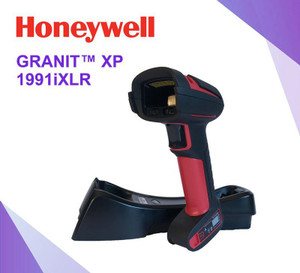
Honeywell 1991IXLR-3SER-5-N Granit XP 199Xi Area Imager Barcode Scanner
The Honeywell Granit XP 199Xi (1991IXLR-3SER-5-N) is a wired area imager scanner purpose-built for high-velocity retail checkouts, warehouse receiving, and logistics operations where barcode read reliability directly drives throughput. Unlike single-line laser scanners, the area imager engine captures entire image frames, enabling it to decode 1D barcodes at any angle and read 2D codes like QR and Data Matrix in a single capture. This flexibility eliminates the positioning guesswork that slows down operators in time-critical environments.
The IP65 rating means the scanner shrugs off water spray and dust common in dock environments and behind damp checkout counters—a real operational concern in facilities with wash-down protocols or high humidity. The 2.0 m (6.5 ft) drop rating puts it in the durability tier you want when scanners are dropped multiple times per shift across concrete floors. That durability translates directly to lower replacement costs and fewer scanning interruptions that cascade through your supply chain or POS network.
Key Features
- Area Imager 1D/2D Decoding: Captures both linear (EAN, UPC, Code 128) and matrix codes (QR, Data Matrix) without operator re-positioning—saves seconds per transaction across hundreds of daily scans, adding up to measurable throughput gains in retail and shipping.
- IP65 Environmental Protection: Withstands direct water spray and dust ingress, critical for dock areas, outdoor loading zones, and facilities running regular washdowns. Not submersion-rated, so keep it above standing water.
- 2.0 m Drop Tolerance: Designed to survive repeated drops onto hard floors without optical misalignment—reduces field repairs and keeps scanners productive instead of on warranty replacement.
- RS-232 and USB Wired Connectivity: Hardwired connection eliminates Bluetooth pairing complexity and RF interference concerns. Ensures zero-latency barcode transmission to your POS system or WMS, a critical factor in checkout environments where read delays create customer friction.
- Close-Range Optical Design (5–80 cm): Optimized for stationary scanning at checkout lanes and receiving stations where scanning distance is predictable. Not suited for long-range scanning; if operators need to capture barcodes 3+ meters away, consider a pistol-grip handheld scanner instead.
- Multi-Symbology Support: Reads EAN, UPC, Code 128, Code 39, QR Code, Data Matrix, and additional formats—eliminates the need to swap scanners when moving goods through different supply chain stages with mixed barcode standards.
- High First-Pass Read Accuracy: Optimized optical engine minimizes mis-reads and no-read events, reducing operator rescans and the downstream data errors they create in inventory and financial records.
- Consistent Performance Across Lighting: Performs reliably in bright retail spaces and dimly lit warehouse aisles, removing the need for supplemental lighting at scanning workstations.
Integration & Deployment Context
The 1991IXLR-3SER-5-N connects via standard RS-232 or USB, making integration straightforward with legacy POS systems, modern WMS platforms, and enterprise inventory software. The wired design requires cable management—plan for desk-mounted or pole-mounted cable routing if you're deploying multiple units across a facility. Verify your host system supports one of these two protocols; USB is more common on newer systems, RS-232 on older retail infrastructure. The close-range optical design makes this scanner ideal for fixed scanning stations (checkouts, receiving tables, shipping tables); if operators need mobility or longer-range captures, the Granit XP 199Xi is not the right fit.
Typical Use Cases
- Point-of-sale retail scanning and checkout lanes—where multi-symbology support and consistent read speed reduce customer wait time.
- Warehouse receiving and putaway—IP65 durability handles dock spray and dust; close range matches typical dock-to-scanner distances.
- Shipping and proof-of-delivery scanning—area imager reads mixed barcode types on the same shipment label without re-positioning.
- Manufacturing quality control and serialization—captures both 1D product codes and 2D traceability codes in a single scan.
- Asset management and fixed-asset tagging—multi-symbology support accommodates legacy asset tag formats alongside newer QR-based systems.
Frequently Asked Questions
Q: Can the 1991IXLR-3SER-5-N scan barcodes at a distance, or is it really limited to close range?
A: The scanner's optical design is optimized for 5–80 cm (roughly 2 to 31 inches), making it ideal for stationary workstations like checkout lanes and receiving tables. Beyond 80 cm, read reliability drops significantly. If operators need to scan items at arm's length or across a table, this model is not a good fit—consider a pistol-grip handheld scanner or a longer-range fixed-mount imager.
Q: Is the 1991IXLR-3SER-5-N compatible with my POS system?
A: The scanner outputs via RS-232 or USB, which are supported by most retail POS systems and WMS platforms built in the last 20 years. Verify your system accepts one of these protocols before purchasing. If your system requires Ethernet or a proprietary interface, this scanner will not work without a protocol gateway.
Q: Does the IP65 rating mean I can submerge it or run it under a hose?
A: IP65 handles direct water spray and splashing, making it safe for dock areas and wet environments. It is not submersion-rated—do not soak it or use it underwater. If you need submersion protection, look for an IP67-rated model.
Q: What happens if the scanner is dropped?
A: The 2.0 m drop rating means it can survive repeated drops onto hard flooring without optical degradation or data transmission errors. Drops beyond 2 m or onto sharp corners may cause damage. This rating is typical for warehouse and retail environments where accidental drops are common.
Q: Does the 1991IXLR-3SER-5-N require batteries or a power supply?
A: This is a corded scanner—it draws power from the USB or RS-232 host system. No separate power supply or batteries are required, eliminating battery management overhead and ensuring the scanner is always ready to scan.
Q: Can I use this scanner with QR codes and other 2D barcodes?
A: Yes. The area imager engine decodes QR Code, Data Matrix, and other 2D symbologies. It also reads traditional 1D barcodes (EAN, UPC, Code 128, Code 39) in a single capture, so a single scanner handles mixed barcode types across your supply chain.
Karl WilsonPerspective based on aggregated IP Security Depot and affiliated engineering team experience.
The Granit XP 199Xi (1991IXLR-3SER-5-N) is a workhorse in retail and warehouse scanning where barcode throughput and device reliability drive operational efficiency. The combination of IP65 durability and a 2.0 m drop rating positions this scanner squarely in the industrial-grade tier—it survives dock environments and high-traffic checkout floors where consumer-grade scanners fail within months. The area imager engine is the real differentiator: it reads 1D and 2D codes without operator re-positioning, eliminating the re-scan delays that accumulate into measurable labor cost and customer friction in high-volume environments.
Technical Highlights:
- Area Imager vs. Laser: Captures full image frames rather than a single line. Means you read EAN/UPC at any angle and QR codes in one shot—no fumbling with barcode orientation. In a 200-transaction-per-hour checkout, that saves 10–15 seconds per hour of total checkout time across all lanes.
- IP65 + 2.0 m Drop: This combination is purpose-built for wet docks, outdoor staging, and high-drop-frequency floors. IP65 blocks dust and water spray; 2.0 m drop means accidental floor impacts don't require warranty claims or downtime.
- Wired RS-232/USB Connectivity: No Bluetooth pairing, no battery management, no RF dropout. Direct connection to your POS or WMS means zero-latency barcode delivery—critical in time-sensitive retail and logistics scanning where read confirmation delays cascade into line delays.
- Close-Range Optics (5–80 cm): Purpose-built for fixed scanning stations. Beyond 80 cm optical performance degrades—don't attempt to use this for roaming or long-reach scanning or you'll encounter high no-read rates.
Deployment Considerations:
- Cable Management: Wired deployment requires desk-mounted cable routing or pole-mounted drops. Plan cable runs before deployment, especially if rolling out across multiple checkout stations or dock tables.
- Protocol Lock-In: Verify your POS or WMS accepts RS-232 or USB input. Older retail systems often support RS-232; modern WMS platforms typically expect USB. If your system is Ethernet-only, this scanner will not integrate without a protocol gateway (additional cost, latency risk).
- Range Boundary: The 80 cm upper bound is hard. Beyond that distance, decoding accuracy drops sharply. Do not deploy this scanner for long-range or roaming applications—that mismatch will create high no-read rates and operator frustration.
The 1991IXLR-3SER-5-N is the right choice for fixed-position, high-volume retail checkouts and warehouse receiving stations where durability and 1D/2D versatility matter more than scanning range. If your operation requires roaming scanners or long-range barcode capture across a receiving floor, look to the Honeywell handheld or longer-range fixed imager product line instead.