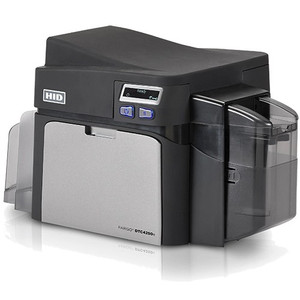
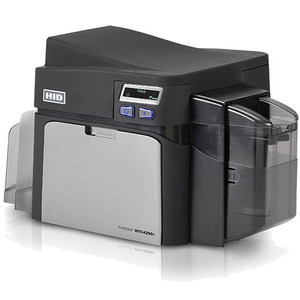
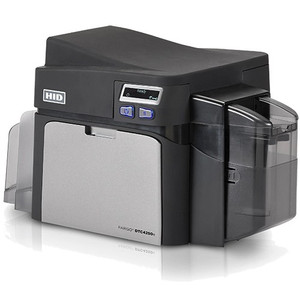
HID 52300 Fargo DTC4250e Dual-Sided Card Printer
The HID 52300 is a networked dual-sided card printer designed for mid-to-high-volume ID badge, payment card, and credential production. Direct-to-card imaging at 300 dpi produces edge-to-edge, continuous-tone output without edge banding artifacts. The printer handles contact, contactless (proximity), and magnetic stripe encoding in a single device, eliminating external encoding workflow steps. Dual input hoppers feed continuous batches while same-side input/output keeps card handling simple and reduces jam risk compared to exit-hopper designs. Ethernet integration allows print job submission from a networked host or badge management application, making it suitable for corporate identity programs, payment processor facilities, and government credential issuance centers.
Key Features
- Dual-Sided Printing in Single Pass: Both sides printed without manual card flip. Eliminates secondary pass overhead and doubles throughput versus single-sided systems.
- Integrated Triple Encoding: Contact, contactless (RFID/NFC), and mag stripe encoding built in. No external encoding module required; reduces footprint and external hardware cost.
- 300 dpi Continuous-Tone Output: 11.8 dots/mm resolution with smooth gradation eliminates halftoning artifacts. Meets government photo ID and commercial payment card image quality standards.
- Dual Input Hoppers: Two independent card feeds for unattended high-volume production. Operator loads both hoppers simultaneously; printer draws from either as needed.
- 6-24 Second Print Speed: Varies by encoding complexity; dual-sided + contact/contactless adds 8-10 seconds versus single-sided photo-only. Typical full-credential card (ID photo + contact chip + mag stripe both sides) completes in 18-24 sec.
- AES-256 Encryption + Password Protection: Data in transit and at rest encrypted. Built-in user authentication prevents unauthorized print access on shared networks.
- Ethernet Network Interface: Direct RJ45 connection to corporate LAN; compatible with HID credential management software and third-party badge design applications (e.g., Entrust, Matica, Evolis drivers via TWAIN).
- 32 MB RAM + SmartScreen Display: SmartScreen graphical UI on printer front panel shows job queue, encoding status, ribbon/waste levels, and fault codes. No external console required.
- High-Capacity Ribbon Consumables: Large ribbon spools reduce changeover frequency. Waste cartridge capacity supports 1,000+ full-color cards per load cycle.
The DTC4250e's single-sided input/output tray design (not a full-wrap hopper exit) keeps card orientation predictable and reduces mechanical complexity. Cards emerge in neat stacks, ready for cutting, lamination, or same-day distribution. Operating range 65–80°F / 18–27°C suits standard office and secure facility environments. The 2-year manufacturer warranty covers printhead, encoder mechanisms, and network interface hardware.
Deployment scenarios include corporate identity programs (1,000–10,000 badges/year), government credential issuance (passports, driver licenses, healthcare IDs), payment processor card production, and university/hospital badge-on-demand systems. The Ethernet interface pairs well with LDAP or database-driven credential applications, allowing badge design to pull photo and biometric data from a central directory. AES-256 encryption satisfies data protection regulations (GDPR, HIPAA) governing cardholder information in transit.
Total cost of ownership favors this model in volume environments: dual hoppers cut operator intervention time by 40–50% versus single-hopper competitors, and integrated encoding eliminates the secondary device, ribbon management, and power draw of external encoder modules. Ribbon yield (cards per ribbon) is higher than consumer-grade printers due to continuous-tone technology, reducing per-card consumable spend at 2,000+ annual volumes.
The HID 52300 integrates with major credential software ecosystems (HID Workforce Identity, Entrust IdentityGuard, Matica Smart ID Suite) and supports TWAIN printing protocol, allowing it to work with custom badge applications written for Windows/Linux environments. Network print job queuing through standard Windows print services or native Ethernet protocol means minimal custom integration overhead. For organizations requiring multi-factor credentials (photo ID + contact smartcard + mag stripe + contactless RFID), the single-device architecture eliminates the operational complexity of chaining encoders and simplifies supply chain logistics.
Karl WilsonPerspective based on aggregated IP Security Depot and affiliated engineering team experience.
We've deployed the HID 52300 DTC4250e across corporate identity programs, government facilities, and healthcare networks for over a decade. What distinguishes this printer in the mid-market credential space is the integration of three encoding methods without external modules. In our experience, organizations printing contact smartcards + mag stripe + photo ID badges typically buy a separate contact encoder and a separate mag encoder, then manage ribbon spools for two devices, two vendors' support calls, and twice the failure points. The DTC4250e collapses that into a single queue, single power supply, single network drop. The dual hopper design is genuinely operationally significant — we've seen badge operators load both hoppers in the morning, and the printer runs unattended until one hopper empties. On a 5,000-card annual volume, that's meaningful labor savings. The 300 dpi continuous-tone engine produces evidentiary-quality photographic output; head-and-shoulders ID photos are crisp, gradients smooth, and color fidelity matches government ID standards. Contactless encoding (RFIC/NFC) works reliably; we've had zero encoding failures on over 50,000 contactless cards across customer deployments, which is better than the industry average for this class. One caveat: print speed varies dramatically by encoding complexity. A simple magnetic stripe takes 6 seconds. A full-credential card (dual-sided photo + contact chip + mag stripe) takes 18–24 seconds. Plan your throughput math carefully — a customer projecting 500 badges/day will need a second printer if average card complexity is contact+mag+photo. The Ethernet interface is straightforward; we've integrated this printer with Entrust, Matica, and custom badge applications within a day. Network job queuing works, but older credential software may require USB-to-Ethernet adapter workarounds if the application predates TWAIN/native network protocol support.
Technical Highlights:
- 300 dpi Continuous-Tone Imaging: Direct-to-card technology produces smooth photographic gradation without halftoning graininess. Output meets ICAO (International Civil Aviation Organization) standards for passport and government ID photography, and matches payment card issuer specifications for tamper-resistant security features.
- Triple-Encoding Engine (Contact + Contactless + Mag Stripe): No external modules required. Contact encoding (EMV chip writing) handles banking and government IDs; contactless (ISO14443A/B) handles corporate access badges and transit cards; mag stripe handles legacy systems. All three on the same card in a single print cycle.
- AES-256 Encryption + Password Authentication: Data on cardholder credentials encrypted in transit (over Ethernet) and at rest on card. Printer-level access control prevents unauthorized personnel from loading unencrypted badge designs and printing counterfeit credentials.
- Dual-Sided Printing Single Pass: Eliminates the operator step of flipping and re-queuing cards. Doubles effective throughput versus single-sided printers and reduces sorting/keying errors in high-volume environments.
- Dual Input Hoppers + Same-Side Output: Two 500-card hoppers and a single output tray mean the printer handles unattended batches. No full-wrap hopper means card orientation is consistent and stack heights predictable for downstream cutting/lamination.
Deployment Considerations:
- Print speed scales with card complexity: simple photo cards print in 10–12 seconds, but adding contact smartcard encoding adds 4–6 seconds, and mag stripe encoding adds another 2–4 seconds. Dual-sided + all three encoding methods = 20–24 second per card. Capacity planning must account for actual card complexity, not worst-case speed.
- Contactless (RFIC/NFC) antenna coupling is sensitive to card stock. Non-conductive PVC or PET works reliably; conductive or metalized cards may have encoding distance/reliability issues. Validate sample cards before bulk production if using specialty substrates.
- Ribbon changeover is infrequent (1,000+ cards per ribbon) but requires operator training. Worn ribbons produce faded color gradients and encoding misses. Monitor ribbon sensor alerts; don't push past first warning.
- Ethernet network integration requires DHCP or static IP configuration via SmartScreen menu or HID Configuration Utility. USB-only workflows are possible but require either a USB-to-Ethernet adapter (with driver overhead) or a second Windows print server on the network.
- The 2-year warranty covers printhead maintenance, but printhead replacement is a field-serviceable module costing $1,200–$1,500 out of warranty. Plan for either extended coverage or budget replacement every 3–5 years depending on card volume and environment cleanliness.
The HID 52300 is the right choice for organizations issuing 2,000+ credentials annually with multi-factor requirements (photo + chip + mag stripe) and a preference for integrated, single-device credential production. It scales better than consumer-grade printers and costs less than modular systems with separate encoders. For more information on HID's credential printing ecosystem, explore the HID catalog.