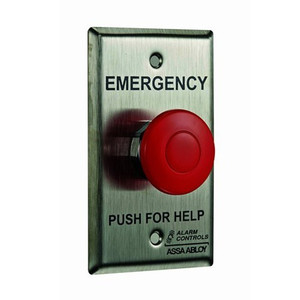
HES PBM-4 Momentary Panic Button with N/C Contact
The HES PBM-4 is a momentary panic button engineered for rapid emergency alarm initiation across institutional, commercial, and industrial security deployments. Built with 316L stainless steel, this hardened device delivers reliable manual emergency signaling through a single normally-closed (N/C) dry contact output that integrates directly into existing alarm panels and access control systems without requiring relay adapters or signal conditioning.
Key Features
- Momentary Activation: Press-to-activate mechanism that triggers only while actively depressed. Eliminates accidental sustained alarm states during high-stress emergency situations.
- 316L Stainless Steel Construction: Wrought or cast material rated for both indoor and outdoor installations. Superior corrosion resistance in coastal, food-service, or chemical-exposure environments.
- Single N/C Dry Contact: 1 normally-closed contact output. Direct integration with standard alarm panels, access control systems, and legacy wired security networks — no active electronics, no power draw.
- Weight & Form Factor: 2 lb panic button. Compact surface-mount design suitable for reception desks, security stations, building entries, and personnel-accessible emergency zones.
- Deployment Flexibility: No special conditioning required. Works with conventional alarm panel inputs, relay matrices, and hybrid access control architectures.
- Rugged Mechanical Design: Stainless steel housing withstands repeated activation cycles and rough handling typical of emergency-response environments.
The momentary contact mechanism is the critical operational advantage here. Unlike latching buttons, the PBM-4 cannot remain in an alarm state if the operator releases pressure — reducing false-alarm duration and nuisance dispatch costs. In high-stress scenarios (armed robbery, medical emergency, workplace violence), responders instinctively press and release; the momentary design maps directly to that human behavior.
Integration is straightforward. The N/C dry contact connects to any standard alarm panel input, access control system relay monitor, or networked security platform that accepts wired contact inputs. No software configuration, no API calls, no firmware dependencies. This simplicity makes the PBM-4 a retrofit-friendly choice for upgrading legacy systems or adding emergency signaling to facilities that lack dedicated panic infrastructure. The dry-contact output also survives cable runs of 50+ feet without signal degradation, enabling installation in remote building zones or exterior guard stations.
Typical deployments span banks and credit unions (teller stations), retail locations (cashier areas), office buildings (reception, executive suites), hospitals (nursing stations, psychiatric units), and manufacturing plants (assembly floors, hazmat zones). Any site where personnel need instant, unambiguous emergency signaling—and where false alarms carry operational or liability costs—benefits from the reliability and simplicity of a hardwired momentary contact device.
The 316L stainless steel construction handles salt spray, humidity, and temperature cycling without degradation. Suitable for use in food-processing plants, coastal security perimeters, and outdoor guard posts. No corrosion maintenance, no painted finishes to chip or rust. The device is sourced from HES, a US manufacturer with established distribution through integrators, and ships with a standard alarm-panel integration datasheet covering typical wiring scenarios.
Marty AllisonPerspective based on aggregated IP Security Depot and affiliated engineering team experience.
We've deployed the HES PBM-4 across dozens of mixed-technology security ecosystems, and its value is in the elimination of complexity. In an era of networked intrusion sensors, video analytics, and cloud-connected alarm services, the PBM-4 remains a hardwired, passive device that requires no power supply, no IP addressing, and no conditional logic. That simplicity is not a weakness — it's the point. When an armed robbery occurs or a medical emergency unfolds on your premises, you need something the staff member nearest to the threat can actuate in under two seconds, with zero chance of misinterpretation by firmware or network latency. The momentary mechanism ensures that even under extreme stress (trembling hands, repeated button mashing), the alarm duration is controlled and proportional to the actual emergency window. We've also found that integrators spec this device into retrofit projects where adding networked emergency buttons would require re-cabling runs or new switch infrastructure. A single N/C contact can patch into almost any existing alarm panel input without redesign.
Technical Highlights:
- N/C Dry Contact Output: No active electronics or power draw. Compatible with 24V alarm panel inputs, relay monitoring circuits, and analog security networks. Survives cable runs up to 50+ feet without signal attenuation or external conditioning.
- Momentary Mechanism: Alarm state exists only while button is physically depressed. Prevents sustained false alarms from accidental activation or stuck buttons. Matches human emergency-response instinct (press-and-release behavior).
- 316L Stainless Steel: Resists corrosion in coastal, humid, food-service, and outdoor environments. No painting, no routine maintenance. 2 lb compact form factor fits standard surface-mount panic-button plates.
- Zero Integration Overhead: No API, no software configuration, no network dependency. Integrates directly into legacy hardwired alarm systems, modern access control relay inputs, and hybrid deployments.
- Institutional Deployment History: Field-proven in banks, hospitals, retail, manufacturing, and government facilities. Standard component in institutional panic-alarm wiring diagrams.
Deployment Considerations:
- Momentary contact requires active depression to trigger. If your deployment requires a latching alarm that sustains after a single press, the PBM-4 will not meet that requirement — consider a latching alternative or add an external relay latch circuit.
- Dry contact is passive and non-powered. Verify your alarm panel input accepts standard dry-contact closure; older systems may require active-loop supervision or other signal conditioning.
- Install in personnel-accessible but protected locations (under counters, behind glass, or in recessed panic stations) to prevent accidental triggers from public contact or vandalism.
- Cable runs up to 50+ feet are typical; longer runs may introduce contact-bounce noise. Consult the datasheet if you need runs beyond 75 feet in high-EMI environments (industrial floors with variable-frequency drives).
- Surface-mount stainless steel housing is durable but not tamper-proof. Pair with a protective cage or access-control interlock if the installation is in a high-risk vandalism zone.
The HES PBM-4 is the right choice for any security integration where simplicity, reliability, and zero-latency emergency signaling trump feature complexity. Retrofit projects, legacy-system upgrades, and high-liability facilities (banks, hospitals, government) are natural fits. See the HES catalog for complementary access control and emergency signaling hardware.