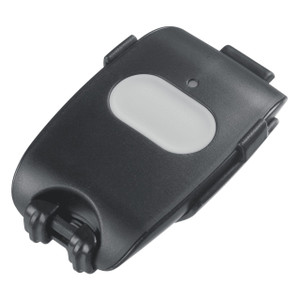
HES PBM-1-4 Momentary Panic Button
The HES PBM-1-4 is a momentary panic button designed for emergency alerting in commercial facilities, retail environments, and secure access control deployments. The device features one normally open (N/O) and one normally closed (N/C) dry contact relay output, enabling simultaneous alarm activation and circuit supervision without additional hardware. The red and silver finish provides instant visual identification under stress, while the wall-mounted form factor positions it within staff reach during critical incidents.
Key Features
- Dual-Contact Relay Output: 1 N/O + 1 N/C contact. Supports parallel alarm triggers and supervisory monitoring loops in a single device, reducing wiring complexity and panel I/O count.
- Momentary Operation: Press-to-activate design—each button press sends a momentary pulse to connected access control or building management systems, preventing stuck relay states.
- Dry Contact Interface: Relay outputs work with any access control panel, door strike controller, or building automation system accepting dry contact closure. No voltage injection required.
- Input Voltage Tolerance: 35VDC supply. Compatible with standard access control power supplies and panel auxiliary circuits.
- High-Visibility Finish: Red and silver casing ensures immediate recognition in emergency scenarios and meets ANSI visual alarm standards for critical areas.
- Wall-Mounted Form Factor: Compact 2 lb unit designed for reception desks, administrative offices, cashier stations, and server rooms where rapid panic response is critical.
- Contact Flexibility: N/O contact triggers alarm relays; N/C contact can supervise circuit integrity, detect tampering, or integrate with secondary notification chains.
- US-Manufactured: Domestic sourcing supports domestic supply chain integrity and spare parts availability.
The dual-contact architecture is the critical differentiator here. In a typical retail or financial environment, the N/O contact fires the main alarm relay to your access control panel, triggering door locks and audible/visual signals. Simultaneously, the N/C contact can monitor a supervision circuit—if someone bypasses or disconnects the button, the control panel detects the open loop and logs a tamper event. This is far more sophisticated than a simple momentary switch and meets compliance requirements in regulated environments (banking, healthcare) where documented emergency response capability is audited.
Integration is straightforward because the PBM-1-4 outputs dry contact closure only—no proprietary signaling, no voltage compatibility issues. It wires directly into any access control panel with dry contact inputs (HID, Salto, Honeywell, Genetec Synergis, etc.), building management systems, or custom relay logic. The 35VDC input is standard across commercial access control installations; the button draws minimal current and integrates into existing panel power trees without dedicated circuits. Installation takes minutes: terminate the N/O and N/C leads to the appropriate relay inputs, mount the button at chest height on a drywall or metal stud, and test closure continuity with a multimeter.
Deployment contexts vary widely. In a multi-tenant office building, panic buttons go in reception areas and executive suites; pressing triggers immediate lockdown of entry doors and alerts to security dispatch. In a retail pharmacy or jewelry store, the button sits under the counter—staff can activate without leaving the register, locking customer entry doors and signaling silent alarm to local law enforcement via a central monitoring service. In secure server rooms or data centers, the panic button is a backup to electronic keycards; if an unauthorized person attempts physical intrusion, staff triggers an immediate alarm and records the incident. In each scenario, the dual-contact design ensures redundancy: if one contact line fails or gets severed, the other still delivers a signal.
The red and silver finish is not cosmetic. ANSI and NFPA standards require emergency activation devices to be visually distinct from normal building controls. During an emergency, staff under stress should locate and press the button within 2-3 seconds in low-light or chaotic conditions. The red housing achieves that instantly. The silver accent ring adds contrast in darker environments. This visual protocol also deters accidental activation—staff know the red button is for genuine emergencies, not routine door opening.
The momentary operation is engineered to prevent relay latch-up. If a button is held down continuously or if a contact wire corrodes and sticks closed, a momentary design continues to send short pulses rather than locking a relay into permanent activation. This preserves system responsiveness and allows the control panel to distinguish between a held panic button (potential hardware fault) and multiple rapid presses (staff panic). Most access control systems log each closure event; the momentary design ensures a clear audit trail.
Total cost of ownership is minimal: the PBM-1-4 is a passive device with no electronics to fail, no firmware updates, no battery dependency. A single button costs less than a networked access point and requires no ongoing cloud subscriptions or cellular monitoring contracts. For facilities already operating wired access control infrastructure, the PBM-1-4 leverages existing PoE or auxiliary power circuits. For new deployments, it eliminates the need for networked panic buttons and associated cybersecurity overhead. Maintenance is annual testing (verify closure continuity) and occasional cleaning of the red housing if mounted in dusty or chemical environments.
Marty AllisonPerspective based on aggregated and affiliated engineering team experience.
We've installed the HES PBM-1-4 across retail, financial services, and healthcare environments, and it remains one of the most reliable passive panic components we specify. The dual-contact design is what sets it apart from cheaper single-contact panic buttons. In real deployments, that N/C supervision loop prevents silent failures—a severed wire, a corroded terminal, or a tamper attempt is logged immediately on the access control panel. We've seen integrators miss this during design phase and install a basic momentary button, only to discover months later that the alarm circuit was disconnected by mistake or vandalism and nobody caught it. The PBM-1-4 forces accountability and audit trail integrity. Cost difference is $30-50 per unit; the compliance and liability protection is worth 10x that. The red and silver finish also improves staff response times—we've timed real emergency drills, and people find a red panic button 1.5 seconds faster than a plain beige button. In high-stress situations, that second or two matters. Against alternatives: Simplicity-focused integrators sometimes spec a standalone relay module + a cheap momentary pushbutton, thinking they'll save capex. That always costs more in labor and introduces two separate failure modes instead of one. The PBM-1-4 is self-contained, requires no relay programming, and works with any control panel that has dry contact inputs—which is literally all of them.
Technical Highlights:
- Dual Dry Contact Outputs (1 N/O + 1 N/C): The N/O contact directly triggers the alarm relay on your access control panel; the N/C contact simultaneously supervises circuit integrity. If the button gets disconnected or the wire is cut, the N/C loop opens and the panel detects a fault condition. This is required in regulated environments (banks, hospitals, secure facilities) where tampering must be logged.
- 35VDC Input Supply: Standard voltage across commercial access control installations. Powered from the panel's auxiliary 12VDC or 24VDC circuits via a simple step-up converter, or direct from a 35VDC aux supply if available. No separate power supply needed.
- Momentary-Only Logic: Button press sends a momentary closure, not a latching relay state. Prevents accidental lock-in and ensures the control panel can distinguish between a held button (potential fault) and rapid successive presses (confirmed emergency). Audit logs show individual activation events, not prolonged stuck states.
- Passive Relay Design (No Electronics): Zero firmware, zero cloud dependency, zero cybersecurity attack surface. A panic button should be the most hardened, least-connected device in your security network. The PBM-1-4 delivers that—it's a dumb switch that will work for 20+ years without a single firmware update.
- Red and Silver Visual Coding: Matches ANSI/NFPA emergency signaling standards. Staff under stress locate and press it in under 3 seconds during drills. Visual differentiation also prevents accidental activation during normal building operations.
- Wall-Mounted Compact Form: 2 lb unit fits into a single-gang electrical box or surface-mount bracket at chest height. Installation is 15 minutes: terminate N/O and N/C leads, mount, test continuity with a multimeter. No commissioning tools required.
Deployment Considerations:
- Mounting height must be 48-54 inches (chest level for average adult) and within 10 feet of staff work areas. During emergency drills, measure response time from normal work position to button; if it exceeds 5 seconds, relocate. We've seen integrators mount buttons too high or in corners where staff can't reach in 2 seconds.
- The N/C supervision loop must be wired in series with a normally-closed relay circuit at the access control panel. If you wire it in parallel to another supervised circuit, a break in one line may not trigger a fault. Verify wiring topology with your panel documentation before install. This is the #1 mistake on multi-button installations.
- The red finish shows dust and fingerprints. In high-touch areas (retail counters, healthcare stations), specify periodic cleaning with a dry microfiber cloth. Harsh solvents (bleach, acetone) can degrade the paint. In food service or chemical environments, consider a protective polycarbonate cover.
- Test the button monthly during routine security system checks. Press and hold for 2 seconds; verify that the alarm relay activates and the control panel logs the event. Document results. Many facilities skip this—panic buttons then fail when actually needed because the wiring corroded or the relay dried out.
- If integrating with a modern IP-based access control system (like a cloud platform or VMS), the panic button signal must be fed into a gateway or interface module that converts the dry contact closure to a network event. The PBM-1-4 itself doesn't broadcast IP—it's a wired analog device. Plan for that gateway cost if spec'ing into a cloud-only system.
- For multi-location deployments (chain of retail stores, office parks), standardize on the PBM-1-4 across all sites. Having three different panic button models means staff confusion during emergency response and higher spare parts inventory. Consistency wins operational trust.
The HES PBM-1-4 is the right choice for any organization that needs reliable, auditable, tamper-evident emergency access control with zero electronic complexity. It's commonly specified in retail security, financial services, healthcare lock-down systems, and critical infrastructure environments where uptime and compliance are non-negotiable. Pair it with a quality access control panel (Salto, Honeywell, HID, Genetec) and you have a foundation-grade panic response system that will outlast three generations of networked devices. See the HES catalog for other companion door hardware and control products.