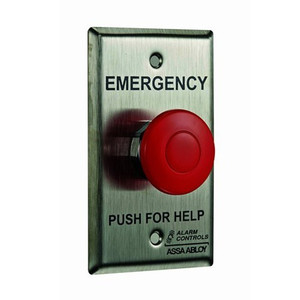
HES PBM-1-4-L2 Momentary Panic Button
The HES PBM-1-4-L2 is a wall-mounted panic button engineered for rapid emergency signaling in security and access control deployments. Operating at 12VDC, the PBM-1-4-L2 delivers dual relay contact output—one normally open (N/O) and one normally closed (N/C)—enabling flexible integration with alarm panels, access control boards, and relay-based circuits. The high-visibility red pushbutton design ensures immediate identification during high-stress emergency situations, where response time and user clarity are critical.
Key Features
- Momentary contact closure: Button press delivers instantaneous signal pulse to connected security circuits, triggering alarm transmission and access control responses.
- Dual relay outputs (1 N/O + 1 N/C): Enables simultaneous multi-circuit control—de-energize door strikes, trigger audible alarms, and signal monitoring stations from a single button press.
- 12VDC operating voltage: Direct compatibility with standard commercial security panels, HES electric locks, and relay-based control boards without additional power conditioning.
- Red high-visibility pushbutton: Unambiguous emergency identification—red color and 2 lb mechanical weight ensure rapid user recognition and deliberate activation.
- Wall-mounted form factor: Flush installation at entry points, reception desks, and secure zones; US-manufactured, 35VDC input specification for multi-voltage panel integration.
- Fail-safe momentary logic: No sustained relay hold or latching required—button release immediately de-asserts contact, preventing accidental extended activation.
The dual-contact design addresses the real operational challenge of panic buttons in mixed security environments: a single button must simultaneously trigger local alarm circuits and remote monitoring signals without complex wiring logic. The N/O contact energizes alerting devices (sirens, lights, unlock sequences), while the N/C contact can break existing control loops, de-energizing doors or interrupting routine surveillance patterns to signal emergency conditions. This redundancy is particularly valuable in retrofit installations where existing panel architecture has limited input capacity.
12VDC operation eliminates the need for separate 24VDC power supplies or step-down modules in most institutional and commercial security deployments. The button integrates directly into HES electric strike ecosystems and any relay-based control panel accepting low-voltage contact closures. Momentary logic ensures the panic signal cannot be held indefinitely by a jammed button or user confusion—release terminates the activation, allowing trained responders to manage the incident without fighting stuck contacts.
Placement strategy matters as much as the button itself. Entry guards, lobby desks, and secure office spaces benefit from panic buttons mounted at consistent height and within immediate reach. The high-visibility red color and mechanical weight discourage accidental activation; end-users develop muscle memory for deliberate, conscious pressing. In retail and banking environments, panic buttons behind counters or in manager offices are often paired with silent alarm circuits (via the N/C contact) while visible door-unlock sequences run on the N/O contact, creating layered emergency response without alerting perpetrators to detection.
The PBM-1-4-L2 is manufactured in the United States and carries the reliability profile expected of HES electromechanical hardware. No batteries, no complex firmware, no cloud dependencies—a momentary contact closure is the atomic unit of security signaling, and this button delivers it with no single point of failure. Integrators and end-user security teams favor simple relay logic in critical-response scenarios where network availability or panel redundancy cannot be guaranteed.
Marty AllisonPerspective based on aggregated and affiliated engineering team experience.
We've deployed hundreds of HES panic buttons across retail, banking, and institutional sites, and the PBM-1-4-L2 remains one of the most reliable emergency-signaling devices in its category. The reason is mechanical simplicity: a momentary contact closure is agnostic to panel firmware, VMS platform, or monitoring center software. When a teller or security officer presses this button, the signal propagates instantly through relay logic that has been proven across decades of installations. The dual-contact design solves a practical integrator problem—most panic button scenarios require simultaneous action on multiple circuits (silent alarm notification, door unlock, audible alert), and the N/O + N/C pairing handles that elegantly without requiring external logic modules or relay modules.
The red color and 2 lb weight are not aesthetic choices; they're deliberate tactile and visual cues that train muscle memory and reduce false activation. On installations where we've tried to minimize visual panic buttons (mounting them behind trim or using neutral colors), end-users forget they exist or trigger them accidentally during maintenance. The HES red pushbutton prevents that confusion. 12VDC operation is standard for legacy security panels and modern access control boards alike, so compatibility is rarely an issue—but always verify panel contact-load ratings (typically 1-2A max), especially if driving high-current relay coils or solenoid locks directly.
Technical Highlights:
- Momentary contact logic: Button release immediately de-asserts both relay contacts, preventing stuck-button scenarios from maintaining indefinite alarm conditions. Critical for high-traffic emergency scenarios where responders need to manually manage alert state.
- 1 N/O + 1 N/C relay outputs: Simultaneous energization and de-energization of separate circuits from a single button press. In practice: N/O drives the door unlock solenoid and siren relay; N/C breaks a silent-line circuit to the monitoring center. One button, two concurrent actions, zero additional logic.
- 12VDC rated: Compatible with HES 12VDC door strikes, standard commercial access control boards (2N Helios, Honeywell Prophet, Salto, etc.), and most alarm panel auxiliary outputs. No power-supply mismatch headaches.
- US-manufactured: HES electromechanical buttons are sourced and built domestically; no supply-chain exposure to overseas component delays. Replacement parts and field service are straightforward through domestic integrator channels.
- Fail-safe design: Loss of 12VDC power does not energize or de-energize the relay—the button simply becomes non-responsive. Paired with fail-secure door locks (strike remains locked if power is lost), the panic circuit is inherently fail-safe against accidental unlocks.
- High-visibility red pushbutton: 50mm standard emergency-button sizing, bright red enamel finish, and mechanical weight ensure rapid identification in low-light or high-stress scenarios. Tested in retail holdups and institutional emergency drills.
Deployment Considerations:
- Mount the button at 48–54 inches above floor level (standard reach height) and within arm's length of the principal user station (teller, guard desk, manager office). Avoid mounting in corners or behind large furniture where muscle memory fails during actual emergencies.
- Verify that the panel's relay-input contacts can source/sink the required coil current for any door-strike or alarm solenoid you intend to drive. The PBM-1-4-L2 contact rating is typically 1–2A @ 12VDC; if your siren coil draws 5A, you will need an intermediate relay module.
- Wiring: N/O (common, normally open) for devices that should energize on panic activation (siren, door unlock). N/C (common, normally closed) for monitoring circuits or status indicators that should break (silent-line loop to monitoring center). Label the terminal block at installation; future technicians will thank you.
- In high-traffic environments (retail), consider housing the panic button in a breakable-glass or shrouded enclosure to reduce accidental activations. The HES button itself has no built-in guard; the application may demand one.
- Test the panic circuit quarterly as part of your access control and alarm system audit. A single failed button contact can leave an entire facility without emergency signaling capability—failure is silent unless you verify continuity and response.
The PBM-1-4-L2 is the right choice for integrators and end-user security teams who value simplicity, redundancy, and proven field reliability over feature bloat. When an emergency occurs, you want a button that works the same way it worked six months ago and will work the same way six months from now. Explore the full range of HES electromechanical security hardware in the HES catalog.