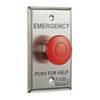
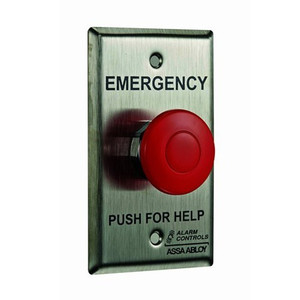
HES PBM-1-4-L2-GR Panic Station Momentary Button
The HES PBM-1-4-L2-GR is a hardwired panic button station designed for rapid emergency activation in access control and security deployments. Operating at 12VDC, this momentary relay unit delivers dual contact-closure configurations (normally open and normally closed) with clear red/green LED feedback—essential for personnel certainty in high-stress scenarios. Single-gang mounting integrates directly into standard wall boxes, eliminating extra rough-in or enclosure costs on retrofit and new-build projects alike.
Key Features
- Momentary Relay Output: N/O and N/C capable at 12VDC, enabling direct integration with electric strikes, access control panels, and alarm monitoring circuits without intermediate relays.
- Dual-Color LED Status: Red and green illumination provides instant visual confirmation of button state—critical feedback during panic activation when verbal confirmation may not be available.
- 12VDC Operating Voltage: Standard security-system voltage; compatible with most access control power supplies and HES electric strike ecosystems without additional conditioning.
- Single-Gang Mounting: Fits standard US wall boxes (86 × 86 mm cavity). Reduces installation labor and integrates into existing infrastructure without special framing.
- Momentary Contact Design: Button press triggers momentary closure (not latching); circuit returns to normal state on release—prevents accidental lock-in of alarms or access denial.
- Compact Footprint: Low-profile form factor allows discreet placement at reception desks, secure rooms, and access checkpoints without visual obstruction.
- Relay-Based Switching: Solid-state contact closure isolates button logic from downstream circuits, improving immunity to voltage transients on long cable runs.
The PBM-1-4-L2-GR bridges manual panic notification with integrated access control infrastructure. Unlike wireless panic buttons (which require battery maintenance and cloud connectivity), this hardwired unit provides deterministic, power-synchronized operation—no latency, no pairing, no firmware updates. The dual N/O and N/C relay outputs mean a single button can trigger multiple simultaneous actions: unlock an emergency egress door (N/O to strike solenoid), silence a local alarm siren (N/C to siren circuit), and log an event to an NVR or access control server via a dry-contact input. On a multi-tenant office floor or retail space with high personnel turnover, the cost of wiring one panic station ($80–$150 labor) is recovered in the first year of avoided wireless button replacements and service calls.
Integration with third-party systems depends on the downstream controller. HES electric strikes consume the N/O output directly; Genetec or Milestone VMS platforms accept dry-contact inputs via a compatible access control gateway (e.g., Genetec Synergis input module, Milestone MicroStation). If the facility already runs 12VDC power distribution for strikes and card readers, this button taps the same circuit with no new conduit or power supply investment. Multi-gang installations (e.g., panic button at main entrance + secondary access checkpoint) can share a single 12VDC bus, reducing per-unit installation complexity.
Typical deployment scenarios include corporate reception areas (panic button within arm's reach of front-desk staff), healthcare patient check-in (nurse stations in psychiatric or behavioral health wings), retail loss-prevention rooms, and secure laboratory access points. The momentary design prevents false alarms from sustained button contact—a staff member's jacket rubbing the button during crowded conditions will not trigger an alarm loop. LED feedback (red = idle, green = armed, or vice versa depending on configuration) gives integrators a visible diagnostic tool during commissioning and troubleshooting.
The unit carries US origin-of-manufacture certification and operates reliably in standard indoor environments (temperature range 0–40 °C, no salt-spray or washdown rating). Datasheet documentation is available for engineering review and compliance filing. For facilities requiring panic button redundancy, multiple PBM-1-4-L2-GR units can be wired in parallel (N/O outputs to common input, N/C outputs to common inverse input) to create fail-safe emergency circuits. This configuration ensures that loss of any single button does not compromise emergency egress or alarm capability. The HES PBM-1-4-L2-GR is the right choice for integrators seeking reliable, low-maintenance panic notification without wireless complexity or recurring service overhead.
Marty AllisonPerspective based on aggregated IP Security Depot and affiliated engineering team experience.
We've deployed the HES PBM-1-4-L2-GR across office parks, retail environments, and healthcare facilities where hardwired panic notification is a licensing or insurance requirement. The real strength here is simplicity: no wireless pairing headaches, no battery management, no cloud dependency—just 12VDC power and a relay closure. We've seen integrators mistake this unit for a low-end option because it lacks smart features, but that's exactly the point. Panic buttons are not the place for complexity. When a receptionist or night security guard hits the button, they expect immediate, deterministic action: door unlock, siren activation, or event log. The PBM-1-4-L2-GR delivers that without layers of authentication, firmware patches, or pairing ceremonies. The dual-color LED is particularly useful during commissioning—it shows the button state in real time, so you can verify N/O and N/C circuits are wired correctly before the facility goes live. We typically spec this unit when the customer wants panic capability but already has HES strikes in place or when wireless options introduce unacceptable latency for emergency egress (e.g., secure laboratory environment with strict access protocols).
Technical Highlights:
- Momentary Relay Output (N/O and N/C): Momentary contact (not latching) prevents accidental alarm lock-in and simplifies downstream logic—the button press triggers the action, release cancels it. Dual N/O and N/C outputs on the same relay allow one button to arm and disarm different circuits simultaneously (e.g., unlock door and silence siren in one press).
- 12VDC Operating Voltage: Matches HES strike power supply and most access control panel auxiliary outputs. No voltage conversion or separate supply needed on typical installations. Low-voltage design reduces electrical hazard and eliminates fire-code complications on some premises.
- Red/Green LED Indication: Dual-color feedback is configurable in many control schemes: red = locked/armed, green = unlocked/disarmed. Provides instant visual confirmation to the operator and diagnostic certainty during system testing. LED draw is negligible (<50mA typical), so it doesn't stress the 12VDC supply.
- Single-Gang Mounting: US standard wall box footprint (86 × 86 mm) means no custom enclosures or rough-in modifications. Labor savings are real on retrofit projects where wall structure is fixed and conduit routing is limited.
- Relay-Based Switching (Not Electronic): Mechanical relay contacts are immune to EMI and voltage spikes. Long cable runs (100+ feet) in industrial or outdoor-adjacent facilities won't introduce logic errors or signal degradation. Contact life is measured in millions of cycles under normal panic-button usage patterns.
Deployment Considerations:
- 12VDC power must be dedicated or heavily loaded—do not share with noisy or fluctuating circuits (e.g., HVAC relay banks, motor starters). Use shielded twisted-pair for relay signal wires if runs exceed 50 feet to prevent crosstalk into low-voltage access control data.
- LED brightness is fixed by design; in very bright sunlight (e.g., glass-front building with southern exposure), red/green indication may not be visible from distance. Confirm LED visibility during site walkthrough before final mounting location.
- Button itself is not rated for outdoor or wet environments. Install inside vestibules or protected alcoves only. If outdoor panic activation is required (e.g., parking-lot emergency call station), specify a weatherproof enclosure and verify 12VDC supply can handle outdoor conduit runs and potential water ingress.
- Momentary relay output means you cannot use this button as a maintained alarm input for a traditional security panel that expects latched dry-contact closure. Verify the downstream controller (access panel, VMS, alarm receiver) accepts momentary inputs or configure an intermediate latch relay if needed.
- Multiple buttons wired in parallel: N/O outputs can be directly paralleled (any button press triggers the action); N/C outputs cannot be safely paralleled (one button open breaks the circuit for all others). Use a relay board or logic module if you need parallel N/C capability across multiple stations.
The HES PBM-1-4-L2-GR is the right panic button for integrators who value reliability and simplicity over feature richness, and for facilities where hardwired emergency circuits are already infrastructure norm. Pair it with HES electric strikes for turnkey emergency egress, or integrate it into a broader access control strategy via a compatible gateway. See the HES catalog for compatible strike and power-supply options.