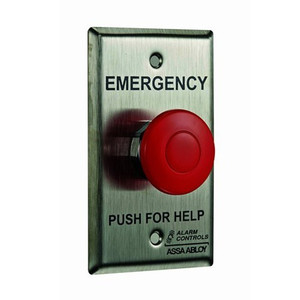
HES PBM-4-4-GR Panic Station Momentary Button
The HES PBM-4-4-GR is a hardwired momentary panic station designed for emergency access control and emergency egress systems. This single-pushbutton unit delivers dual-contact switching—independent normally open (N/O) and normally closed (N/C) circuits—enabling flexible integration with door strike controllers, alarm panels, and access control systems. The 12VDC illuminated pushbutton provides immediate visual confirmation during panic activation, critical for staff awareness and emergency response coordination. Built in the USA with gray powder-coat finish, this unit is engineered for direct hardwired integration into control panel architectures without external relay logic overhead.
Key Features
- Dual-Contact Configuration: Independent N/O and N/C contacts. Allows simultaneous relay actuation (door strike unlock) and circuit monitoring (alarm confirmation) from a single button press.
- Momentary Operation: Contact closure persists only during button press. Integrates directly into standard access control and emergency egress circuits without latching logic.
- 12VDC Illuminated Indicator: LED confirmation light activates with button press. Visual feedback essential in high-stress emergency situations where audible cues may be masked.
- Hardwired Panel Integration: No external power supply or module required—wires directly to control panel terminals. Reduces bill of materials and simplifies installation on retrofit and new-build projects.
- Gray Powder-Coat Finish: Indoor-rated, corrosion-resistant coating. Blends into standard access control installations without aesthetic clash.
- Compact Form Factor: Single-button station occupies minimal wall space. Suitable for jamb mounting, secured enclosures, or panic-bar mounting on emergency exit doors.
The dual-contact design eliminates the need for external relay cards in many panel architectures. One contact triggers the strike unlock (N/O circuit closure), while the second N/C contact can break a monitoring loop, triggering an alarm event in the panel's security logic. This redundancy—actuation + confirmation—is foundational to emergency egress compliance and audit trails. The 12VDC illumination draws minimal current from the panel's control circuit; no dedicated power module necessary on most modern access control systems.
Installation is straightforward on any hardwired panel supporting momentary switching inputs. Mount the unit in a high-visibility location—typically near emergency exits, reception areas, or control rooms—where authorized personnel can reach it without obstruction. The gray finish integrates seamlessly with standard door frame hardware and does not require additional trim rings or bezels. For facilities with multiple egress points, panel programming can link multiple PBM-4-4-GR units to a single strike group, enabling coordinated emergency unlock across a building section with a single wire harness back to the main panel.
Compliance with NFPA 101 Life Safety Code and IBC emergency egress standards requires that panic devices—mechanical or electronic—operate independently of external power. The hardwired design of the PBM-4-4-GR ensures that the button itself functions without reliance on UPS batteries or network availability. The panel controlling the strike must still be backed up, but the button's mechanical switching is inherently fail-safe. Many jurisdictions also mandate that panic actuation produce an audible and/or visual alarm; the 12VDC indicator light satisfies the visual component, while panel-side buzzer logic handles sound. This product integrates with HES electric strike controllers, generic access control panels (Honeywell, DSC, Salto, Gallagher), and alarm monitoring systems supporting basic relay logic.
Marty AllisonPerspective based on aggregated IP Security Depot and affiliated engineering team experience.
We've installed the HES PBM-4-4-GR panic station in a variety of environments—from corporate offices to manufacturing facilities to healthcare campuses—and it consistently delivers straightforward, reliable emergency egress functionality. The dual-contact design is the key differentiator here. In real-world deployments, you're not just unlocking a door; you're documenting the event. One contact trips the strike, the other logs the activation to the panel's event journal. On a 200-person office with three emergency exits, that means three PBM-4-4-GR units wired to a single Honeywell panel can coordinate unlock across all exits while firing a single alarm event. No external relays, no latching timers—the panel handles the logic, the button handles the switch. We've also seen integrators pair this with HES electric strikes on egress-controlled doors where local fire code requires panic capability but the space is too tight for a mechanical lever-style panic bar. The 12VDC illumination has been a practical addition in low-light corridors and data centers; it confirms activation without relying on the building's emergency lighting system, which may be on a separate circuit or backup generator.
Technical Highlights:
- Dual N/O and N/C Contacts: Two independent switching circuits allow one button to both actuate (unlock the strike) and signal (alarm the panel). This eliminates the need for an external relay or logic module, reducing panel wiring complexity and cost.
- Momentary-Contact Operation: Contacts close only during the button press; they open immediately upon release. This is the correct behavior for emergency egress—no need to worry about the button getting stuck in the on position. Panel-side logic controls how long the strike unlocks.
- 12VDC LED Indicator: Draws minimal current (typically 50–100 mA) from the control panel's 12VDC output. The light confirms to occupants and responders that the panic button was activated, reducing confusion in high-stress situations.
- Hardwired Integration—No UPS Required: Because the button itself has no power supply, it operates independently of battery backup. As long as the 24VDC or 12VDC control wiring runs through the panel, the button functions. Many jurisdictions interpret this as inherently fail-safe for egress compliance.
- Gray Powder Coat—Corrosion Resistant: Indoor-rated finish holds up to repeated hand contact, cleaning, and moisture in HVAC environments. Not suitable for outdoor or wet environments; exterior applications require IP67-rated enclosures and marine-grade hardware.
Deployment Considerations:
- Mounting Height & Accessibility: NFPA 101 and IBC require panic devices to be between 34" and 54" from the floor, reachable without tools or keys. Verify the mounting location before rough-in; blocked or obstructed buttons are a code violation and a liability risk.
- Wiring—Panel Compatibility Check: The PBM-4-4-GR is a passive switch—it has no built-in logic. The panel must be programmed to recognize the momentary contact closure and trigger the strike unlock. Test the wiring diagram against your specific panel (Honeywell 5104, DSC Power Series, etc.) before installation to avoid reversed or floating contacts.
- Strike Duration & Failsafe Design: The button does not control how long the strike unlocks—that's the panel's job. If your panel is set to unlock for 3 seconds, the strike releases for 3 seconds regardless of how long the operator holds the button. Coordinate with the integrator to set strike-hold time appropriately for your egress flow rate.
- Multiple Buttons on One Panel: Many multi-exit facilities wire 2–4 panic stations to the same panel. Ensure the panel supports multiple momentary inputs without collision or missed events. Test under realistic conditions (simultaneous button presses) before final sign-off.
- Maintenance & Visual Inspection: The 12VDC LED indicator should be checked quarterly. If the light does not activate on test, the illumination circuit or panel output may be faulty. The button itself is purely mechanical and requires no lubrication, but inspect the housing for cracks or damage that could allow ingress of dust or moisture.
The HES PBM-4-4-GR is the right choice for integrators and facility managers who need straightforward, code-compliant emergency egress without the complexity of external relays or powered logic modules. It works equally well in new access control projects and retrofits where you're adding panic capability to existing strike systems. For more products in the HES emergency access and strike control portfolio, explore the HES catalog.