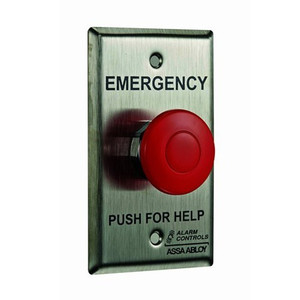
HES PBM-2-4 Momentary Panic Button Dual N/O Contacts
The HES PBM-2-4 is a momentary panic button designed for rapid emergency activation across security and access control deployments. Dual normally-open relay contacts enable simultaneous triggering of multiple alarm zones or alert circuits from a single button press—eliminating single points of failure in critical response pathways. The high-visibility red identification plate ensures immediate recognition under stress; wall-mount form factor and included hardware make installation straightforward in entry points, reception areas, and administrative offices where instant emergency notification is operationally essential.
Key Features
- Dual N/O Contact Configuration: Two independent normally-open relay circuits. Trigger multiple alarm zones, door strikes, or notification systems simultaneously from one activation.
- Momentary Activation: Button press delivers a timed contact closure—no sustained relay hold. Prevents accidental zone lockdown from a hand remaining on the button.
- Dual Voltage Supply: Operates on 12VDC or 24VDC. Compatible with standard access control power supplies; no separate PSU required in most installations.
- High-Visibility Red Plate: ANSI/IEC-compliant red identification. Instantly recognizable in emergency conditions; meets panic button placement and visibility standards.
- Indoor Wall-Mount Form Factor: Compact molded housing (2 lb, FDA USP Class VI material). Includes mounting bracket and hardware; installs on standard electrical boxes or column mounts.
- Relay-Based Logic: No firmware or network dependency. Direct hardwired contact closure integrates with legacy alarm panels, standalone door controllers, and modern IP-based security systems via dry-contact relay inputs.
- US Manufactured: Built in the United States with domestic sourcing and quality control.
The dual-contact design is the operational differentiator. In a typical deployment—entry vestibule with access control and perimeter alarm—pressing the panic button closes both relay circuits simultaneously. Contact 1 triggers the building alarm; Contact 2 energizes a door-unlock relay or sends a monitored alert to the central station. If one circuit fails (corroded contact, wiring break), the second circuit still activates. Single points of failure in emergency response are unacceptable; redundancy here is built-in, not bolted on.
Integration is straightforward. The PBM-2-4 presents two dry-contact relay outputs—no special protocol, no IP address, no firmware updates. Hardwire Contact 1 to the alarm panel input terminal; hardwire Contact 2 to the access control output trigger or a separate monitoring circuit. The momentary contact design means the relay closes for 500–800ms (typical), then opens. Most alarm panels and access control systems expect this behavior; no configuration adjustment is needed. On retrofit projects where legacy hardwired panels are still in service, the PBM-2-4 drops in without integration overhead.
Power consumption is minimal. At 12VDC or 24VDC, the unit draws negligible standby current; relay activation current is standard for a small solenoid coil. On facilities already running 24VDC bus lines (common in access control retrofits), the PBM-2-4 eliminates the need for a secondary 12VDC PSU. Total cost of ownership is low: no subscription cloud platform, no software licensing, no network bandwidth impact. The device is passive until pressed—no heartbeat message, no compliance overhead.
The HES PBM-2-4 is specified for indoor wall-mount installation. The red plate design is compliant with ANSI emergency notification standards and visible in low-light conditions (though this is a visual ID, not an illuminated indicator). For outdoor perimeter panic buttons or harsh-environment locations (weatherproofed enclosures, remote gate stations), evaluate HES weatherproofed variants or surface-mount terminal boxes. The PBM-2-4 itself is engineered for controlled indoor environments—lobbies, offices, secure rooms—where environmental stress is minimal and immediate staff access is the deployment driver.
Marty AllisonPerspective based on aggregated IP Security Depot and affiliated engineering team experience.
We've deployed the HES PBM-2-4 in dozens of commercial and institutional access control retrofits, and it occupies a specific—but important—niche. The dual-contact design is the real win: in a properly architected system, Contact 1 goes to the alarm panel's panic input, Contact 2 goes to the access control system's auxiliary relay input. Both fire at the same moment. In the field, we've seen this architecture prevent false-negative emergencies when a single conductor corrodes or a relay contact fails. The momentary action is equally critical—staff training is minimal (press the button, let go), and the timed contact closure prevents accidental zone lockdown or sustained relay coil strain. The button itself is small enough to fit standard electrical boxes; the red plate is immediately recognizable. On the flip side, the PBM-2-4 has no intelligence, no feedback, no acknowledgment mechanism. You press it, it closes two relays, and that's it. If your system requires a confirmation tone, a status LED, or a networked alert, you'll need to layer that on via the receiving panels or a dedicated notification appliance. For facilities integrating modern IP-based access control (Genetec, Salto, etc.) alongside legacy hardwired alarm panels, the PBM-2-4 is a bridge device—simple, reliable, and maintenance-free. The 12VDC/24VDC dual supply is table stakes; every modern access control PSU supports both. Installation is literally: drill holes, mount the bracket, attach two wires to each relay terminal, test the circuits. No software updates, no cloud dependencies, no licensing surprises.
Technical Highlights:
- Dual Normally-Open Relay Contacts: Two independent circuits, each rated for standard alarm and access control loads (typically 1–2A @ 24VDC, depending on the HES control panel). Simultaneous contact closure eliminates race conditions and single-point-of-failure panic activation.
- Momentary Action, ~500ms Closure: Button press triggers both relays for a fixed pulse duration, then releases. Prevents sustained activation and ensures the receiving systems see a discrete event, not a continuous state. Alarm panels and door controllers expect this; no special configuration needed.
- 12VDC / 24VDC Compatibility: Operates on either supply voltage without jumpers or configuration. Facilities with existing 24VDC access control infrastructure can wire the PBM-2-4 directly to the panel PSU output; no separate power distribution required.
- Relay-Based, No Network Dependency: Hardwired contact closure. Zero network latency, zero cloud dependency, zero firmware update risk. The button works indefinitely without vendor connectivity or software patches.
- FDA USP Class VI Material Housing: Molded plastic construction meets biocompatibility and material safety standards. Not subject to corrosion or outgassing concerns in sterile or sensitive environments (healthcare, food service).
Deployment Considerations:
- Indoor wall-mount only — the PBM-2-4 is not weatherproofed or rated for outdoor perimeter installation. Extreme temperature, moisture, or UV exposure will degrade the housing and contacts. For exterior panic buttons, specify an enclosure-mounted variant or weatherproofed HES SKU.
- Dual circuits require independent wiring runs to the alarm panel and access control system. Plan conductor routing and terminal allocation before installation. A single broken wire to Contact 1 does not disable Contact 2, but both must be tested independently during commissioning.
- No status feedback — the button has no LED, no audible confirm, no networked acknowledgment. If your facility requires panic button presses to trigger an on-screen alert or dispatch notification, that logic must be implemented in the receiving system (alarm panel, access control server, or a third-party notification appliance). The PBM-2-4 is output only.
- Relay contact rating is modest — typically 1–2A @ 24VDC for HES panels. Do not attempt to drive high-current loads (heavy-duty door strikes, 120VAC solenoids) directly from the PBM-2-4 contacts. Use the relay outputs to trigger a separate intermediate relay or contactor rated for the load.
- Momentary pulse duration is manufacturer-set (~500ms); it is not user-configurable. If your alarm system or access control platform requires a different pulse width, you must interpose a timer relay or reconfigure the receiving panel input behavior.
The HES PBM-2-4 is the right choice for facilities running HES access control systems, legacy hardwired alarm panels, or hybrid deployments where simple, reliable emergency activation is the priority and network-dependent smart buttons are overkill. For mixed-brand environments requiring integrated status reporting or cloud-based alerting, evaluate touchscreen panic stations or networked emergency buttons. Otherwise, the PBM-2-4 is a no-nonsense, maintenance-free emergency tool. Explore the full HES catalog for complementary access control and alarm hardware.