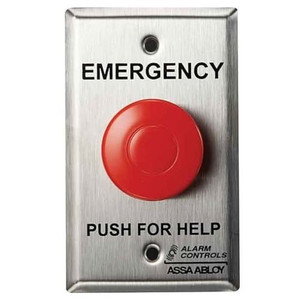
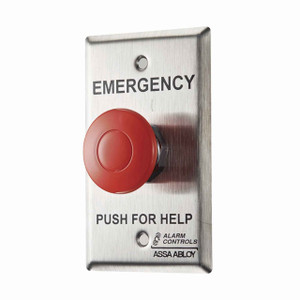
HES PBL-5-1 Latching Panic Button N/O Contact
The HES PBL-5-1 is a latching panic button designed for emergency access control and security panel integration. Unlike momentary buttons that close only while pressed, this device maintains electrical contact closure until manually reset — critical when response time matters and signal loss cannot happen. The single normally-open (N/O) contact rated for reliable switching makes it compatible with any standard access control system or security panel that accepts N/O relay inputs. Stainless steel SG 302 construction resists corrosion in high-moisture and salt-air environments, eliminating the risk of electrical failure from oxidation — a real concern in coastal facilities, parking structures, and humid industrial sites.
Key Features
- Latching Mechanism: Contact remains closed after activation until manual reset, preventing accidental signal dropout during emergency situations. This matters in door unlock circuits where a dropped contact could lock users inside or prevent alarm transmission.
- N/O Contact Switching: Single normally-open contact rated for reliable electrical switching with standard 24VDC and AC relay circuits. Works with any panel that accepts N/O loop closure.
- SG 302 Stainless Steel Housing: Superior corrosion resistance compared to painted steel — allows outdoor or high-humidity installations without protective shelters. No re-coating or maintenance required to prevent rust failure.
- Indoor and Outdoor Rated: Environmental sealing suitable for building lobbies, warehouse exits, loading dock doors, and exterior emergency stations. Check the datasheet for specific IP rating to confirm fit for your environment.
- Standard Access Control Integration: Wires directly into N/O relay inputs on control panels from Honeywell, Bosch, Salto, HID, and other manufacturers. No converters or special interfaces needed.
- Compact Form Factor: Sized for wall-mount installation at standard ADA-compliant heights (typically 42–48 inches above floor). Minimal footprint for corridor and entrance placements.
Typical Applications
- Emergency door unlock circuits paired with access control panels
- Panic alarm signaling to security operations or monitoring centers
- Industrial facility emergency notifications and zone lockdown
- Institutional security (schools, hospitals, government buildings) requiring fail-safe manual override
- Loading dock and warehouse emergency egress systems
Integration & Compatibility
The PBL-5-1 integrates with any access control or security panel that provides an N/O relay input circuit. Standard wiring is simple: connect the button's two terminals (normally open) to the panel's input terminals. Voltage varies by panel — confirm your system supports 12VDC to 24VAC before installation. The latching feature holds the contact closed, so the panel must include a manual reset button or relay control to de-energize the circuit. If your panel lacks a reset function, consider adding an external relay with a latching coil circuit.
For multi-button installations (e.g., multiple emergency exits), wire each PBL-5-1 to its own input channel on the panel or use a consolidation relay to feed a single zone. Consult your panel documentation for daisy-chain or parallel wiring rules.
Ted PerryPerspective based on aggregated and affiliated engineering team experience.
The PBL-5-1 solves a real problem with momentary panic buttons — signal dropout. I've seen sites where a brief contact bounce or electrical glitch caused the panel to miss the alarm trigger. The latching design in this HES model keeps the circuit closed until you manually reset it, which eliminates that failure mode. Stainless steel is a no-brainer for any humid or corrosive environment; painted steel housings degrade fast and become unreliable.
Technical Highlights:
- Latching Contact Hold: N/O contact remains closed after activation until manual reset is invoked on the panel or via external relay reset. Prevents missed emergency signals due to momentary contact bounce or electrical noise.
- SG 302 Stainless Steel: Resists salt spray and high-moisture oxidation — no painted coating to chip or degrade. Suitable for coastal, humid, and car-park installations where carbon steel would fail within 2–3 years.
- Standard N/O Relay Integration: Works with any 12VDC to 24VAC control panel with N/O input terminals. No proprietary electronics or custom wiring — straightforward installation on Honeywell Vista, Bosch Solution, HID VertX, or any legacy system.
Deployment Considerations:
- Confirm your panel includes a manual or automatic reset mechanism for the latch. If it doesn't, you'll need to add an external relay circuit to de-energize the button after the alarm is acknowledged.
- In high-traffic areas (lobbies, exits), the button location and labeling must comply with ADA and NFPA life-safety codes — verify mounting height and signage before installation.
- Test the reset circuit during commissioning. A stuck latch could prevent re-arming the system after an accidental activation or false alarm.
Deploy this button where you need guaranteed signal transmission and don't trust momentary contact reliability — emergency exits in data centers, pharmaceutical facilities requiring contamination lockdown, and secured warehouses where signal dropout could delay response by seconds.
Frequently Asked Questions
Q: Does the PBL-5-1 work with wireless access control systems?
A: No. The PBL-5-1 is hardwired and requires a direct N/O relay input on a control panel. Wireless systems typically use RF door contacts or keypads. If you need wireless panic signaling, consult your panel manufacturer for compatible wireless input modules.
Q: Can I use the PBL-5-1 for both door unlock and alarm signaling?
A: Yes, if your panel supports dual-output relay logic. The single N/O contact can trigger a door unlock relay and simultaneously send an alarm signal to your monitoring center, depending on how the panel's rules are configured. Check your panel documentation for relay output programming.
Q: What's the rated voltage and current for the PBL-5-1 contact?
A: The datasheet specifies contact ratings — download the PDF from the product page to confirm the exact volt/amp limits for your panel's switching circuit. Most standard 24VDC and 24VAC circuits will be within limits, but verification is required before installation.
Q: Is the PBL-5-1 ADA-compliant for button force and size?
A: The button itself meets mechanical actuation standards, but ADA compliance also depends on mounting height (typically 42–48 inches), visual signage, and clear approach space. Consult NFPA 101 and your local building codes for full compliance verification.
Q: Can the PBL-5-1 be used in a wet outdoor environment?
A: Yes, the SG 302 stainless steel housing resists corrosion in wet and humid conditions. However, verify the IP rating in the datasheet to confirm it meets your specific water/dust exposure requirements (e.g., spray vs. splashing).