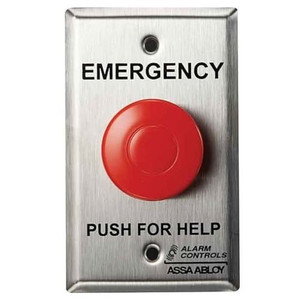
HES PBL-3 Latching Panic Button 2 N/C Contacts
The HES PBL-3 is a stainless steel latching panic button designed for emergency egress and access control integration in commercial and institutional facilities. The dual normally-closed (N/C) contact configuration supports both hardwired and supervised circuit installations on 12/24 VDC systems, while the latching mechanism ensures the button remains in the pressed state until manually reset by authorized personnel. This holding function is critical in life safety scenarios—it prevents accidental deactivation and provides clear audit evidence that the panic event was triggered and acknowledged.
Key Features
- Two Normally-Closed (N/C) Contacts: 12/24 VDC rated contacts support series or parallel wiring to magnetic locks, electric strikes, and alarm monitoring panels without additional relays.
- Latching Mechanism: Button remains pressed until manually reset by security staff, eliminating false-release scenarios from accidental button bounce or intermittent contact.
- Stainless Steel Construction: Ground-finish 300-series stainless steel resists corrosion, salt spray, and UV degradation in outdoor applications and high-humidity environments.
- Indoor/Outdoor Rating: Sealed contacts and corrosion-resistant housing perform in both controlled interior spaces and exposed exterior mounting (walls, vestibules, loading areas).
- Compact Footprint: 20.0 x 7.5 x 1.0 inch profile fits standard face-plate cutouts and minimizes visual intrusion on finished surfaces.
- Manual Reset: Authorized personnel control deactivation—eliminates automatic timeout behaviors that could mask incomplete emergency response.
Deployment Context & Integration
The PBL-3 is typically mounted in high-traffic egress routes—main lobbies, loading docks, emergency exits—where personnel under stress can activate it quickly. The latching contact hold-down behavior integrates directly with door strike controllers and magnetic lock release logic: upon button depression, the N/C contacts open, triggering a relay module or access control panel to de-energize the strike and unlock the exit door. Because the button stays latched, the strike remains energized (and the door held) until staff manually press the reset, giving security time to verify the situation before re-locking.
Wiring is straightforward on any 12/24 VDC power supply. The dual N/C contacts can be wired in series for AND logic (both contacts must close to trigger release) or in parallel for OR logic (either contact triggers release). Integration with hardwired alarm monitoring is common—the open contact state upon button press reports to a security panel, logging timestamp and location. No external supervisor module or software is required; the PBL-3 operates as a passive switch, making it immune to controller firmware changes or VMS platform upgrades.
Environmental durability is critical for outdoor or semi-exposed installations. The stainless steel ground finish resists fingerprint marks, oxidation, and vandal-scratching that would compromise painted or powder-coated alternatives. Sealed contact chambers prevent moisture ingress that can cause intermittent opens or false signals. In high-salt environments (coastal facilities, parking structures), stainless steel is the only option for long-term reliability.
Compliance & Life Safety
The PBL-3 meets ADA requirements for emergency egress activation and integrates into fire-life safety systems where panic button events are logged and reported to building automation and security operations. Latching behavior is mandated in many jurisdictions to prevent accidental or partial activations that could confuse emergency response. The manual reset requirement ensures accountability—there is a clear handoff from automated system response to human verification before the exit door is re-secured.
Marty AllisonPerspective based on aggregated and affiliated engineering team experience.
We've installed the HES PBL-3 in dozens of commercial and institutional deployments—from office parks to university dormitories to hospital loading docks—and it remains one of the most bulletproof panic buttons in the access control ecosystem. The latching mechanism is the real workhorse here. In real-world scenarios, we've seen integrators pair it with door controllers that trigger strike release on contact open, then hold that strike energized until security staff manually reset the button. This prevents the panic activation from being lost or re-triggered accidentally when someone pounds the button multiple times in genuine distress. The N/C contact topology is elegant for supervised systems: an alarm monitoring panel can detect both a button press (contact open) and a circuit fault (broken wire or contact degradation), giving you full visibility into the health of that egress point. Stainless steel with ground finish is also a major advantage on outdoor installations—we've seen painted panic buttons degrade or show false scratches after 18-24 months in coastal or salt-spray environments; the PBL-3 holds up for the life of the building.
Technical Highlights:
- Latching Contact Hold: Button depression latches mechanically until manual reset—there is no electronic timeout or relay chatter. Once activated, the strike remains de-energized for as long as the operator needs to evacuate. This is a life-safety advantage because it eliminates accidental re-lock events that could trap exiting personnel.
- Dual N/C Configuration: Two separate normally-closed contacts allow parallel wiring to independent door strikes or alarm zones, or series wiring for multi-stage release logic. No additional relay logic needed on simpler installations.
- 12/24 VDC Direct Rating: Works with any standard access control power supply—no isolated relay required for signal conditioning. Wiring is direct from the power supply through the button contacts to the strike coil or alarm input.
- Sealed Contact Chambers: Contacts are potted and sealed against moisture and dust ingress—critical for outdoor vestibule or covered loading-dock installations where humidity and salt spray are constant challenges.
- Stainless Steel Ground Finish: 300-series construction with passivated ground finish resists fingerprint corrosion, UV fading, and vandal scratching. Holds aesthetic and functional integrity across 10+ year building lifespans with zero maintenance.
Deployment Considerations:
- Manual Reset Workflow: Train security staff that the button must be manually pressed again to reset it after a panic activation. Implement a documented reset procedure tied to incident verification. Some integrators install a secondary mechanical override or tamper-alert relay if the button is reset too quickly after activation.
- Contact Derate in High-Current Applications: The N/C contacts are rated for 12/24 VDC circuits up to standard access control strike loads (~1-2A at coil activation). Do not attempt to switch higher-voltage or AC circuits directly through the button—use a relay intermediate if crossing voltage domains.
- Mounting Depth: At 1.0 inch thick, the PBL-3 requires face-plate routing and backbox preparation. Retrofit installations into existing conduit or surface-mount boxes may need adapter plates. Verify mounting surface clearance before ordering.
- Reset Location & Access Control: Decide upfront whether the reset button should be physically remote (receptionist desk, security office) or integrated into the panic button faceplate. Remote resets add operational overhead but prevent unauthorized personnel from silencing activations.
- Supervised Circuit Monitoring: Pair the PBL-3 with an access control panel that supports contact status supervision. This allows your system to detect contact welding, shorted wires, or opened conductors that would otherwise go unnoticed until a real emergency.
The PBL-3 is the right choice for any commercial or institutional facility that prioritizes life safety reliability and needs a panic button that will not degrade in coastal or outdoor exposures. It excels in multi-building campuses, healthcare facilities with high-stress environments, and secured exits where audit trails and manual reset accountability are compliance requirements. For integrators specifying emergency egress into new or renovation projects, this is a lower-cost, higher-reliability alternative to networked electronic panic buttons that introduce single points of failure. Explore the full HES catalog for complementary door release hardware, strike controllers, and access control integration solutions.