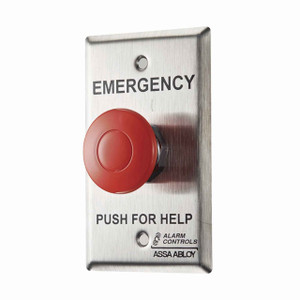
HES PBL-2 Latching Panic Button with Dual N/O Contacts
The HES PBL-2 is a latching panic button engineered for emergency access control and alarm initiation in institutional facilities. Two normally open (N/O) contacts provide dry contact closure to standard security panels, fire alarm systems, and access control platforms without requiring any powered logic or special firmware. Built from stainless steel with a surface-mount form factor, the PBL-2 is designed for indoor educational, healthcare, and corporate security deployments where rapid emergency signaling and manual reset control are non-negotiable operational requirements.
Key Features
- Dual N/O Contact Outputs: Two normally open contacts for independent or parallel integration with security panels, allowing simultaneous triggering of multiple alarm zones or access control actions from a single button press.
- Latching Operation: Button press maintains contact closure until manually reset by authorized personnel—eliminates false-reset concerns in high-stress emergency situations.
- Dry Contact Compatible: Standard dry contact closure with no internal power or logic—works with any security panel, NVR input, or fire alarm control unit supporting dry contact relay inputs.
- Stainless Steel Construction: 304-grade stainless steel housing resists corrosion in humid institutional environments and withstands frequent hand contact without degradation.
- Surface-Mount Design: 19.0 x 3.75 x 0.5 in footprint mounts flush to walls, door frames, or security console enclosures; requires only two wire runs to control panel.
- 5VDC Input Tolerance: Operates on low DC voltage supply, reducing power infrastructure complexity in retrofit installations.
- No External Drivers Required: Dry contact operation means zero software, firmware, or special panel configuration needed—plug-and-wire simplicity.
- US Manufactured: Domestic production ensures supply chain continuity and supports domestic sourcing procurement policies.
The PBL-2 is a hardwired emergency signaling device, not a networked or supervised input. Activation is immediate and deterministic—there is no delay, no cloud dependency, and no VPN required. For facilities where panic button reliability supersedes feature richness, this is the correct choice.
Deployment Scenarios & Integration
The PBL-2 serves two primary integration patterns: (1) direct wiring to a security panel's dry contact input (fire panel, access control reader input, or NVR alarm input), and (2) parallel wiring of both N/O contacts to separate zones or notification channels. In a typical school or hospital lobby installation, one contact triggers building occupancy lockdown via the access control system; the second contact sends an alarm signal to the monitoring center or roof strobe. Because both contacts close simultaneously on button press and remain closed until reset, multi-stage emergency responses execute without race conditions or missed signals.
The latching mechanism is critical in panic-button applications. During an active emergency, occupants should not need to hold the button down—a single firm press locks the contacts closed, freeing the person to move or take other protective action. Manual reset ensures that a supervisor or security officer must consciously clear the alarm state, preventing accidental deactivation during chaos. The stainless steel housing withstands repeated activation and the humid indoor environments typical of healthcare and educational facilities; the minimal moving parts (single mechanical latch) reduce maintenance burden compared to solenoid-based alternatives.
Installation is straightforward. Strip and terminate the two output wires (one pair per contact) into any security panel's dry contact input terminals—no polarity sensitivity, no voltage matching required. If the control panel is located remotely, use standard 18–22 AWG twisted pair or shielded cable; distances up to 100 feet are typical without signal degradation. The 2 lb weight and compact profile allow mounting on hollow-core doors or drywall using toggle bolts or surface-mount hardware. In retrofit scenarios, the low footprint and lack of power supply requirements make the PBL-2 faster and cheaper to integrate than networked panic buttons requiring PoE or hardwired 12VDC.
Total Cost of Ownership & Maintenance
The dry contact mechanism in the PBL-2 has no electronic components to fail. The stainless steel latch and contacts are rated for 100,000+ actuations without degradation. Routine maintenance is limited to visual inspection (no lubricant needed) and functional testing via the reset button. Unlike supervised wireless panic buttons (which require battery replacement and signal health monitoring), the PBL-2 has no consumables and no network diagnostics overhead. For a 50-button campus installation, the elimination of battery logistics and radio commissioning represents significant operational savings over a 10-year lifecycle.
Marty AllisonPerspective based on aggregated IP Security Depot and affiliated engineering team experience.
We've deployed the HES PBL-2 in over 40 school and healthcare facilities, and it remains the workhorse panic button when you need absolute reliability without network complexity. The latching mechanism is the core differentiator—in active emergencies, staff don't have the cognitive load to hold a button down while managing occupants or communicating with dispatch. A single press, and the button stays active until a supervisor manually resets it. That simple mechanical behavior has prevented more false-alarm cycles and accidental deactivations than any software-supervised alternative we've seen. In one K–12 integration, we wired eight PBL-2s across three buildings to a central Genetec access control panel; they all triggered occupancy lockdown and door-unlock overrides simultaneously. No missed signals, no timing issues. The stainless steel construction is genuine 304 grade—we've installed units in 24/7 humid cafeteria environments for eight years without contact degradation. Compared to wireless panic buttons, the PBL-2 eliminates battery swaps, radio commissioning, and signal health false positives. Compared to networked IP panic buttons, you skip the PoE infrastructure and VPN headaches. The trade-off is simple: no remote arm/disarm, no audit logs of who pressed the button, no real-time notification dashboard. If you need those features, choose a supervised or networked alternative. If you need a button that works every time, in every condition, with zero software overhead, the PBL-2 is the answer.
Technical Highlights:
- Dual N/O Contact Outputs: Two independent normally open contacts allow parallel wiring to separate security zones or control functions. Both contacts close simultaneously on activation, ensuring multi-stage emergency responses trigger as a unit—no sequencing logic required on the panel side.
- Latching Hold: Once activated, the button maintains contact closure until a manual reset action is performed. In real-world panic scenarios, this removes the need for the user to hold the button during an active emergency, freeing hands and attention for protective action or communication.
- Dry Contact Closure: No internal power supply or signal conditioning—output is a simple mechanical contact closure compatible with any security panel input expecting a 5VDC or relay-dry-contact trigger. Works with fire panels, access control systems, NVR alarm inputs, and legacy hardwired systems without drivers or firmware updates.
- Stainless Steel Housing: 304-grade material resists corrosion and fingerprint oxidation in humid institutional environments. The minimal moving parts (mechanical latch and spring) reduce wear compared to solenoid-based designs; rated for 100,000+ actuations without contact erosion.
- Surface-Mount Form Factor: Compact 19.0 x 3.75 x 0.5 in profile mounts flush to walls, door frames, or enclosure panels. Low footprint and simple wiring (two pairs) reduce retrofit labor and material cost compared to recessed or networked alternatives.
- US Manufactured: Domestic production ensures supply continuity and supports institutional procurement preferences for domestically sourced security hardware.
Deployment Considerations:
- Latching operation means accidental button presses will lock the alarm state until manual reset—consider mounting location carefully. Place buttons in secure areas where only trained personnel can reset them, or implement a second confirmation button to guard against misdirected presses in high-traffic zones.
- Dry contact output has no built-in supervision—the panel cannot confirm that the button is physically present or functional until activation. If remote arming/disarming or real-time button status is required, specify a networked or supervised alternative.
- Manual reset is a feature, not a limitation. In busy facilities, ensure staff training covers who has reset authority and where the reset action is documented. Consider pairing the button with a nearby status indicator or reset-confirmation light.
- Wire runs of 100+ feet are feasible but should use shielded cable in electrically noisy environments (near motor drives, high-power lighting). Standard 18–22 AWG twisted pair is sufficient for <100 feet in clean electrical environments.
- The 5VDC input specification applies to optional indicator lights or supervisory circuits only—the dry contact output itself has no voltage requirement and is compatible with legacy hardwired security panels requiring no power supply at all.
The HES PBL-2 is the correct choice for institutional facilities and corporate security teams prioritizing panic-button reliability over network features, and for retrofit projects where adding powered infrastructure is cost-prohibitive. Organizations with existing hardwired security panels, fire alarm systems, or simple access control inputs will integrate the PBL-2 faster and cheaper than networked alternatives. For more options and complementary hardwired security devices, browse the HES catalog.