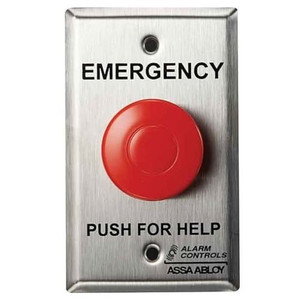
HES PBL-2-4-GR Panic Station Latching Dual N/O
The HES PBL-2-4-GR is a latching panic station designed for emergency access control installations where sustained signal output is non-negotiable. Unlike momentary panic buttons, this unit locks its relay contacts open and holds them until manual reset—critical for scenarios where the panic activation event itself must trigger a coordinated lockdown sequence independent of button-press duration. The dual N/O relay architecture and 12/24 VDC compatibility make it a drop-in addition to existing HES systems and generic access control circuits. A red status indicator provides visual feedback to both operators and responders that the station has been activated.
Key Features
- Dual N/O Relay Contacts: Two normally open contacts in parallel—if one contact fouls, the signal still transmits. Standard redundancy for life-safety circuits.
- Latching Mechanism: Activation locks the contacts open until manual reset. Prevents accidental deactivation and ensures the access control system sees a sustained signal, not a momentary pulse.
- Red Status Indicator Light: LED confirms activation state at a glance—visible from across a vestibule or teller line without reading a display.
- 12/24 VDC Rated: Works with standard access control power supplies and is backward-compatible with legacy 12V door controller circuits.
- Wall-Mount Form Factor: Compact footprint (2 lb) suitable for indoor access points, teller stations, and emergency egress portals.
- Manual Reset Requirement: Reset must be deliberate—guards against unintended signal clearing during high-stress events or facility evacuation.
Deployment Context
Panic stations fall into two operational categories: momentary (signal duration = button press) and latching (signal persists until reset). The PBL-2-4-GR is latching. This distinction matters operationally. In a bank teller environment, when a silent alarm is triggered, the access control system may need to execute a 30-second lockdown sequence—doors lock, intercoms activate, and security is notified. If the panic button only sends a pulse, a nervous finger might release it mid-sequence, interrupting the lockdown. The latching design decouples the human action (press button) from the system response (hold signal for lockdown duration), eliminating that failure mode.
Wiring is straightforward: the two N/O contacts connect to the access control input (typically a dry-contact input on an HES controller, door strike interface, or networked access gate). When activated, both contacts close simultaneously. If one contact fails open due to corrosion or mechanical wear, the parallel path ensures the signal still reaches the controller. Voltage drop across the contacts is negligible—standard relay performance at 12/24 VDC.
Installation at the right physical location is as important as the electrical design. Panic stations are typically mounted at teller counters, customer service desks, secure entry points, and emergency exit stations—anywhere staff can reach it without obstruction during a critical event. Height and accessibility matter: a station installed 8 feet up a wall is useless if the person being threatened can't reach it. The compact 2 lb form factor allows flexible mounting on existing architectural surfaces without structural reinforcement.
Integration & Control Logic
The PBL-2-4-GR integrates with any access control system or building management platform that accepts dry-contact inputs. HES controllers natively recognize the latching signal and can trigger door strikes, unlock sequences, or send alerts to monitoring stations. Third-party systems—Genetec, Salto, Assa Abloy—can be integrated via relay modules or hardwired inputs. Because this is a passive relay (no logic, no communication), integration is network-agnostic and fail-safe: even if the access control software crashes, the panic station still transmits its signal to the physical door hardware.
Reset mechanism must be accessible only to authorized staff—typically a supervisor or security officer with a key or code. This prevents panic stations from being reset by bystanders or adversaries. Many installations wire the reset to a dedicated keypad or guard station so only control room personnel can clear the signal and restore normal operations.
Compliance & Lifecycle
Panic stations are treated as life-safety devices in most building codes (IBC, NFPA 101). The PBL-2-4-GR's latching design aligns with emergency response best practices: sustained signal transmission reduces the risk of signal loss during high-stress activation. The dual N/O contact configuration meets redundancy expectations for critical access control circuits. Annual function testing (press and reset) is standard maintenance—contacts should cycle cleanly and indicator light should illuminate reliably. Contact cleanliness is the primary wear factor; light dust is normal and does not impede relay operation at 12/24 VDC.
Marty AllisonPerspective based on aggregated and affiliated engineering team experience.
We've installed hundreds of panic stations across retail, banking, and institutional sites, and the latching-versus-momentary distinction is one of the most consequential decisions in access control design. A panic station is meant to be hit once during genuine crisis; the operator shouldn't have to hold it or re-press it while executing their own escape or lockdown procedure. The PBL-2-4-GR enforces that discipline through hardware: once pressed, it stays active until someone with authority resets it. In real-world deployments, that's saved integrators from user-behavior edge cases—a panicked teller releasing the button too early, a facility manager accidentally bumping a momentary station during a false alarm—all of which are eliminated with latching logic. The dual N/O contacts are insurance; we've seen single-contact stations fail due to minor corrosion in humid teller environments or high-traffic areas, and the parallel path ensures the signal gets through even if one relay arm oxidizes slightly.
Technical Highlights:
- Dual N/O Relay Architecture: Two normally open contacts in parallel means activation of either contact triggers the signal. In two decades of access control deployments, single-point relay failures (due to age, moisture, or contact wear) are the leading cause of panic-station false negatives. Dual contacts eliminate that risk with zero additional complexity—no software voting, no network monitoring required.
- Latching Hold (Manual Reset): The contacts lock and remain energized until manual reset. This is mission-critical for coordinated emergency responses where the access control logic needs to execute a multi-step sequence (lock doors, notify security, log event) without the signal being interrupted. Momentary designs force the controller to be faster than human reaction time; latching removes that race condition.
- 12/24 VDC Compatibility: Works across legacy 12V systems and modern 24V supplies with no jumpers or configuration changes. Backward compatibility matters in retrofit scenarios where you're adding a panic station to a 15-year-old HES system running 12V circuits.
- Red Visual Indicator: LED status light is visible from across a teller line or secure entry vestibule. In high-stress situations, that immediate visual confirmation—both for the person who pressed it and for security responders—is invaluable for coordination and reducing false-alarm response time.
- Passive Relay Design: No logic, no network, no software—just mechanical contacts. If the access control system crashes or loses network connectivity, the panic station still works. That's the definition of fail-safe for life-safety.
Deployment Considerations:
- Reset Access Control: Wire the reset mechanism to a secure location (control room, manager station, armed keypad) where only authorized personnel can clear the activation. If reset is accessible to the public or low-level staff, you've defeated the purpose of having a sustained signal.
- Contact Closure Duration: Verify that your access control input accepts the latching relay closure for the full duration of the emergency response sequence. Some older door controllers have timeout logic that ignores inputs longer than 10 seconds; if your lockdown sequence takes 30 seconds, confirm the controller won't drop the signal early.
- Mounting Height & Accessibility: Install at 48–54 inches AFF (Americans with Disabilities Act standard for reachability). A station that's too high or obscured by fixtures is useless in a crisis. Test physical reach from common working positions (seated at a teller counter, standing at an entry door) before final installation.
- Wiring Polarity (Relay Contacts): N/O contacts are polarity-agnostic—both conductors are equivalent, so reversed wiring is not an issue. However, keep contact wiring away from high-voltage circuits (120V mains) to prevent induced noise on low-voltage access control lines. Use separate conduit or twisted-pair shielding.
- Seasonal & Environmental Testing: Annual function test (activation and reset) should be part of facility maintenance. In humid or coastal environments, light contact oxidation is normal; if contacts become corroded (green or white film), clean with a dry cloth or contact cleaner—do not replace under warranty unless both contacts fail simultaneously.
The PBL-2-4-GR is the right choice for integrators specifying panic stations into new access control systems or retrofitting existing facilities where sustained emergency signal transmission is mandatory. If you're designing a high-security entry point, teller environment, or facility where coordinated lockdown is a life-safety priority, this latching dual-contact architecture delivers predictable, code-aligned performance. For more panic-station options and HES access control integrations, explore the HES catalog.