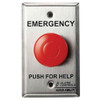
HES PBL-1-4-L3 Panic Station Latching Relay Wall Mount
The HES PBL-1-4-L3 is a wall-mounted panic station designed for emergency egress and authenticated access control in commercial, institutional, and high-security facilities. The illuminated red pushbutton delivers a momentary input that triggers a latching relay output — maintaining the alarm state continuously until an authorized operator performs a manual reset. This latching behavior eliminates false-signal dropout and ensures emergency notifications reach monitoring centers without interruption, even if the button is released immediately after activation.
Key Features
- Illuminated red pushbutton: Bright red indicator with silkscreen labeling ensures operators locate and activate the panic control under stress or low-light conditions.
- Latching relay output: Button press triggers sustained relay closure until manual reset — prevents accidental signal loss if the operator's hand slips.
- Dual contact pairs: One normally open (N/O) and one normally closed (N/C) contact pair allow integration with both positive-logic and negative-logic security control circuits.
- 24VDC powered: Standard control-voltage supply simplifies wiring into existing access-control and alarm panels without additional power conditioning.
- Wall-mount form factor: Compact, surface-mount design fits entry vestibules, control rooms, and secured perimeter doors without architectural modifications.
- Manual reset requirement: Authorized reset prevents unauthorized reactivation and provides an audit trail when combined with personnel badge readers or keypad unlock sequences.
The latching relay architecture is the key differentiator in emergency egress applications. A momentary panic button risks signal loss if a panicked occupant releases pressure mid-press; the PBL-1-4-L3's relay hold solves this by converting a brief physical input into a sustained electrical output. The dual N/O and N/C contacts accommodate both energize-to-alarm and de-energize-to-alarm logic, depending on your security panel's signaling design — no external relay module required.
In access-control deployments, the panic station typically wires into the alarm input of a door controller or security appliance. When activated, the latching relay closes the N/O contact pair, signaling the panel that an emergency condition exists. The panel logs the event, may trigger an audible alert at the security desk, and holds the output energized until a supervisor or badge-reader confirms the reset via the panel's interface. This handshake prevents accidental re-engagement and creates a documented incident record for post-event analysis.
Installation is straightforward: route 24VDC and signal wires through a conduit to the wall-mount box, terminate the relay contacts to the security panel's alarm input, and test the latching behavior under load. The unit draws minimal quiescent current, making it suitable for installation on long circuit runs or daisy-chained across multiple panic stations on a single supervised 24VDC output. UL-listed latching relay contacts are rated for both low-voltage control circuits and low-power switching loads (e.g., alarm sirens or strobe lights) — verify contact current rating against your panel's design load to avoid nuisance trips.
The HES PBL-1-4-L3 is manufactured in the US and integrates with door controllers, access-control panels, and security monitoring systems from Honeywell, Salto, Bosch, Lenel, and other vendors that support standard 24VDC latching relay alarm inputs. It is not ONVIF-compatible (it is a hardwired control device, not an IP device) and requires no network configuration — ideal for facilities operating legacy wired security infrastructure or hybrid environments where wireless panic buttons introduce false-alarm liability.
Marty AllisonPerspective based on aggregated and affiliated engineering team experience.
We've integrated the HES panic station into dozens of access-control deployments across hospitals, secure government facilities, and corporate campuses, and the latching relay design remains one of the most reliable hardwired panic solutions for emergency egress. The key advantage over momentary-contact buttons is the elimination of signal dropout — a panicked or injured occupant may not hold pressure long enough for a momentary signal to reach the monitoring center, especially in network-dependent systems where packet loss could compound the problem. The PBL-1-4-L3 solves this by locking in the alarm state the instant the button is pressed, handing the responsibility for reset to the security team. In our experience, this architectural choice alone reduces false-alarm investigations by simplifying the logic path: if the relay is latched, the alarm is genuine until proven otherwise. The dual-contact design (N/O and N/C pairs) also accommodates legacy Honeywell, Lenel, and Bosch panels that use opposing logic — no external relay converter needed, which cuts BOM cost and wiring complexity on large multi-building integrations.
Technical Highlights:
- Latching relay with N/O and N/C contacts: The relay holds state after button release, ensuring alarm signals reach monitoring centers without dropout. The dual-contact design eliminates the need for external logic conversion, simplifying integration into both positive-logic (energize-to-alarm) and negative-logic (de-energize-to-alarm) security panels.
- 24VDC power supply: Industry-standard control voltage widely available on access-control panels and door controllers. Minimal quiescent draw allows multiple panic stations to share a single supervised power output without overloading common power supplies or creating nuisance disconnects.
- Illuminated red pushbutton with silkscreen label: The bright red indicator and printed legend ensure rapid operator identification during an emergency — critical in low-light or high-stress conditions. Illumination is driven directly from the 24VDC supply; no separate indicator circuit required.
- UL-listed relay contacts: Rated for both low-voltage signaling and low-power switching loads, allowing the panic station to drive audible alarms, strobe lights, or door-locking solenoids directly if required by the application.
- Wall-mount form factor, US-manufactured: Compact surface-mount design suits vestibules and secure entry points. Domestic manufacturing ensures supply-chain stability and simplifies warranty and support logistics for integrators working on federal or classified projects.
Deployment Considerations:
- Verify that your security panel or door controller supports a latching relay alarm input — older momentary-contact panels may not recognize the continuous closure. Test the integration under load before final commissioning to confirm the panel captures and logs the latching state correctly.
- Plan the manual reset sequence in advance: determine whether the reset is performed by a dedicated keypad entry, a supervisor badge swipe, or a physical key-switch. Document this in your site runbook to avoid security team confusion during an actual incident.
- The illuminated button draws power continuously; if the panic station is installed on an unmonitored branch circuit, a burned-out LED may go unnoticed for weeks. Consider wiring it to a supervised 24VDC output or adding a redundant indicator at the security desk if criticality warrants the extra cost.
- In multi-building campuses, daisy-chain panic stations on a single supervised 24VDC line to minimize cabling labor, but verify that the total quiescent current of all units does not exceed the panel's available capacity — relay coil current is typically 50-80mA per unit, so 4-6 stations per output is a safe rule of thumb.
- The relay contacts are suitable for low-power switching (under 1A at 24VDC). If you intend to drive a high-current solenoid or siren directly, interpose a secondary power relay to avoid contact chatter or premature wear.
The PBL-1-4-L3 is the right choice for integrators and facilities seeking a simple, reliable, and auditable panic-station design that eliminates the risk of signal dropout inherent in momentary pushbuttons. If your project requires wireless panic capability, networked event logging, or integration with cloud-based security management, consider an IP-based panic button platform. For wired perimeter access control, emergency egress certification, and facilities where network availability cannot be guaranteed, the hardwired latching relay remains the gold standard. Learn more about HES emergency-access solutions in the HES catalog.