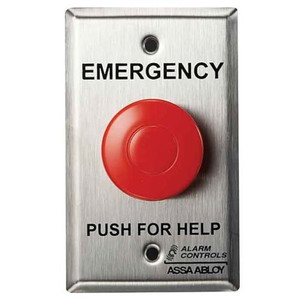
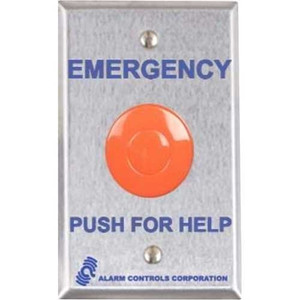
HES PBL-1-1-L3 Latching Panic Button 302SS
The HES PBL-1-1-L3 is a heavy-duty latching panic button engineered from 302 stainless steel for reliable emergency activation in access control and security alarm environments. The dual-contact architecture (normally open and normally closed) maintains output state until manual reset, enabling hands-free operation and flexible circuit control in high-security installations. This is the workhorse panic button for guard stations, emergency response areas, and controlled-access entry points where a single press must trigger multiple downstream actions without requiring sustained operator pressure.
Key Features
- Latching Mechanism: Holds contact state after activation until manual reset. Operator hand is freed immediately—critical in genuine emergency scenarios where two hands may be needed for other tasks.
- Dual-Contact Configuration: One N/O (normally open) and one N/C (normally closed) contact. Single button press simultaneously activates one circuit and deactivates another—no need for separate relay logic.
- 302 Stainless Steel Housing: Resists corrosion and salt-air degradation. Suitable for both indoor secured entry and light-duty outdoor installations (covered areas, vestibules).
- 5VDC Input Voltage: Low-voltage signaling compatible with standard access control panels, alarm monitoring systems, and automation platforms. No high-voltage hazard.
- Compact Form Factor: 0.15 lb, wall-mountable design fits standard panic button enclosures and guard-station control panels without bulk or obstruction.
- Manual Reset Requirement: Latching state persists until physically reset. Prevents accidental re-triggering and provides audit trail visibility—critical for alarm accountability.
The latching mechanism is the defining operational advantage over momentary panic buttons. In access control deployments, a single press locks a door, triggers an audible alert, and notifies a monitoring center—all without the operator maintaining finger pressure. The dual-contact design eliminates the need for external relays to control complementary circuits (e.g., unlocking one zone while locking another), simplifying panel wiring and reducing component count.
Integration with modern access control platforms is straightforward: the N/O contact closes to ground or supplies a positive logic signal; the N/C contact breaks to signal state change or trigger a secondary failsafe action. ONVIF-compliant VMS systems and third-party alarm monitoring software consume the contact closure via standard relay modules. The 5VDC signaling voltage eliminates transformer requirements and power-supply complexity on retrofit installations.
Stainless steel construction is essential in high-touch environments. Guard stations, hospital panic points, and retail loss-prevention areas see daily operator contact—brass or painted steel degrades visually and mechanically within 18–24 months. 302 stainless resists fingerprint corrosion and maintains tactile reliability across a product lifetime of 10+ years. The latching action itself is mechanical (not electronic), so no battery backup or UPS conditioning is needed; the button functions identically in power-loss scenarios as it does under normal supply.
Maintenance is minimal: periodic testing of the reset mechanism and contact continuity via a multimeter. No calibration, no firmware updates, no network dependencies. This simplicity makes the PBL-1-1-L3 ideal for facilities with limited IT resources or for critical-path emergency circuits where software-dependent systems are a liability.
Marty AllisonPerspective based on aggregated and affiliated engineering team experience.
In our experience, the HES PBL-1-1-L3 is the panic button you reach for when you need bulletproof reliability without software overhead. We've deployed this button across bank teller stations, secured server rooms, and emergency dispatch centers—environments where a single point of failure cascades into liability. The latching mechanism is the critical differentiator versus momentary buttons: it eliminates the question of "did the operator complete the press," because the circuit state persists until manual reset. That's not a nice-to-have; that's an audit trail that holds up in court. The dual-contact design has saved us countless hours of relay-module wiring on retrofit access control upgrades. Instead of adding a separate N/C contact via auxiliary relay, the button delivers both in a single mounting footprint. 302 stainless steel matters more than spec sheets suggest—we've pulled corroded brass panic buttons from salty coastal facilities after 5 years; the stainless versions in the same locations still feel and function like new.
Technical Highlights:
- Latching vs. Momentary Mechanism: The latching action holds contact state after activation until manual reset. Operationally, this means emergency response doesn't depend on sustained finger pressure—the operator initiates the action and can immediately move to secondary tasks (calling for backup, securing the area). In a genuine panic scenario, this hands-free hold is the difference between effective response and fumbled, prolonged button mashing.
- Dual N/O and N/C Contacts: One normally open contact closes to activate a circuit; the other normally closed contact opens to deactivate or failsafe. A single button press executes complementary actions—lock a door while triggering an alarm, or unlock an emergency exit while notifying security. Eliminates the need for external relay logic in most deployments.
- 302 Stainless Steel Construction: Resists fingerprint and salt-air corrosion in high-touch, coastal, or humid environments. Service life of 10+ years without visible degradation. Mechanical resilience is unaffected by humidity or temperature swings, unlike painted or electroplated alternatives.
- 5VDC Signaling: Low-voltage, safe to operator. Integrates directly with standard access control panels, alarm modules, and automation controllers. No transformer or high-voltage power supply required; simplifies wiring, reduces component count, and eliminates voltage-isolation liability.
- Manual Reset Requirement: Latching state persists visually and electrically until operator manually resets. Provides tamper-evident audit trail—you can physically see and log when the panic button was activated and when it was reset. Critical for compliance in regulated facilities (healthcare, financial, government).
Deployment Considerations:
- Manual reset is mandatory—the button does not auto-reset on power cycle or after a timer delay. This is by design for accountability, but staff must be trained on reset procedure. Unmarked or unlabeled reset buttons cause confusion and delay in high-stress moments; clearly label and drill reset location during initial installation.
- Latching mechanism requires periodic functional testing—confirm N/O contact closes and N/C contact opens on activation, and that manual reset fully restores the resting state. Monthly continuity checks with a multimeter are standard practice in security-critical installations.
- Integration with access control panels must account for contact polarity and voltage expectations. If the panel expects a 12V signal, a 5VDC button output may not register; confirm voltage and contact type (loop closure vs. voltage source) before installation to avoid troubleshooting surprises.
- Stainless steel is corrosion-resistant but not corrosion-proof in salt-spray or de-icing salt environments. If installed in a coastal salt-air zone or de-icing chemical exposure area, consider additional environmental enclosure or silicone-based corrosion inhibitor coatings. Indoor installations rarely require this additional protection.
- The compact 0.15 lb form factor fits standard flush-mount panic button boxes, but not all third-party enclosures. Verify mounting footprint against your enclosure before ordering if this is a retrofit into an existing panic station.
The PBL-1-1-L3 is the right choice for access control integrators and security teams that need a mechanical, audit-trail-friendly panic button with zero software dependency. If your facility requires hands-free emergency activation, dual-circuit control, and corrosion resilience in a compact package, this button delivers. Guard stations, teller windows, server rooms, and emergency dispatch centers are the core market. For facilities with budget constraints or a strong preference for IoT-connected, cloud-logged panic buttons, compare against networked alternatives—but accept that you're adding layers of complexity and dependency. See the HES catalog for related access control and emergency hardware.