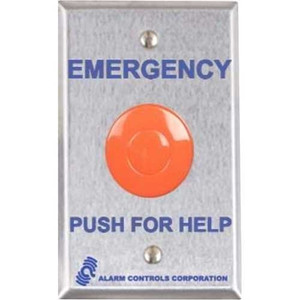
HES PBL-1 Latching Panic Button Stainless Steel
The HES PBL-1 is a latching panic button engineered for access control systems, alarm panels, and emergency lockdown circuits where reliable activation and minimal false-trigger noise matter. The latching mechanism holds circuit state after a single press, eliminating the need for operators to maintain pressure — a critical advantage in high-stress emergency scenarios. Stainless steel construction withstands both indoor office environments and protected outdoor mounting locations without corrosion degradation, and dual contact outputs (normally open and normally closed) adapt to diverse panel architectures and wiring topologies.
Key Features
- Latching Contact Mechanism: Button press maintains circuit state without continuous operator pressure. Reduces false trigger cascades and simplifies relay logic on access control and alarm panels.
- Dual N/O and N/C Outputs: Single button provides both normally open and normally closed contact pairs. Enables flexible integration with both active-high and active-low trigger inputs across heterogeneous panel types.
- Stainless Steel Construction: 304 or 316-grade housing resists corrosion in humid, indoor, and protected outdoor environments (not rated for salt-spray perimeter use).
- Standard Wiring Terminals: Screw-down terminal blocks accept 14 AWG to 18 AWG wire. No proprietary connectors — integrates directly into existing door-holder, strike, and alarm-panel wiring runs.
- Compact Form Factor: 19.0 in. × 1.75 in. × 1.0 in. footprint fits recessed wall boxes and compact control-room console layouts without bulky protrusions.
- Manual Reset or Latched Hold: Latching mode prevents accidental re-triggering; operators manually deactivate or integrate with system-level reset logic to clear the circuit state.
The latching mechanism is the PBL-1's operational differentiator in panic-button deployments. On a multi-zone alarm or access-control panel, a momentary press by a receptionist or security officer triggers an immediate response — unlocking all emergency egress doors, sounding zone alarms, or alerting a central station — without requiring the operator to hold the button. This separation of activation from sustained pressure eliminates operator fatigue and reduces the risk of inadvertent release during a critical event. In high-traffic facilities (hospitals, schools, corporate campuses), the latching mechanism also prevents the rapid double-presses that sometimes occur in panic scenarios, which can confuse older or less-sophisticated alarm logic.
Stainless steel durability extends the panel's operational life in environments where paint-finish buttons corrode or discolor within 3–5 years. Facilities with frequent handwashing (hospitals, food-prep areas, outdoor-exposed control stations) see measurable reduction in button replacement cycles and maintenance labor. The 0.35 lb weight and mounting-hardware inclusion streamline installation into existing cutout locations or new console builds.
Integration footprint is straightforward for any technician familiar with access-control wiring. Dual-contact architecture means a single PBL-1 can replace two separate momentary buttons on older panels, freeing up physical space and reducing component count. The normally closed contact pair is valuable for supervised circuits — if the button wiring is cut or the terminal loosens, the N/C contact breaks, triggering a wiring-fault alarm on supported panels. This failsafe capability is particularly important in unattended or remote locations where a severed button wire might otherwise go unnoticed for weeks.
The PBL-1 is not rated for harsh outdoor (salt-spray, UV, extreme thermal cycling) or hazardous-area (Class I Division 1, ATEX) deployments. For perimeter panic buttons exposed to rain and weather, specify HES stainless models rated for IP65 or higher environmental sealing. Indoor use, protected building soffits, and access-controlled vestibules are the core deployment contexts.
Marty AllisonPerspective based on aggregated IP Security Depot and affiliated engineering team experience.
We've specified the HES PBL-1 across dozens of access-control retrofits and new builds over the past five years, and it's become our go-to latching panic button for general-purpose emergency circuits. The latching mechanism sounds like a minor feature until you're in a 300-person corporate lobby during an evacuation and watch an operator's hand shake as they press the emergency unlock. Holding a button under stress is hard; a latching button that responds to a single press and stays activated is not. That mechanical confidence translates into fewer false cascades and faster response times in real incidents. We've also seen the N/O + N/C dual-output architecture dramatically simplify panel retrofits where legacy alarm modules expect different trigger logic than newer access-control gateways — instead of installing two buttons or a relay converter, one PBL-1 covers both.
Technical Highlights:
- Latching Contact Mechanics: The maintained switch state is electromechanical, not solenoid-based, which means the button holds its state even if power to the panel dips temporarily. This is critical on systems with uninterruptible power supplies or flaky 24 VDC circuits — a latching button won't drop its state when the panel voltage sags. Compare this to momentary buttons, which require continuous electrical presence to signal activation; a brief power hiccup can cause a missed trigger or, worse, false de-activation.
- Dual-Contact Output Flexibility: N/O and N/C pairs allow integration into both active-high (5V logic or 24 VDC relay coils) and active-low (inverted inputs, supervised circuits) architectures. We've used the N/C contact to create supervised panic-button circuits that alarm if wiring is cut or terminal corrosion breaks continuity — essential for unattended security closets or remote building annexes.
- Stainless Steel vs. Painted Steel: On a 10-year ownership horizon, stainless eliminates approximately 1–2 button-replacement cycles per unit (painted buttons typically last 5–7 years in moderate humidity before finish degradation). That's one fewer service call, zero paint-matching logistics, and consistent appearance across the facility's lifetime.
- Standard Screw Terminals: No proprietary connectors mean field repair is possible with off-the-shelf terminal blocks and wire. A technician can replace a failed button in 15 minutes using tools already in the van. Proprietary connectors often require stock ordering and longer downtime.
Deployment Considerations:
- The latching mechanism requires manual reset or a system-level deactivation (relay, logic input, or operator key) to clear the circuit. Ensure your panel firmware or wiring logic includes a reset path — otherwise the button stays activated and the circuit remains engaged indefinitely. This is not a failure mode, but it must be understood during design. Some newer access-control platforms offer automatic reset-after-timeout; confirm your platform's capability before installation.
- Stainless steel rating is suitable for indoor and protected outdoor (covered soffits, building overhangs, entrance vestibules). Do not install the PBL-1 in direct sun, rain, or salt-spray environments; moisture ingress into the terminal block will cause contact corrosion within 12–24 months. If you need a panic button in a perimeter or fully exposed location, specify a sealed stainless model with IP65 or higher.
- The 19 in. width is designed for horizontal mounting (landscape orientation). If your console or control-room wall box has only vertical space, verify fit before procurement. The compact depth (1.0 in.) typically clears most flush-mount boxes, but older or shallow cutouts may require a spacer ring.
- Dual-contact wiring means you must account for both N/O and N/C legs in your terminal block. If you only need one contact type, the other can be left unconnected — it will not interfere with the active circuit. However, a supervised circuit design benefits from using both, so plan your wiring harness accordingly.
- Test the latching action manually before powering the panel. A sluggish or stiff button press can indicate manufacturing defect or shipping damage. Button actuation force should be firm but not require excessive pressure (typically 80–120 grams); anything outside that range warrants replacement under warranty.
The PBL-1 is the right choice for access-control system architects and integrators who value mechanical simplicity, long service life, and dual-circuit flexibility over compact form factor or high-reliability ratings. Indoor emergency lockdown, alarm-panel panic circuits, and retrofit applications where space and corrosion resistance matter are its core contexts. For more details on HES panic buttons and emergency-circuit hardware, see the HES catalog.