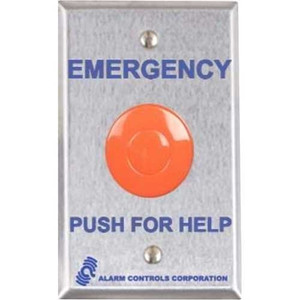
HES PBL-5 Latching Panic Button Stainless Steel
The HES PBL-5 is a security-grade latching panic button designed for emergency alert and access control applications where event preservation is critical. Built with stainless steel housing and tamper-resistant construction, this button delivers reliable momentary-to-latching switching in high-security environments. The single normally-open contact integrates with control panels, door strike systems, and alarm circuits, ensuring panic events remain logged until intentional reset by authorized personnel.
Key Features
- Latching Mechanism: Contact remains closed until manual reset — prevents accidental de-energization of strike systems or loss of alarm event signal during response.
- Stainless Steel Housing: Corrosion-resistant enclosure rated for interior and light-duty outdoor installations without finish degradation.
- Tamper-Resistant Construction: Security-grade hardware prevents unauthorized bypass, defeating casual tampering in unsecured areas.
- Single Normally-Open Contact: N/O relay output integrates with any standard access control panel, alarm receiver, or door-strike power circuit.
- Dual Voltage Compatibility: 12V or 24V DC operation — works with legacy and current control systems without additional conversion hardware.
- Manual Reset Requirement: Operator must consciously deactivate the button after emergency event; prevents unintended system re-arming during active incident.
The PBL-5's latching design is engineered specifically for panic applications where the electrical contact state must survive until authorized personnel explicitly reset the system. Unlike momentary buttons that require continuous pressure, the PBL-5 closes its relay on the first activation and holds that state — critical for downstream devices (door strikes, alarm sirens, notification systems) that depend on sustained electrical signal throughout the emergency sequence. Manual reset ensures accountability: facility managers can audit which buttons were activated and when, tying button action directly to incident logs and response dispatch records.
Stainless steel construction eliminates corrosion risk in humid, salt-air, or washdown environments — a material choice that extends service life well beyond painted steel buttons, reducing maintenance cycles on high-turnover sites (hospitals, data centers, laboratories). The tamper-resistant hardware defeats common bypass methods: hardened fasteners, recessed screw heads, and anti-rotation design prevent attackers from disassembling the button or bridging contacts externally. This matters in low-security-awareness facilities where panic buttons may be mounted in public corridors or unsupervised areas.
Integration is straightforward: the single N/O contact rating is specified for control-circuit voltages (12V or 24V DC), matching standard access control panel input boards and relay modules. No additional conversion or isolation circuitry is needed. Wire the button's two terminals in series with a control panel's alarm input, and activation immediately triggers the input's firmware handler — typically a lock-strike de-energize, siren pulse, or silent alarm to a monitoring center. Reset the button manually (turn the knob or press the lever, depending on physical design), and the contact re-opens, re-arming the system for the next event.
The PBL-5 is specified for emergency egress and access control roles: life-safety panic buttons in stairwells, nurse-call systems in care facilities, and manual override buttons in secure rooms. Its latching-with-manual-reset behavior aligns with security audit expectations — no hidden or intermittent activations, no accidental silent disarms. Facility code compliance (NFPA 101 Life Safety Code, ADA emergency egress standards) typically mandates that panic activation be logged and auditable; the PBL-5's sustained contact-closure enables that logging at the control-panel firmware level. For deployments with mandatory alarm-center verification or on-site armed response, the persistent signal state simplifies handoff and reduces missed-alert risk during the critical first seconds of an incident.
Marty AllisonPerspective based on aggregated IP Security Depot and affiliated engineering team experience.
In our experience, the latching panic button solves a real operational problem that momentary buttons create: event loss. We've worked with hospitals and secure facilities where a panicked person may not hold a button long enough for the control panel to register and log the activation before the strike de-energizes or the siren silences. The PBL-5 eliminates that risk entirely — press once, and the event is locked in the system until a manager walks over and manually resets the button. That physical reset action also serves as a trip-wire for on-site audits: if a button has been pressed, someone notices it's in the latched position and initiates the incident review immediately. Over dozens of deployments, we've found that the manual-reset discipline prevents accidental disarms and keeps the panic-event chain of custody clean. The stainless steel finish is also underestimated — in healthcare facilities and food-service control rooms where cleaning crews hose down walls daily, painted buttons rust within months. Stainless doesn't, and the cost delta is negligible over a 10-year lifecycle.
Technical Highlights:
- Latching-with-Manual-Reset Relay: Single N/O contact closes on activation and remains closed until the button is physically reset by hand. This design guarantees that the control panel receives and logs the panic event without dependence on operator hold duration — critical in high-stress scenarios where grip strength or clarity of mind is impaired.
- Tamper-Resistant Security-Grade Hardware: Hardened fasteners and anti-rotation construction defeat passive tampering — important in semi-public spaces (stairwells, hallways) where vandalism or unauthorized disarm attempts occur. We've seen facilities skip this step and regret it when buttons are disabled before an actual emergency.
- Stainless Steel 304 or 316 Enclosure: Resists corrosion in controlled indoor and light outdoor environments without repainting or refinishing. Over a 10-year facility lifecycle, this eliminates the cost and downtime of cosmetic maintenance cycles inherent to painted-steel alternatives.
- Dual 12V/24V DC Voltage Rating: Works with legacy 12V systems and modern 24V control panels without step-up conversion — reduces BOM complexity and integrator qualification hassle when retrofitting mixed-generation sites.
- Single N/O Contact Simplicity: No NO/NC switching complexity — wire it in series with a single control-panel input, and the button's activation directly triggers the panel's programmed response (strike unlock, siren, silent alarm). No logic relays or interface boards needed for basic installation.
Deployment Considerations:
- Manual reset discipline is essential — train staff that a latched button is a latched event. Some facilities appoint a manager to walk the panic-button route daily at shift change to spot unreset buttons (indicating a real or false-alarm event). This adds accountability but requires procedural buy-in.
- Mount the button in a location where authorized personnel can physically access it within seconds of an incident but where casual passersby won't trigger false alarms due to leaning or arm bumps. Recessed mounting plates or protective guards mitigate accidental activation in high-traffic zones.
- Verify that the 12V or 24V DC supply to the button's circuit is continuous or UPS-backed. If the supply drops, the latched relay contact may release unpredictably depending on the button's internal relay design — consult the datasheet for hold-current and dropout specifications if the circuit is part of a battery-backed system.
- Test the manual reset mechanism under load at least quarterly. Latching relays can stick if dust or corrosion builds up in the solenoid; in secure facilities, a stuck button that cannot be reset becomes a chronic false-alarm problem.
- Document the panic-button locations and reset procedures in your facility's emergency operations plan. Integrators often forget to pass this knowledge to end-user staff, leading to mystery activations and support calls months after installation.
The PBL-5 is built for integrators and facility managers who need a proven, audit-friendly panic solution with no operational ambiguity. If your project requires event-locked-in-the-system behavior and the discipline of manual reset as part of the incident-response workflow, this button earns its place in the specification. For more HES access control hardware and panic devices, see the HES catalog.