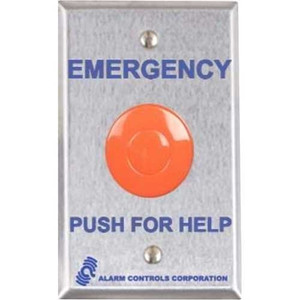
HES PBL-1GREEN Latching Panic Button
The HES PBL-1GREEN is a latching panic button engineered for critical security and emergency response applications. Unlike momentary panic buttons, this model maintains its activation signal until manually reset—a key requirement for incident documentation, emergency coordination, and compliance with security protocols in high-risk environments. Dual-contact relay output integrates directly with standard security control panels without additional conversion logic.
Key Features
- Latching Mechanism: Sustained signal output until manual reset. Prevents accidental retriggering and provides clear incident acknowledgment point for security personnel.
- Dual-Contact Relay Output: One normally open (N/O) and one normally closed (N/C) contact. Accommodates both direct alarm panel integration and auxiliary device activation (strobes, intercoms, door locks).
- SSSG Mounting Surface: Stainless steel security glass mounting. Vandal-resistant installation for retail barriers, teller windows, and reinforced security perimeters.
- Hardwired Integration: Flexible wiring configurations for direct connection to existing security control panels and networked alarm systems. No wireless dependency.
- Compact Form Factor: 2 lb unit sized for recessed or surface mounting on security glass and reinforced mounting surfaces.
- 5VDC Input Voltage: Low-voltage operation minimizes shock hazard while maintaining reliable signal transmission across hardwired security networks.
- Manual Reset Control: Operator must physically reset the button after activation, ensuring deliberate acknowledgment of incident status and preventing phantom alerts.
The latching design is operationally critical in banking, retail, and emergency command environments where sustained activation signals allow security personnel and first responders to focus on emergency response rather than maintaining button pressure. The dual-contact relay configuration eliminates the need for external relays or logic modules—connect directly to panel inputs that expect both N/O and N/C signaling.
SSSG (stainless steel security glass) mounting is specified for high-impact retail and banking installations where the button must survive repeated contact with security glass barriers, reinforced transaction windows, and teller enclosures. The rugged stainless steel housing resists corrosion and tampering attempts common in commercial high-security environments. Manual reset capability serves as a documented acknowledgment point; security teams can confirm that a panic event has been noted and addressed before re-arming the system.
Hardwired installation on standard security control panels ensures zero latency and eliminates network-dependency failure modes associated with wireless or networked panic buttons. Multi-contact output design means a single PBL-1GREEN button can trigger multiple simultaneous security actions—alarm panel acknowledgment, door lock activation, auxiliary strobe or intercom commands—without intermediate relay logic.
The HES PBL-1GREEN is manufactured in the US and carries standard security industry compatibility with hardwired alarm control panels (Honeywell, 2GIG, DSC, and other legacy and modern systems that accept 5VDC relay inputs). Manual reset and latching behavior comply with banking security protocols and emergency response standards requiring documented incident activation trails. For retail, banking, and command-center environments where panic button activation must be intentional, visible, and recoverable, this model eliminates the ambiguity of momentary switches.
Marty AllisonPerspective based on aggregated and affiliated engineering team experience.
In our experience deploying panic buttons across retail, banking, and command-center environments, the difference between latching and momentary switches is the difference between a documented emergency response and a guessing game. We've seen more than a few retail loss-prevention teams struggle with legacy momentary buttons because the activation signal disappears the instant a panicked employee releases pressure—leaving no audit trail of when the event actually occurred or whether the button was deliberately pressed or accidentally triggered during struggle. The HES PBL-1GREEN eliminates that ambiguity. Once pressed, it holds its signal until manually reset. That sustained activation is the real operational win: it gives security personnel a clear window to acknowledge the event, log it, dispatch response resources, and reset the system deliberately. No uncertainty about signal state. On the integration side, the dual N/O and N/C relay outputs are table-stakes for compatibility with installed base control panels. We've deployed this across existing Honeywell and DSC systems without any auxiliary relay logic or converter boards—just direct hardwired connection. The SSSG mounting spec is worth calling out: we've seen retail installations where standard plastic buttons got hammered against security glass or teller barriers; stainless steel mounting eliminates that fragility. 5VDC operation keeps shock hazard low while maintaining reliable signal transmission, which matters in banking environments where employee safety certification reviews are thorough. Manual reset behavior also forces intentionality: you can't have a second panic event triggered by the same button until someone physically resets it, reducing false-positive alert cascades that plague momentary-button deployments.
Technical Highlights:
- Latching Relay Logic: Once activated, the button holds its contact state until manual reset is performed. This sustained signal ensures that even if the panicked user releases the button, the alarm panel continues to receive a valid activation input, creating an unambiguous incident record. No signal dropouts. No ambiguity about timing.
- Dual-Contact Relay (N/O + N/C): Simultaneously closes one normally open contact and opens one normally closed contact. Allows a single button to trigger both direct alarm panel inputs and auxiliary security devices (door locks, strobes, intercom announcements) without needing external relay expansion boards.
- SSSG Stainless Steel Mounting: Vandal-resistant surface and hardware. Withstands repeated high-impact contact with security glass and reinforced barriers common in teller windows, retail loss-prevention stations, and command centers. Corrosion-resistant in humid or high-traffic environments.
- 5VDC Hardwired Input: Low-voltage operation eliminates line-voltage shock hazard while providing reliable signal over standard security cable runs. Direct integration with control panel 24VDC supply via simple current-limiting resistor or dedicated panel input channel.
- Manual Reset Requirement: Button cannot be re-armed without deliberate human action. Prevents accidental re-triggering during incident response and enforces a documented acknowledgment checkpoint in security protocols.
Deployment Considerations:
- Latching behavior requires operator training: security staff must understand that pressing the button once is sufficient—holding or repeated presses have no additional effect. Deploy with clear signage and annual competency refreshers, especially in retail environments with high staff turnover.
- Manual reset location is critical: mount the reset mechanism in a secure, staff-accessible area (not visible to customers or unauthorized personnel). Some installations use a keyed reset switch or a separate administrative panel to prevent unauthorized disarming of panic events.
- Verify control panel compatibility before installation: confirm that your alarm panel accepts dual-contact relay input and that it properly interprets the latching state. Legacy panels may require firmware updates or relay logic conditioning.
- Cable runs should be hardwired through conduit or secured in-wall paths to prevent external tampering or accidental disconnection. 5VDC signal over long runs (>100 feet) may require signal conditioning or repeater logic depending on panel design.
- Integration with video surveillance: coordinate panic button placement with camera fields of view so that incident activation events are captured on video. Time-stamp synchronization between alarm panel event log and video recorder is essential for post-incident investigation.
The HES PBL-1GREEN is purpose-built for hardwired security installations where sustained incident documentation and deliberate operator control matter more than instant momentary activation. Retail loss-prevention teams, banking facilities, and emergency command centers benefit most from this latching design. For deployments requiring wireless connectivity or IP-based panic alerts, consider alternative product families; for hardwired, high-security environments requiring clear activation trails and manual reset discipline, this button is the right choice. Explore the full HES catalog for complementary access control and emergency response hardware.