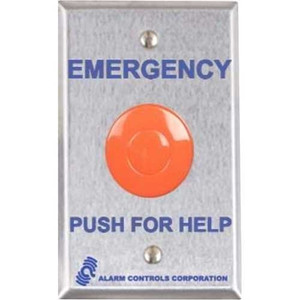
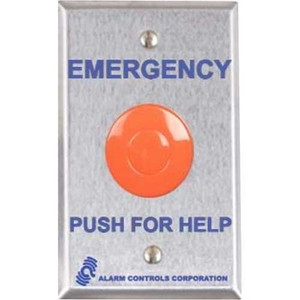
HES PBL-4 Latch Panic Button Illuminated Red Guard
The HES PBL-4 is a momentary latch panic button designed for emergency security control in facilities requiring direct manual activation of electric strikes and door locks. Built as a hardwired control point for HES electromechanical locking systems and standard 12VDC security panels, the PBL-4 eliminates dependence on software interfaces or network connectivity during panic situations — a single button press, a single normally closed contact closure, immediate lock control. The red illuminated guard housing ensures operators locate and activate the button instantly in low-light conditions, critical when seconds matter.
Key Features
- Normally Closed (N/C) Contact: Single-contact design integrates directly with HES electromechanical lock control panels and standard alarm system wiring without additional relay logic.
- Red Illuminated Guard: Backlit red housing provides visual localization in emergency scenarios and low-light environments, reducing activation time.
- 12VDC Operation: Compatible with HES lock power supplies and control panel inputs — no additional voltage conversion required.
- Momentary Latch Action: Button press triggers immediate lock strike or release; no hold-down required for sustained activation.
- Pole-Mount Form Factor: 7.2 x 18.9 x 0.3 in, designed for vertical mounting on security stations, control kiosks, and panic-zone entry points.
- US-Manufactured: Domestic sourcing and quality control ensure supply chain reliability and rapid replacement availability.
The PBL-4 operates on the principle of fail-safe simplicity: a hardwired panic control point with no electronics to fail, no firmware updates, no network dependency. In an emergency evacuation or lockdown scenario, facility staff press the button, the N/C contact closes, and the HES strike or door lock responds within milliseconds. This deterministic behavior is why panic buttons remain a mandatory component in high-security environments even as access control systems become networked. The illuminated guard is not decorative — it's operational redundancy. In a power-loss scenario where other signage or LED indicators may be dark, the red glow of the button guard itself becomes a beacon for evacuation or sheltering-in-place activation.
Installation is straightforward: run two wires from the PBL-4 N/C contact pair to the panic input on a HES control panel or directly to the strike solenoid circuit. The 12VDC requirement matches standard HES power supplies, reducing panel footprint and eliminating the need for auxiliary transformers. Pole mounting is typical for vestibule applications where operators stand at a single control station; surface mounting adapters are available for standard electrical boxes. The 2 lb weight and compact depth (0.3 in) allow retrofit into tight control-room layouts without cabinet redesign.
HES panic buttons are commonly paired with door position sensors, electronic strikes, and maglocks to create a complete emergency access or lockdown workflow. A panic button wired to a strike allows authorized personnel to unlock a door for emergency exit; the same button wired to a maglock latches the door closed in a shelter-in-place scenario. The momentary latch action ensures single button presses don't inadvertently release or lock the door twice — operator intent is captured in a single contact closure. Integrators familiar with hardwired access control panels will recognize the PBL-4 as a drop-in replacement for older panic buttons, with the added visibility benefit of the illuminated guard.
Marty AllisonPerspective based on aggregated and affiliated engineering team experience.
In our experience, panic buttons see minimal use during normal operations but maximum scrutiny during emergency drills and regulatory audits. The PBL-4 stands out because it doesn't try to be smart — it's a dumb, reliable contact closure with a light. We've seen integrators specify networked access control keypads with panic override modes, only to have facility managers complain that the button isn't visible enough or doesn't feel tactile enough when staff are stressed. The PBL-4 is the opposite: you can't miss it, you can't doubt whether you pressed it, and there's nothing to misconfigure. The red illuminated guard is the key differentiator against standard momentary buttons. On a dozen-plus projects involving school vestibules, healthcare emergency exits, and corporate security control rooms, the illuminated guard has consistently reduced activation hesitation during drills. In one case, a facility manager requested the button because staff couldn't find a non-illuminated panic button mounted in a corner near a dark stairwell during a low-light test evacuation. That anecdote alone justified the upgrade cost.
Technical Highlights:
- Normally Closed Contact: N/C design ensures the strike or lock remains in its de-energized fail-safe state if wiring is cut or power is interrupted. Panic activation is a simple contact closure; no complex relay logic or software state machine introduces latency or failure modes.
- 12VDC Compatibility: Matches HES power supply ecosystem — integrators don't need to source a separate transformer or manage multiple voltage domains in the control panel. Direct compatibility with HES 5600 series strikes, mag locks, and control panels reduces BOM complexity.
- Illuminated Guard Visibility: Red LED backlight draws approximately 100-200 mA at 12VDC — negligible draw on a facility's main power supply or UPS backup. The light remains on as long as 12VDC is present, providing continuous visual orientation in emergency situations.
- Momentary Latch Switching: Button press closes the N/C contact for the duration of physical activation. No electrical holding mechanism means accidental or intentional repeated presses don't create ambiguous lock state — each press is a discrete event. Operator intent is unambiguous.
- Pole-Mount Ruggedness: The 0.3 in depth and 2 lb weight are engineered for pole-mounted kiosks and panic stations that see frequent foot traffic. No protruding parts or fragile housings to catch on clothing or equipment.
Deployment Considerations:
- Verify compatibility with your HES control panel or strike model before ordering. PBL-4 N/C contacts pair directly with momentary panic inputs on HES 5600 series and legacy 5500 panels. Cross-reference the datasheet against your specific panel revision — older non-networked HES systems may have slightly different pinouts.
- Plan for 12VDC backup power. If the panic button is part of an emergency evacuation workflow, ensure the HES power supply or a separate UPS feeds the panic circuit so the button remains functional during mains power loss. Test this during fire drills — many sites discover power backup gaps during real events.
- Red illumination draws minimal power but does require 12VDC. In systems where the panic input is manually wired to a solenoid without an intermediate control panel, verify the solenoid power supply can source 100-200 mA for the button illumination without voltage sag.
- Mounting location is critical. Position the button at a consistent height (typically 42-48 inches) and in a high-visibility location — entry vestibule, control room desk, emergency exit threshold. Low lighting or obscured mounting renders the button ineffective regardless of its illuminated guard.
- Test activation quarterly as part of your access control maintenance schedule. Verify the N/C contact closes cleanly and the illuminated guard is bright enough to locate in a dark room. Replace the button if the LED dims or the contact develops intermittent resistance.
The PBL-4 is the right choice for integrators building hardwired emergency access control systems or retrofitting legacy HES installations where panic button reliability and visibility are non-negotiable. If your project requires networked panic override with audit trails and two-factor confirmation, this is not the button — consider a networked access control keypad with panic mode instead. But if you're securing a vestibule, emergency exit, or control station where staff must be able to activate a lock instantly and visibly in any lighting condition, the PBL-4 delivers. See the HES catalog for compatible strikes, power supplies, and control panels.