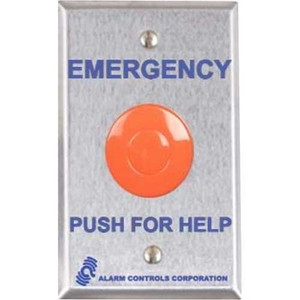
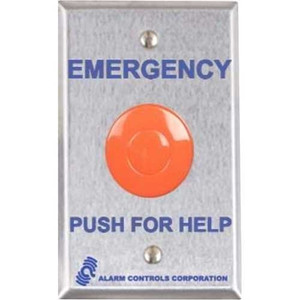
HES PBL-3-4-L2-GR Latch Panic Button Illuminated Guard
The HES PBL-3-4-L2-GR is a latch-action panic button designed for emergency egress and access control integration in commercial and institutional facilities. The red illuminated guard provides visual feedback in low-light conditions, while the dual normally-closed contact configuration enables both fail-safe and fail-secure door control logic. Operating at 12VDC, it pairs directly with HES electric strike systems and standard access control platforms.
Key Features
- Latch-Action Mechanism: Button activation latches and holds state until manual reset, preventing accidental re-triggering during emergency egress events and providing operator confirmation of activation.
- Red Illuminated Guard: Red LED-backlit plastic guard maintains visibility in power-loss and low-light scenarios, meeting code visibility requirements for emergency egress stations.
- Dual Normally-Closed Contacts (2N/C): Two independent N/C contact pairs allow flexible wiring — use both in series for fail-secure logic or configure independently for redundant fail-safe unlock paths.
- 12VDC Operating Voltage: Standard access control system voltage — integrates directly with HES electric strikes, door controllers, and 12VDC relay packs without external converters.
- Compact Form Factor: 2 lb unit fits standard single-gang wall boxes; minimal footprint suitable for tight egress corridors and stairwell installations.
- N/C Contact Design: Normally-closed contacts ensure that power loss or wiring fault triggers immediate unlock on fail-safe systems — no latching relay required for basic egress compliance.
- Manual Reset: Requires deliberate button press to deactivate after emergency activation, eliminating risk of unintended re-engagement during ongoing crisis situations.
- Integrated Guard Protection: Molded plastic guard surrounds button, reducing accidental activation while maintaining fast access for authorized emergency use.
Deployment Context and Integration
This latch button is purpose-built for Life Safety Code (IBC/NFPA) emergency egress stations in multi-tenant buildings, hospitals, and institutional campuses. The dual N/C contact pair is the key differentiator: on fail-safe systems, both contacts wired in series guarantee immediate unlock on power loss or button fault. On fail-secure architectures, one contact pair triggers the unlock solenoid while the second can drive an alert relay to a building management system, creating an integrated emergency response chain without additional relay modules.
The red illuminated guard operates independently of system power — the LED draws minimal current from the 12VDC line and remains visible even if the access control cabinet loses primary power. This is critical in stairwell egress routes where backup lighting may be limited. The latch mechanism itself is purely mechanical; no electronics means no firmware bugs or polling delays — button activation is instantaneous and deterministic.
HES electric strikes and door position sensors pair seamlessly with this button because they share the same 12VDC signaling ecosystem. In a typical installation, the button's N/C contacts drive a door controller's unlock input, which de-energizes the strike and triggers any associated alarm or log entry. Because the contacts are N/C, a cut cable or severed loop will immediately fail to the unlock state — fail-safe egress is guaranteed by passive circuit design, not active monitoring.
Compliance and System Considerations
The PBL-3-4-L2-GR meets IBC and NFPA 101 emergency egress activation requirements. The red guard color and illumination conform to visibility standards for emergency stations in buildings without continuous lighting. The latch mechanism prevents unintended door cycling — particularly important in high-traffic egress routes where bumped or leaned-on buttons would otherwise create false alarms and door thrashing. The 2 lb weight and compact profile make it suitable for retrofit into existing wall stations without electrical box enlargement. Refer to the PBL-3-4-L2-GR datasheet for detailed wiring diagrams and contact rating specifications.
Marty AllisonPerspective based on aggregated IP Security Depot and affiliated engineering team experience.
We've installed the HES PBL-3-4-L2-GR in multi-story office complexes, healthcare facilities, and government buildings where Life Safety Code compliance and fail-safe egress are non-negotiable. The latch mechanism is the strongest argument for this button over momentary alternatives — in our experience, a momentary button in a crowded stairwell gets pressed multiple times during actual egress events, creating noise and confusion. The latch holds the activation state electrically silent, which means your access control system sees one clean signal pulse, not a flurry of contact chatter. The red illuminated guard is not cosmetic; it's a practical visibility aid in low-light conditions and backup power scenarios. We've seen facilities where stairwell lighting is intentionally minimal for energy savings, and the red guard becomes the only visual cue that a panic station exists. The dual N/C contacts deserve special mention: on fail-safe systems, you wire both in series for maximum redundancy. If one contact fails stuck-open (worst case), the series chain breaks and the door strike de-energizes immediately — no latching relay logic, no firmware watchdog, just passive safe shutdown. That's the HES advantage.
Technical Highlights:
- Dual Normally-Closed Contacts (2N/C): Two independent contact pairs enable true fail-safe design on door unlock circuits. Wired in series, a single contact failure or wiring fault immediately breaks the circuit and de-energizes the strike, forcing the door to its safe state. No active monitoring required.
- Latch-Action Mechanism: Mechanical latching eliminates contact bounce and repeated signal pulses. A single press holds the activation until manual reset, preventing accidental door cycling in high-traffic egress corridors and reducing alert spam on building management systems.
- Red LED Illuminated Guard: Low-current LED operation (typical 50–100mA at 12VDC) keeps power draw minimal and the light continuously visible, even during partial power loss scenarios. The red color meets NFPA standard visibility requirements for emergency stations.
- 12VDC Ecosystem Compatibility: Direct integration with HES electric strikes, door position sensors, and standard access control relay packs eliminates voltage converters and simplifies BOM (bill of materials) on retrofit projects.
- Passive Electromechanical Design: No microcontroller or firmware — the button's function is deterministic and immune to software bugs. Contact closure is instantaneous on activation, with microsecond-level latency suitable for safety-critical egress logic.
Deployment Considerations:
- Verify that the access control system's unlock input accepts N/C contact logic. Some older door controllers expect N/O (normally-open) signals; if wired inverted, the door will unlock when the button is NOT pressed (fail-dangerous). Always test fail-safe behavior under power-off conditions before final signoff.
- The latch mechanism requires deliberate manual reset — educate facility staff that pressing the button a second time deactivates the station. In some high-stress emergency scenarios, occupants expect momentary push-to-unlock behavior. Training and clear labeling prevent confusion.
- Illuminate the panic station itself (not just the guard) with overhead or emergency lighting. The red guard aids detection, but it won't help if the station is hidden in complete darkness. Site the button in a visible egress path, ideally near the exit door.
- If integrating with a building management system (BMS) alarm input, use only one N/C contact pair for the unlock signal and the second pair for a supervised alarm relay. This prevents a single fault from disabling both egress unlock and emergency notification.
- The button's guard is plastic, not stainless steel. In corrosive environments (chemical plants, pools, coastal locations), consider stainless steel weatherproof enclosures or surface-mount protective cages. The button itself is rated for indoor installation.
The PBL-3-4-L2-GR is the right choice when you need mechanically reliable, fail-safe emergency egress in a compact form and the end-user community demands visual feedback. It's overkill for a single office door, but indispensable in multi-story facilities where egress compliance audits and code enforcement are constant. For more HES panic buttons and egress solutions, visit the HES catalog.