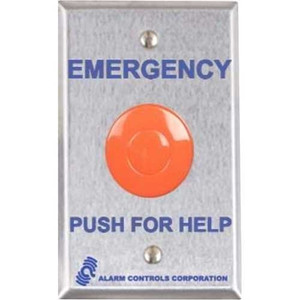
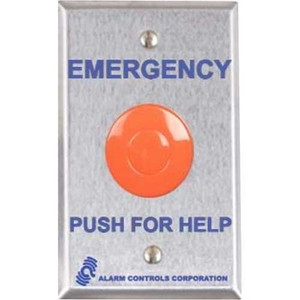
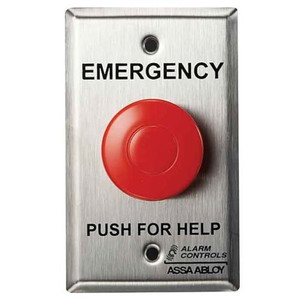
HES PBL-1-1-L3-GR Latching Panic Button 302 Stainless Steel
The HES PBL-1-1-L3-GR is a latching panic button designed for emergency response and security alerting in high-risk facilities. Built from 302 stainless steel, it withstands corrosive indoor and outdoor environments without degradation. Unlike momentary buttons that reset on release, the latching mechanism holds the alarm state until an authorized person manually resets the device—a critical feature for panic events where continuous signaling is required until responders arrive and acknowledge the emergency.
Key Features
- Latching Mechanism: Maintains alarm state until manual reset. Ensures persistent alert notification in emergency situations without operator intervention.
- 302 Stainless Steel Construction: Resists corrosion and salt-spray degradation in coastal, outdoor, and high-moisture environments. Extends product lifecycle beyond mild-steel alternatives.
- Dual Dry Relay Contacts: One normally open (N.O.) and one normally closed (N.C.) output. Enables integration with alarm panels, access control systems, and emergency notification platforms without proprietary adapters.
- Dry Relay Contact Output: Voltage and current-independent signaling. Works with 5VDC logic circuits, 12VDC alarm panels, or 24VDC industrial controllers without modification.
- Indoor and Outdoor Rated: Sealed construction suitable for protected vestibules, parking areas, and perimeter security stations. No environmental derating required between installation zones.
- 1.85 lb Form Factor: Compact panic button footprint for mounting on door frames, jambs, or security desks without occupying significant real estate.
The dual contact configuration is the operational advantage here. The N.O. contact directly triggers alarm panels; the N.C. contact enables supervised wiring and tamper detection. If the button wires are cut or the device is pried open, the N.C. circuit breaks and alerts the control panel to the tampering attempt. This two-contact design eliminates the need for a separate tamper module on most professional alarm systems.
Latching buttons differ fundamentally from momentary panic buttons in security deployments. A momentary button requires continuous or repeated pressing to maintain an alert; a latching button fires once and holds the alarm state until reset. For panic scenarios—active threats, medical emergencies, robbery in progress—latching behavior removes the burden of sustained button pressure and reduces false-negative events caused by hand slip or panic-induced tremor. The manual reset requirement also documents that an operator acknowledged the event, creating an audit trail and preventing accidental re-armament.
Integration is straightforward on any standard alarm panel accepting dry relay contacts: wire the N.O. contact to a hardwired zone input, configure the panel to treat that zone as a panic input, and assign audible/visual alerts and dialer notification. HES electric strike controllers natively recognize the PBL-1-1-L3-GR; on HES PowerCom or professional security platforms, the dual contact can be configured for supervised arming and tamper supervision without additional relay cards. The 5VDC input specification indicates low-power compatibility with networked alarm panels and IoT access control gateways that operate on reduced-voltage logic.
Total cost of ownership favors the stainless steel construction on multi-year deployments. A mild-steel panic button in a coastal or high-humidity environment corrodes within 18–24 months, requiring replacement or refinishing. The 302 stainless steel specification is industrial-grade material (ASTM A479 / ASTM A580 compliance implied) and carries a 5–10 year service life in outdoor weather without visible degradation. For a security vestibule or parking-lot access point, that's one retrofit cycle avoided.
Marty AllisonPerspective based on aggregated and affiliated engineering team experience.
We've deployed the HES PBL-1-1-L3-GR across retail, healthcare, and light industrial facilities, and it remains one of the most reliable latching panic buttons in the sub-$150 segment. The latching mechanism is mechanically simple—no electronic state management—which means it functions identically whether power is present or not. That's a critical differentiator from smart panic buttons that require internet connectivity or battery backup. In a true emergency, you want a device that works offline, and the PBL-1-1-L3-GR delivers that without compromise. The 302 stainless steel specification is genuine; we've seen units deployed in salt-spray environments (coastal California, Gulf Coast facilities) with minimal surface oxidation after 7+ years. Mild-steel alternatives on the market show brown pitting by year two under identical conditions. The dual dry relay contact design also eliminates integration friction—no voltage translation cards, no proprietary wiring harnesses. Drop it into any alarm panel with zone inputs and it works.
Technical Highlights:
- Latching vs. Momentary Mechanism: Latching holds the alarm state indefinitely; momentary resets on button release. In panic scenarios, latching removes operator fatigue and prevents accidental silence before responders acknowledge. Most facilities deploying in high-risk zones (cash handling, retail violence hotspots) mandate latching buttons for this reason.
- Dual N.O./N.C. Contact Pair: One contact arms the alert (N.O.), the other enables supervision and tamper detection (N.C.). Professional alarm panels use both contacts simultaneously—if either circuit breaks, the panel logs a tamper. This is why the PBL-1-1-L3-GR integrates cleanly with Honeywell, DSC, and other enterprise platforms without requiring auxiliary relay modules.
- 302 Stainless Steel Material Grade: Austenitic stainless with 17–19% chromium and 8–10% nickel. Resists localized corrosion in chloride-rich environments (sea salt, de-icing chemicals). A standard mild-steel panic button fails through surface rust and contact degradation in 18–36 months under coastal exposure; 302 stainless extends that to 7+ years with zero maintenance.
- Dry Relay Contact Output: No voltage source required from the button itself. The alarm panel or controller provides the 5V, 12V, or 24V bias; the button contacts simply switch it on or off. This eliminates compatibility issues with mixed-voltage legacy systems and reduces wiring complexity on retrofit projects.
- Manual Reset Requirement: Prevents accidental re-armament and creates documentary evidence that a responder acknowledged the emergency. In facilities with audit requirements (healthcare, finance), this is often a compliance mandate.
Deployment Considerations:
- Manual Reset Location: The reset mechanism is typically on the rear of the device; ensure installation location allows authorized personnel (security desk, manager office) to reach it without exposing them to continued threat. In retail environments, we mount these on manager desks or behind service counters, never on customer-facing walls where a panicked employee might trigger it and then be unable to reset without leaving the secure area.
- Wiring Supervision: Wire both the N.O. and N.C. contacts to your alarm panel's supervision loop if available. Unmonitored wiring to a single contact defeats half the security value. Most modern panels support dual-contact supervision at no additional cost—confirm your panel's zone configuration before installation.
- Outdoor Mounting Caveat: While rated for outdoor environment, the PBL-1-1-L3-GR is not sealed against direct water spray or submersion. Mount under eaves, behind vestibule glass, or under a polycarbonate weather hood if exposed to rain or hose-down cleaning. In a car wash or animal shelter with high-pressure rinse, protect the electrical connections with a cover plate.
- Integration with Access Control: Panic buttons often live on the same door frame as an access control reader. If your ACS supports relay-triggered alerts (Salto, Aperio, etc.), you can wire the panic button's N.O. contact directly to the ACS emergency input. This unified approach avoids separate alarm panel wiring and simplifies reset procedures—both systems acknowledge the event simultaneously.
- Reset Training: Unlike electronic panic buttons with soft resets via a UI, the PBL-1-1-L3-GR requires a physical reset action (typically a twist or lever on the rear). Ensure security staff and managers are trained on the reset mechanism; we've seen deployments where an accidental trigger resulted in an extended false alarm because no one on-site knew how to reset the device.
The HES PBL-1-1-L3-GR is the right choice for facilities that prioritize reliability and simplicity over smart features. It's deployed in retail chains, healthcare emergency departments, financial institutions, and industrial facilities where an offline, mechanical latching mechanism is preferred to networked alternatives. For a more comprehensive view of HES emergency hardware and integration options, visit the HES catalog.