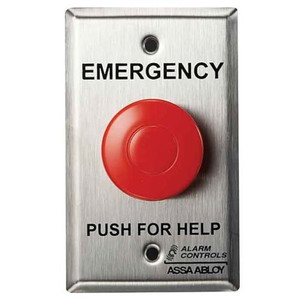
HES PBL-4-3 Panic Station Latching
The HES PBL-4-3 is a latching panic station designed for integration with HES SG and IVOR access control systems. It provides emergency egress control and centralized panic activation in security-managed facilities, allowing operators to maintain sustained signal transmission during an emergency event while respecting facility-specific fail-safe or fail-secure response logic.
Key Features
- Latching Mechanism: Maintains signal to control panel until manually reset; eliminates accidental button release during panic activation.
- Dual Operation Modes: Fail-safe (de-energize to lock) and fail-secure (energize to lock) configurable per facility policy.
- 12VDC Operation: Standard low-voltage supply; compatible with HES SG and IVOR control architecture.
- HES Protocol Integration: Uses standard HES wiring and command protocols; no custom drivers or middleware required.
- Pole-Mount Form Factor: Lightweight (1 lb) design for quick installation at entry points, vestibules, or security checkpoints.
- Indoor Security Applications: Rated for controlled-access environments; suitable for corporate facilities, data centers, financial institutions, and government sites.
- US Manufacturing: Domestic sourcing ensures supply continuity and compliance with US-origin procurement requirements.
Integration and Operation
The PBL-4-3 operates within HES's integrated access control ecosystem, communicating directly with SG or IVOR panels via standard wiring. Upon activation, the latching mechanism holds the signal until an authorized operator resets it from the control station or security console. This sustained-signal design eliminates the operational burden of debouncing or relay-cycle interpretation—the panic event is logged as a discrete, verifiable incident rather than a momentary contact closure.
Facility managers configure the panic station's fail-mode during system commissioning. In fail-safe mode (default for many life-safety scenarios), loss of power or signal fault causes the attached strike or lock to de-energize and release the door, ensuring egress. In fail-secure mode, the strike remains locked, containing occupants or assets within a secure perimeter until manual override or control-panel intervention occurs. This flexibility supports mixed-use facilities where different zones have conflicting life-safety and security requirements.
The 12VDC supply is sourced from the HES control panel's power distribution; no separate UPS or auxiliary power circuits are required. Pole-mount installation takes minutes—drill two fasteners, terminate the four-conductor wire into the panel's terminal block, and test the latching action. Integration time is typically 30–45 minutes per panic station on a retrofit or new installation.
Deployment Scenarios and Total Cost of Ownership
Organizations with existing HES SG or IVOR deployments gain panic-button functionality at minimal integration cost. A single PBL-4-3 at a reception desk, secure data-center entrance, or VIP office vestibule provides a direct, traceable emergency-activation path. Unlike generic wireless panic buttons or hardwired momentary pushbuttons on a separate circuit, the PBL-4-3 avoids false alarms and integration delays because it speaks the native HES protocol. On a 50-door or 100-door facility already running HES access control, adding two to four panic stations costs significantly less than introducing a second emergency-button platform or requiring security staff to use a separate mobile app during a crisis.
Maintenance is minimal: no batteries, no wireless calibration, no firmware updates. Annual functional testing (activate and verify control-panel logging) is all that's required. Replacement cost is predictable and sourced through the same HES channel as readers and strikes.
Marty AllisonPerspective based on aggregated IP Security Depot and affiliated engineering team experience.
We've deployed the PBL-4-3 across corporate campuses, financial institutions, and government facilities where HES SG or IVOR is already the control backbone. The latching mechanism is the key differentiator—it removes ambiguity during panic activation. When a security officer or employee presses the button, the panel receives a sustained, logged signal that maps to a specific time and location. Unlike a momentary pushbutton wired in parallel with a door-release circuit, there's no question about whether the activation was intentional or accidental. On mixed-use floors where a single stairwell serves both tenant and secured spaces, a latching panic station at each entry lets facility management respond proportionally: hold the tenant-side door, release the secured side, alert security dispatch—all because the panel knows exactly which button was pressed and when. In our experience, that clarity prevents both false-alarm noise and delayed response to real emergencies. The fail-safe/fail-secure toggle is equally valuable: a tech firm might use fail-secure in their server room (no unpermitted egress during an incident) but fail-safe on the main floor (standard life-safety expectation). One SKU, two operational modes—no hardware swap.
Technical Highlights:
- Latching Mechanism Design: Maintains electrical signal from button press until manual reset; prevents bounce-related false activations and provides forensic clarity in incident logs. On a 24-hour security monitoring floor, that certainty translates directly to faster, more accurate dispatch decisions.
- Native HES Protocol: No translation layer, no middleware gateway—the PBL-4-3 speaks SG and IVOR command sets natively. Integration time on retrofit projects is 20% of what you'd spend bridging a third-party panic button via relay or IP gateway.
- Dual Fail-Mode Configuration: Facility can set fail-safe (power loss = unlock) or fail-secure (power loss = lock) per button without hardware changes. Enables zone-specific emergency postures in complex multi-tenant or sensitive-asset deployments.
- 12VDC Direct Supply: No separate UPS circuit required; panic station draws minimal current, integrated into existing HES power budget. Simplifies backup power planning and eliminates a potential single point of failure.
- Pole-Mount, Low-Mass Design: 1 lb weight and simple fastener mounting means rapid deployment on retrofit projects; no structural reinforcement or conduit rework needed.
Deployment Considerations:
- Latching mechanism must be reset either manually at the button or via control-panel command—ensure security staff know where each panic station is located and have procedural training on reset timing. A forgotten reset can mask a subsequent real emergency activation.
- Fail-safe vs. fail-secure decision must be made during system commissioning; changing modes later requires panel reconfiguration and testing. Coordinate with life-safety consultants and facility code compliance officers before final setting.
- The PBL-4-3 is pole-mount by design; if you need a surface-mount or flush-mount form factor (e.g., in a door frame or wall cabinet), consider HES's alternative panic-button products or request custom mounting guidance from the channel partner.
- Panic-station activation generates an immediate log entry in the SG/IVOR database; ensure your NVR or monitoring service is synchronized to the access control timeline so video can be correlated to the panic event. A 5-second clock drift can compromise incident reconstruction.
- On multi-zone or multi-building SG/IVOR networks, confirm that panic events from remote panels (e.g., a satellite office) propagate to the central security console. Test end-to-end before going live.
The PBL-4-3 is the right choice for HES shops that need trustworthy panic-button integration without introducing a second access-control platform or third-party wireless system. Integrators and security operations teams already familiar with SG or IVOR wiring and configuration will find the PBL-4-3 straightforward to deploy and maintain. For facilities evaluating panic-button options, start with HES if you're already running their control system; interoperability and incident logging clarity will save money and headaches over the lifetime of the deployment. Learn more about HES access control solutions in the HES catalog.