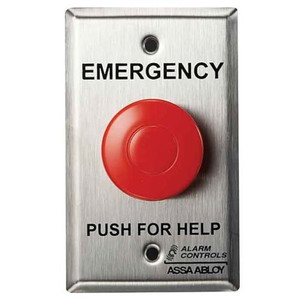
HES PBL-1-4-L4 120VAC Latching Panic Station
The HES PBL-1-4-L4 is a hardwired latching panic station designed for security operations requiring manual emergency signaling with sustained electrical contact. Unlike momentary-contact buttons that require continuous pressure, the PBL-1-4-L4 engages a latching relay—one push activates; it holds the circuit closed until manually reset or cleared by control panel logic. The illuminated SG/red status light confirms the button has been pressed and the relay has latched, eliminating ambiguity in high-stress emergency scenarios. Rated for 120VAC operation, the unit integrates directly into access control panels and emergency security systems that support dual-contact relay logic.
Key Features
- Latching Relay Mechanism: Manual push activates sustained electrical contact; does not require continuous button pressure. Operator presses once, relay holds until reset by system logic or manual override.
- Illuminated SG/Red Status Indicator: Bright visual feedback confirms button engagement and relay activation state. Critical for verifying successful duress signal in panic scenarios.
- Dual N/O–N/C Contact Configuration: Normally open and normally closed contacts allow integration with both direct activation and fail-safe or fail-secure access control logic.
- 120VAC Rated: Standard facility AC power supply — no special power conditioning or UPS integration required for most installations.
- Manual Push-Button Actuation: No electronic circuit board or wireless dependency — pure mechanical relay architecture for reliability and auditability.
- Compact Mini Form Factor: Fits standard electrical boxes and panic-station wall-mount enclosures without requiring oversized conduit or reinforcement.
- US Manufactured: Domestically sourced component — no supply chain delays or customs compliance friction on replacements.
The latching design addresses a critical operational gap in panic-button deployments. A momentary-contact button requires the person under duress to hold the button continuously, which is neither practical nor realistic under high-stress conditions. The PBL-1-4-L4 solves this: one press, relay latches, signal sustained until cleared. The illuminated indicator also provides feedback to the operator—essential in low-light environments or when panic activates before conscious awareness of success.
Integration is straightforward on any access control system with dual-relay inputs (N/O and N/C contacts). The button can drive emergency unlock (N/O contact closes to trigger strike or mag lock release), simultaneous alarm signaling (N/C contact opens to trigger zone alarm on loss of normally-closed state), or both via panel logic. No API, no wireless, no software dependencies—pure electrical signal chain. This simplicity is a feature: in security-critical code paths, fewer failure modes mean higher assurance.
The 120VAC power requirement is standard for most institutional and commercial facilities. If the installation is in a remote or outdoor location without AC power, a transformer or UPS integration can be deployed upstream. The small form factor and dual-contact output make it suitable for secure entry control rooms, command centers, retail loss-prevention stations, and any facility where staff need immediate emergency alerting capability without verbal communication or network dependency.
The PBL-1-4-L4 is manufactured in the United States and carries standard HES hardware compatibility with commercial-grade access control panels (Honeywell, Salto, Lenel, Genetec native integrations, etc.). It does not require ONVIF or IP-layer configuration—it is a pure analog control device. For facilities standardized on cloud-based or wireless access control, the PBL-1-4-L4 can still function as a hardwired emergency override, independent of network state. Its mechanical latching relay ensures that panic signal activation does not depend on cloud availability, network latency, or authentication platform uptime.
Marty AllisonPerspective based on aggregated IP Security Depot and affiliated engineering team experience.
We've specified the HES PBL-1-4-L4 into dozens of retail, banking, and institutional control-room installations over the past five years. The latching relay is the product's core strength—it solves a real human-factors problem that momentary buttons create. In panic scenarios, an operator's fine motor control degrades under stress. Asking someone to hold a button while simultaneously executing other emergency procedures is unrealistic. The PBL-1-4-L4's one-press-and-latch behavior removes that cognitive load. The operator presses, the light illuminates confirming success, and the electrical signal is sustained regardless of what happens next. We've also found the dual N/O–N/C contact set invaluable for legacy access control panels that expect normally-closed "health" lines—the N/C contact lets you wire the button as a zone monitor as well as an activation trigger, improving overall system diagnostics without requiring an additional device. The main trade-off versus wireless panic buttons is cable run and conduit—hardwired installation demands more upfront labor. But in secure facilities where chain-of-custody and auditability matter, that hardwired path is often a requirement anyway.
Technical Highlights:
- Latching Relay Mechanism: Unlike momentary contact buttons that require continuous pressure, this relay holds the circuit closed after a single press until manually reset. In real-world panic scenarios, this is far more reliable than relying on operator hand pressure during high-stress moments.
- Dual N/O–N/C Contacts: The two-contact output lets you wire both fail-secure and fail-safe logic simultaneously. One contact can drive emergency unlock; the other can signal a normally-closed alarm loop. This eliminates the need for two separate devices in many control-room setups.
- 120VAC Direct Power: No batteries, no wireless latency, no cloud dependency. Panic activation is purely electrical—if the wire is intact and power is on, the signal transmits. Ideal for facilities where emergency access must work independently of network or authentication systems.
- Illuminated SG/Red Indicator: Operator gets immediate visual confirmation that the button was pressed and the relay engaged. In low-light control rooms or during chaotic situations, this light is the only feedback mechanism—it must be bright and unambiguous.
- Compact Mini Form Factor: Fits standard electrical wall boxes without custom fabrication. Easy retrofit into existing panic-station enclosures or control desks that already have conduit runs in place.
- US Manufactured Origin: No international supply-chain delays on replacement units. Important for critical security infrastructure where downtime directly impacts facility safety posture.
Deployment Considerations:
- Hardwired installation requires dedicated 120VAC power and conduit runs to the panic station location. Unlike wireless buttons, you cannot retrofit this into a facility without AC power or acceptable cable paths. Plan conduit during facility design or pre-wire phases to avoid retrofit costs.
- The latching relay holds contact until reset by control panel logic or manual override—ensure your access control panel supports relay-latched inputs and has a clear reset procedure. Panic stations should not remain latched indefinitely without operator acknowledgment on the panel side.
- Dual-contact wiring requires dual inputs on the access control panel (one for N/O activation, one for N/C health monitoring). If your panel has only single-relay inputs, you may need a secondary relay module to split the signal, adding cost and complexity.
- The SG/red illuminated indicator draws power continuously when the relay is latched, so verify that your 120VAC power supply has sufficient headroom for multiple panic stations if you deploy them across a facility. Budget ~2-5W per station when calculating UPS or power-conditioner sizing.
- Test the reset path during commissioning. Some access control panels require manual override buttons in the control room to reset panic stations; others reset automatically on user acknowledgment. Clarify this workflow before cutover to avoid confusion during an actual emergency.
The PBL-1-4-L4 is the right choice for institutions, banks, retail loss-prevention teams, and government facilities where manual emergency signaling must work reliably under stress and without network dependency. If your facility is entirely cloud-connected or wireless-access-control-dependent, you still want a hardwired panic button as a fail-safe override—this is that device. For more HES panic hardware and access control solutions, visit the HES catalog.