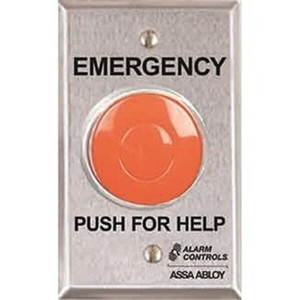
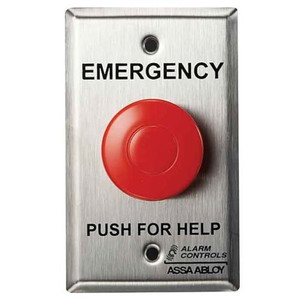
HES PBL-2-1-L2 Illuminated Latching Panic Station
The HES PBL-2-1-L2 is a 12VDC illuminated panic station built on a latching relay architecture for security installations where a momentary button press must sustain an alarm or access-control signal until deliberately reset. The unit houses an SG/302 latching relay module and delivers two normally-open contacts, making it suitable for emergency egress, duress signaling, and access-control bypass applications in retail, office, healthcare, and controlled-access environments.
Key Features
- Latching Relay (SG/302 Module): One press holds the relay closed indefinitely — critical in duress scenarios where the operator's hands may be needed elsewhere after the initial button activation. Traditional momentary panic buttons release immediately; this unit remains engaged until a system administrator resets it, ensuring the alarm panel or door controller stays notified even if interrupted.
- Two Normally-Open (N/O) Relay Contacts: Provides dual contact paths for wiring flexibility. Wire one contact to your alarm panel input and the second to an electronic strike or access-control system. This eliminates the need for external relay modules in many installations and simplifies wiring termination to standard security infrastructure.
- 12VDC Illuminated Design: Integrated LED indicator confirms power status and button activation at a glance. In low-light retail or warehouse environments, the illumination makes the button's location and state immediately obvious to staff and emergency responders.
- Panic Station Form Factor: Designed for wall mounting in common egress points—near exits, at reception desks, or in secure areas. The familiar panic-button profile ensures users instinctively recognize and locate the device during an emergency.
- Direct Security System Integration: Compatible with conventional alarm panels, electronic lock controllers, and access control systems that accept 12VDC latching-relay inputs. No special protocol or network setup required; standard dry-contact wiring applies.
- No Additional Relay Modules Required: The SG/302 latching relay is integrated into the unit itself. Unlike momentary buttons that require an external relay to hold state, the PBL-2-1-L2 (often searched as PBL 2 1 L2) reduces bill-of-materials and commissioning complexity.
Deployment Scenarios
Install the PBL-2-1-L2 at any staffed ingress or restricted-area exit where hands-free duress signaling is essential. In retail environments, a sales associate triggered by an armed robbery can press once and immediately attend to customer safety while the system automatically notifies loss prevention and police. In healthcare facilities, a nurse or receptionist can activate a panic alarm without holding the button throughout an altercation. The latching logic ensures the alarm stays active whether or not the button remains physically pressed.
Integration & Compatibility
The PBL-2-1-L2 integrates with any access control system or alarm panel configured to monitor normally-open dry contacts. Standard 12VDC power and two-wire contact loops are all that is required. The unit's latching architecture is compatible with panel inputs expecting sustained contact closure; verify your panel or door controller manual to confirm support for latching-relay activation (most commercial panels do, but some older systems expect momentary signals). If your system requires a momentary pulse rather than sustained closure, a momentary panic button or an external timer relay would be needed instead.
What's in the Box
- 1x HES PBL-2-1-L2 panic station unit
- Mounting hardware
Frequently Asked Questions
Q: What is the difference between a latching and momentary panic button?
A: A momentary button closes its contacts only while being pressed; releasing it opens the contacts. A latching button (like the PBL-2-1-L2) closes its contacts on one press and holds them closed until manually reset. Latching is preferred in duress scenarios because the operator does not need to hold the button down; one press triggers an indefinite alarm signal.
Q: Can I use the two N/O contacts independently?
A: Yes. Wire one contact pair to your alarm panel input and the other to an electronic strike or secondary control circuit. Both contacts close together when the button is pressed and remain closed until reset, allowing parallel triggering of multiple systems from a single button press.
Q: What voltage does the PBL-2-1-L2 require?
A: The unit requires 12VDC power. Do not apply 24VDC or AC voltage; it will damage the relay module. Verify your power supply is rated for 12VDC before wiring.
Q: How do I reset the PBL-2-1-L2 after activation?
A: Resetting is performed at the control panel or security system level, not at the button itself. Most alarm panels include a reset or acknowledge button or command. Consult your panel manual for the reset procedure. The button itself has no manual reset mechanism.
Q: Is the PBL-2-1-L2 suitable for outdoor installation?
A: The PBL-2-1-L2 is designed for indoor use. It lacks environmental sealing (IP rating) required to withstand rain, snow, or extreme temperatures. For outdoor panic buttons, consider a weatherproof alternative or mount it in a sheltered alcove under an overhang.
Q: Will the illuminated LED stay on continuously or flash when activated?
A: The integrated LED indicator confirms power status and activation state; the exact behavior (steady on, flash, or color change) depends on the specific electrical integration with your alarm panel. Consult the panel's relay input documentation to understand how the LED will behave in your installation.
Ted PerryPerspective based on aggregated IP Security Depot and affiliated engineering team experience.
The PBL-2-1-L2 solves a real problem in security installations: most panic buttons are momentary, meaning they only send a signal while pressed. That creates risk in duress scenarios — an attacker may force an employee to release the button, killing the alarm. The latching relay in this unit (the integrated SG/302 module) holds the contact closure indefinitely after a single press, ensuring the alarm stays live even if the operator is incapacitated or forced away. That's a critical operational difference worth factoring into your deployment.
Technical Highlights:
- SG/302 Latching Relay Module: Maintains contact closure after momentary activation — no external relay needed. This reduces installation complexity and bill-of-materials compared to a momentary button paired with a separate relay card.
- Two Normally-Open Contacts: Dual contact paths allow parallel triggering of alarm panel inputs and electronic lock controllers from a single button press, eliminating daisy-chain or multiple-button scenarios in high-risk areas.
- 12VDC Illuminated Design: LED feedback confirms power and activation state; low-light retail or warehouse environments benefit from the visual indicator, which improves operator confidence during panic activation.
Deployment Considerations:
- Verify that your alarm panel or door controller accepts latching-relay inputs (standard dry-contact closure). Some older systems expect momentary pulses and may not arm correctly with sustained contact.
- The PBL-2-1-L2 is indoor-only; it has no environmental rating (IP rating) and will not survive exposure to rain, condensation, or extreme temperature swings. Do not mount it near doors that open to the outdoors or in unconditioned spaces.
- Reset is performed at the panel level, not the button. Train staff on how to clear a false alarm using your specific panel's reset procedure; a panic button pressed by accident requires a deliberate system reset to clear.
The PBL-2-1-L2 is a best fit for staffed access points (retail registers, healthcare reception, secure office lobbies) where duress protection and hands-free activation are non-negotiable. If you're replacing momentary panic buttons in an existing system, confirm that your panel can handle latching relay logic before ordering; most commercial systems do, but documentation review is essential.