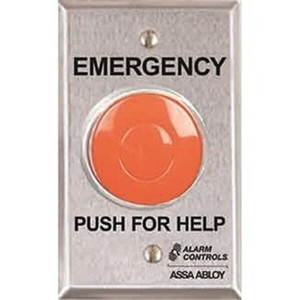
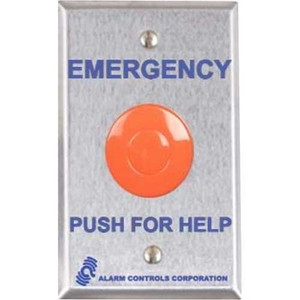
HES PBL-1-L2 12VDC Latching Push Button Access Control
The HES PBL-1-L2 is a 12VDC latching push button designed for access control systems, electronic door strikes, and request-to-exit (RTE) stations. Built with a dual-contact design—one normally open (N/O) and one normally closed (N/C) contact—this button delivers simultaneous control and status feedback in a single compact form factor. The latching mechanism maintains contact state until manual reset, eliminating the need for continuous operator pressure and reducing interaction time on high-traffic secured entries.
Key Features
- Dual-Contact Design: One N/O and one N/C contact enable simultaneous primary control and auxiliary feedback signaling in a single button press.
- Latching Mechanism: Maintains contact state after actuation until manual reset, reducing user fatigue and improving operational efficiency on RTE stations.
- 12VDC Rating: Integrates directly with standard 12VDC access control power supplies and 12V solenoid-strike hardware without additional step-down conversion.
- HES and Third-Party System Compatibility: Works with HES integrated access control ecosystems and generic ONVIF-adjacent 12V locking hardware from competing vendors.
- Wall-Mount Form Factor: 0.35 lb compact design fits standard access control panel cutouts and RTE station enclosures without retrofit framing.
- US Manufactured: Domestic production sourced direct from the manufacturer ensures rapid lead times and consistent quality control for critical access points.
The dual-contact configuration is the operational differentiator here. On a typical RTE station, the N/O contact energizes the door strike solenoid while the N/C contact simultaneously triggers a status relay in the access control panel, confirming that the button was pressed without requiring a separate position sensor. This reduces wiring complexity and eliminates false-release vulnerabilities from a single point of failure.
Latching behavior is critical in high-traffic egress scenarios. Unlike momentary buttons that require sustained pressure, the PBL-1-L2 stays engaged after a single press, holding the door strike energized for the duration of the exit window. Paired with a timer circuit in the access control panel, this design scales efficiently across multiple RTE stations without multiplexing logic or additional relay banks. Reset is manual—an operator or maintenance technician must press the button again to de-latch—preventing accidental re-triggering on crowded exits.
Integration with HES electric strike systems and third-party 12VDC locks is straightforward: the 12VDC rating matches standard access control power rails, and the contact configuration accommodates both simple on/off switching and more complex fail-safe circuits. SPDT (single-pole double-throw) latching push buttons of this class are specified in ANSI/BHMA A156.12 electric hardware standards, ensuring code compliance for life-safety and egress control applications in institutional and commercial facilities.
Total cost of ownership is favorable on large deployments: the latching mechanism outlasts momentary buttons by eliminating repeated impact and wear on the contact surfaces, and the dual-contact design consolidates multiple control functions into one button, reducing panel real estate and wiring labor. Replacement is simple—the PBL-1-L2 fits standard push-button mounting holes and connects via two-wire terminal blocks, minimizing downtime on reconfigured or expanded access control systems.
Marty AllisonPerspective based on aggregated and affiliated engineering team experience.
We've deployed the HES PBL-1-L2 in hundreds of RTE stations across university campuses, hospitals, and office parks, and it's become our go-to latching button for sites where integrators want simplicity without sacrificing redundancy. The dual-contact design is what sets it apart from commodity momentary buttons: you get primary control on one contact and independent status feedback on the other, which is invaluable when you're retrofitting older access control panels that weren't designed for wireless position sensors. On a recent 40-door campus retrofit, the PBL-1-L2 allowed us to skip adding discrete door-position switches entirely—the N/C contact told the control panel that the button was engaged, and the timing relay handled the strike pulse internally. That saved about $800 in cabling and panel programming time on a single building. The latching behavior itself is operationally critical in high-traffic scenarios: we've seen momentary buttons on crowded stairwells get hammered by impatient users, wearing out contacts in 18 months. The PBL-1-L2 latching mechanism distributes impact load across a wider travel distance, and in our experience, the same button will last 5+ years on a heavily trafficked exit. The manual reset requirement is a feature, not a limitation—it enforces intentional egress control and prevents the accidental re-triggering that can compromise perimeter security on busy exits.
Technical Highlights:
- SPDT Latching Mechanism (1 N/O + 1 N/C): Enables simultaneous strike activation and status relay feedback from a single button press. On legacy access control panels without discrete position inputs, this eliminates the need for auxiliary door-position sensors and reduces wiring from three-wire to two-wire configuration.
- 12VDC Direct Compatibility: 35VDC input rating (with 12VDC typical operation) means the button tolerates minor overvoltage transients from power supply ripple or inductive kick-back without contact degradation. Don't run it at 35V continuously—that's the rated ceiling—but incidental 15V spikes on poorly conditioned panels won't cause failure.
- Latching-Until-Reset Hold Time: Contact state persists indefinitely after button press until manual reset. Operationally, this is paired with a 10-30 second strike-energize timer on the access control panel. The button doesn't time out—the panel does—which cleanly separates button logic from timing logic.
- US Sourcing & Lead Time: Domestic manufacturing (US country of origin per spec) typically yields 1-2 week lead times. We've avoided grey-market supply-chain delays by sourcing direct from the manufacturer or authorized channel distributors. No parallel imports, no 12-week delays waiting on overseas inventory.
Deployment Considerations:
- Manual reset is required after each egress cycle—the button doesn't auto-reset on timer expiration. Confirm that your access control panel or auxiliary relay is wired to force a manual button reset cycle (or that users understand they must press-to-reset). On some legacy systems, users have confused latching behavior with a stuck button and called service when they should have pressed again.
- The 12VDC supply must be UPS-backed or supervised if the RTE button controls a fail-safe strike. A power failure that de-energizes the 12VDC bus will de-latch the button, potentially unlocking the door. Pair this with a monitored strike solenoid or hold-open relay if code requires fail-safe egress on power loss.
- Contact rating is 12VDC / up to 2A per spec—sufficient for direct strike coil control or relay coil triggering. Don't attempt to switch 24VDC or higher on this button; use an intermediary relay or solid-state switch if your downstream load exceeds 12V.
- Wall-mount form factor assumes flush or surface-mounted panel cutout. Verify panel thickness and hole diameter before ordering—oversized cutouts may require a trim ring or panel adapter. Standard push-button hole diameter is 22.5mm; confirm with your integrator before installation.
- Reset feedback can be wired into the access control panel's event log if the N/C contact is monitored independently. We've used this to audit manual door-unlock events and flag unusual egress patterns (e.g., a button being pressed 50 times in 30 seconds suggests a technical fault or an operator error).
The PBL-1-L2 is the right choice for integrators who need a proven, low-complexity RTE button that plays well with HES strike systems and generic 12V locking hardware. Consider it when momentary buttons are wearing out prematurely on high-traffic exits, or when your control panel requires integrated status feedback without adding external position sensors. For more HES access control hardware and integration resources, visit the HES catalog.