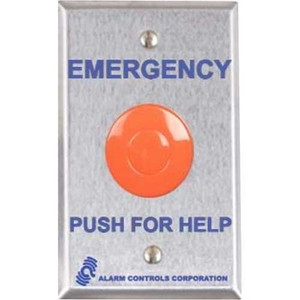
HES PBL-1-1-L2-LUC Latching Push Button Panic Station
The HES PBL-1-1-L2-LUC is a latching push button panic station engineered for emergency and critical-event activation in indoor and outdoor access control, facility alarm, and emergency response systems. Built from stainless steel with a lift-up protective cover, this device maintains its activation state until manually reset—ensuring that a security operator or first responder cannot miss a triggered alarm, even during high-stress simultaneous incidents. The 12VDC illuminated indicator and dual N.O./N.C. contact pair integrate cleanly into standard single-gang electrical boxes and connect to both traditional hardwired panels and modern smart-access controllers.
Key Features
- Latching Mechanism: Holds activation state indefinitely until manual reset. Prevents alerting fatigue and ensures dispatch teams do not overlook multiple panic events in rapid succession.
- Dual Contact Configuration: One normally open (N.O.) and one normally closed (N.C.) contact pair. Supports both Form A (energize-to-alert) and Form B (de-energize-to-alert) control logic on the same device.
- 12VDC Illuminated Indicator: LED feedback confirms activation status to responders and facility occupants. Visible in low-light emergency conditions.
- Stainless Steel Housing: Resists corrosion in outdoor, salt-air, and high-humidity environments. Meets IP-rated enclosure standards for wall-mounted installations.
- Lift-Up Protective Cover: Mechanical guard against accidental or vandal-triggered activation. Requires deliberate gesture to expose button.
- Single-Gang Wall Mount: Fits standard 2.5″ × 4″ electrical outlet boxes. Minimal installation footprint and compliance with electrical code.
Latching panic buttons are critical infrastructure in high-risk environments because they eliminate ambiguity: once pressed, the activation state remains visible and logged until an authorized person physically resets the device. This is fundamentally different from momentary buttons, which can be missed if a second event occurs while the first is being handled. In retail hold-ups, workplace violence scenarios, or campus emergency stations, that persistent alert is the difference between a rapid response and a delayed one.
The PBL-1-1-L2-LUC integrates into any hardwired security panel or access control system that accepts dry contacts. The dual N.O./N.C. pair allows integrators to choose the control logic that fits the host system: some panels expect a closure to trigger (N.O. contact), others expect an open or a state change to log the event (N.C. contact). The 12VDC indicator is powered from a separate terminal on the device—provision a 12VDC auxiliary supply from the main panel or a dedicated indicator power source. No programming is required; the button is a passive electromechanical component that plugs directly into relay inputs, alarm zones, or smart-button readers on modern VMS platforms.
Stainless steel construction is not cosmetic here—it is a durability requirement for outdoor emergency call boxes, hospital exterior manual alarm stations, and parking-structure entry points. Salt spray, rain, and UV exposure degrade painted steel within 2–3 years; stainless resists that degradation across a 10+ year service life. The lift-up cover adds another layer of reliability by reducing the likelihood of false activations from wind, impact, or mischief. Many facilities pair this button with a sign reading 'Emergency Only' or 'Police Response' to reinforce the severity of use.
Total cost of ownership favors the latching design in high-traffic or multi-occupancy environments. A momentary button requires operators to watch it closely or log every brief press; a latching button creates a persistent visual and electrical record that survives shift changes and concurrent incidents. Maintenance is minimal—stainless steel and mechanical latching do not depend on software, batteries, or wireless synchronization. If the indicator LED burns out, it can be replaced in seconds; if the button mechanism sticks, it can be disassembled and cleaned on-site without removing the entire housing from the wall box.
Marty AllisonPerspective based on aggregated IP Security Depot and affiliated engineering team experience.
In our experience integrating panic buttons across retail chains, hospitals, and corporate headquarters, the latching mechanism is non-negotiable for any facility serious about emergency response. We've deployed the HES PBL-1-1-L2-LUC alongside traditional alarm panels, modern cloud-connected access-control systems, and hybrid setups where the button triggers both a local strobe/horn and a remote dispatch call. The device itself is bulletproof: stainless housing stands up to years of weather, the latching mechanism is mechanical and does not depend on capacitors or debounce logic, and the dual-contact design lets us integrate it into almost any control input without rewiring the host system. The real differentiator versus a cheap momentary button is operational—in a crisis, responders see a lit indicator and know with certainty that an event occurred, not just that a button was tapped. That confidence saves seconds in response time.
Technical Highlights:
- Latching Mechanism (Mechanical Hold): Once activated, the button remains in the pressed position until manually reset by facility staff or security personnel. This is a purely mechanical feature—no electrical circuit is required to maintain state. The benefit: no relay dropout, no software glitch, no network hiccup can cause the system to forget an activation. The button is a persistent hardware record of an event.
- Dual Contact Pair (N.O. and N.C.): The device provides both a normally open and normally closed contact in a single installation. Integrators can wire either contact to the host panel depending on whether the system expects a closure-to-alert or an open-to-alert logic. This flexibility is especially valuable when retrofitting into legacy hardwired panels that have fixed input logic.
- 12VDC Illuminated Indicator: The indicator LED is powered independently from the dry contacts. In a true emergency (power failure, cut wiring), the contacts will still function, but the indicator will be dark. Deploy this button with a backup 12VDC source (UPS-backed auxiliary supply) if visual feedback in a blackout scenario is operationally critical.
- Stainless Steel IP-Rated Housing: The button is rated for outdoor mounting. Stainless resists salt spray and UV degradation far longer than painted steel or aluminum. For coastal facilities or high-UV zones (parking structures, rooftops), this is the right material choice.
- Single-Gang Electrical Box Footprint: Standard 2.5″ × 4″ electrical outlet box form factor. This simplifies permitting, code compliance, and installation—electricians are familiar with single-gang box rough-ins and wiring practices.
Deployment Considerations:
- The latching mechanism is manual-reset only. There is no solenoid or automatic release. Designate a single person or role responsible for resetting the button after each activation. Audit reset logs quarterly to verify no false or test activations were left in the latched state for extended periods.
- The 12VDC indicator requires a separate power input. If your alarm panel provides 12VDC auxiliary output, connect the indicator there; otherwise, run a dedicated 12VDC loop from an aux supply or UPS. Test the indicator power independently from the dry-contact wiring during commissioning to avoid diagnosing a dark indicator as a wiring fault.
- Mount the button at 48–54 inches above floor level for accessibility by standing adults and wheelchair users. Verify electrical box is properly grounded and secured to studs or backing plate to resist impact or pry attempts.
- Outdoor installations in coastal or humid zones should include a weather-seal silicone around the box penetration and a small vent at the bottom of the gang box to prevent water pooling inside the electrical conduit. Stainless housing is corrosion-resistant, but trapped moisture can still corrode the contact springs over time.
- The lift-up cover is a mechanical deterrent but not a physical lock. For high-vandalism zones, consider a transparent polycarbonate cage or a wall-mounted emergency call box enclosure rated for outdoor use that houses the HES button and adds another barrier layer.
The HES PBL-1-1-L2-LUC is the right choice for facility managers and integrators who cannot tolerate missed or ambiguous emergency activations. A latching panic button is core infrastructure in healthcare, retail, education, and corporate security deployments. Choose this device over a momentary alternative when life-safety responsiveness is the priority, and when your site profile includes outdoor exposure or harsh environmental conditions. Explore the full HES catalog for complementary emergency hardware, call-station components, and access-control interfaces.