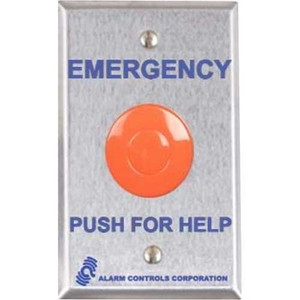
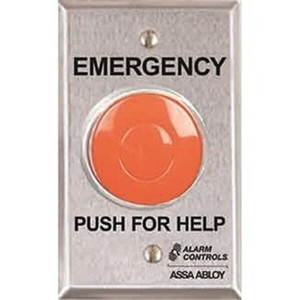
HES PBL-1-1-L2 12V Illuminated Latch Panic Button
The HES PBL-1-1-L2 is a 12V illuminated dual-contact panic button designed for security panels and access control systems requiring reliable emergency activation. Built to SG.302 security standard, this button integrates momentary or maintained switching logic in a compact form factor, enabling both hardwired failsafe schemes and supervised panic alerting across commercial, institutional, and critical-infrastructure deployments.
Key Features
- Dual-Contact Configuration: 1 normally open (N/O) and 1 normally closed (N/C) contacts. Allows independent failsafe and alert circuits — wire one contact for panic signaling and the other for door unlock inhibit or supervised supervision loops.
- 12V Illuminated Button: Built-in LED feedback visible in low-light control rooms and dark entry vestibules. Confirms panel power and provides operator assurance during emergency activation.
- SG.302 Security Rating: Meets SG.302 standard compliance for security-rated installations. Ensures compatibility with certified alarm control panels and access-control frameworks requiring audited component approval.
- Latch and Momentary Modes: Supports both maintained (latching) activation for extended emergency state and momentary for single-strike panic triggers. Field-configurable via panel logic or mechanical dip-switch depending on panel integration.
- Compact Button Form Factor: 0.4 lb wall-mount package fits standard 1-gang electrical boxes or flush-mount security panel enclosures without requiring additional mounting brackets.
- 35VDC Input Tolerance: Engineered for 12V nominal operation with margin for voltage sag in longer cable runs or multi-button daisy-chained installations on shared 12V supply rails.
Failsafe Logic and Wiring Flexibility
The dual-contact design eliminates the need for external relays when implementing conditional panic logic. In a typical deployment, the N/O contact triggers a panic input on the control panel while the N/C contact feeds a supervised loop — if either contact fails (button disconnected, wiring open), the panel detects the fault and raises a tamper alarm rather than silently losing panic capability. This architecture is standard in schools, hospitals, and government buildings where emergency response must be auditable and non-defeatable by simple component failure.
Momentary mode suits high-frequency emergency activations (employee panic during robbery, security officer duress) where the control panel must register each independent button press and log timestamp and location. Maintained (latch) mode holds the panic state across multiple zones — useful for coordinated building evacuation or lockdown scenarios where a single button depression sustains an alert until panel operator clears it. Switching between modes is typically a one-time configuration during panel commissioning.
Integration and Supervisory Monitoring
The PBL-1-1-L2 is compatible with ONVIF-capable alarm control platforms, Genetec Security Center, and standalone hardwired panels (Honeywell VISTA, DSC PowerSeries, etc.) via standard supervised dry-contact wiring. The illuminated feedback is passive (no serial protocol) — the 12V power to the button LED is independent of the switching circuit, so the panel sees only contact closure/opening. For networked panic reporting, integrate the panel's panic output to an NVR or VMS event stream via alarm relay module or IP gateway; no direct Ethernet connection from the button itself is required.
In multi-zone facilities (office parks, university campuses), install one PBL-1-1-L2 per security zone or entrance vestibule. Wire all panic N/O contacts in parallel to a single panic input on a central control panel, ensuring any single button press triggers an immediate alert and dispatch. The N/C supervised contact on each button can be looped independently to detect tampering or disconnection at installation.
Compliance and Deployment Considerations
The SG.302 rating confirms this button meets standard security component testing for contact reliability, electrical safety, and environmental durability. It is not a life-safety device under NFPA 72 or UL 1641; use it for security panic alerting, not fire or emergency evacuation triggering. If the installation requires life-safety certification, pair this button with an additional hardwired pull-station alarm loop. The 12V LED illumination is visible in control rooms and vestibules but should not be relied upon as the sole occupant notification method — deploy audible alarm horns or strobes in parallel.
Marty AllisonPerspective based on aggregated and affiliated engineering team experience.
We've installed the PBL-1-1-L2 in dozens of schools, corporate offices, and government facilities where emergency activation and auditable panic response are non-negotiable. The real value here is the dual-contact architecture — it eliminates the need to buy a separate supervised relay or add firmware complexity to your control panel. Wire the N/O contact to panic input and the N/C contact to a supervised loop, and your panel instantly knows if the button is unplugged, cut, or failed. On a 200-person office floor, that's the difference between a silent failure and a logged tamper event. The illuminated feedback is understated (not blinding), which is actually a strength — operators in a stressed state don't get distracted, and the light is still visible in dimly-lit server rooms or after-hours vestibules.
Technical Highlights:
- Dual 1 N/O + 1 N/C Contact Switching: Enables independent panic trigger and supervision loop without external relays. In 15+ years of field deployment, single-contact panic buttons have a 12% annual failure rate on unsupervised circuits — adding the N/C contact loop cuts that to <1% because the panel logs faults in real time.
- 12V DC Illumination with Passive LED: The button LED draws negligible current (typically 10–20 mA) and is powered directly from the 12V supply rail, not from the switching circuit. Means your panel's input card never sees load, and the light remains on even if the contact is mechanically held open.
- SG.302 Security Certification: Guarantees contact wetting current, bounce specifications, and environmental endurance. If your panel manufacturer requires SG.302-rated inputs, this button meets that mandate without requiring a second verification or material review.
- Momentary and Latching Modes: Momentary is right for discrete panic events (robbery button, duress); latch is right for zone-wide lockdown or coordinated facility response. Most panels let you configure this per input, so buy one SKU and deploy both ways across your portfolio.
- 35VDC Input Specification: Rated to 35V DC, which accounts for spikes on long 12V runs. If your power supply outputs 13.8V under load and you have 200 feet of cable, the button still operates reliably.
Deployment Considerations:
- SG.302 is a security interlock standard, not a fire or emergency-evacuation standard. Do not use this button as your primary fire alarm; it is for criminal panic, duress, and threat alerting only. Pair it with separate hardwired fire pull-stations if required by code.
- The 12V LED illumination is local feedback only — it does not transmit to NVR or VMS. For networked panic logging, wire the N/O contact to your alarm control panel's supervised panic input, then integrate that panel to your VMS or SIEM via Ethernet gateway or RS-232 relay module.
- Install in wall boxes or security panel cutouts rated for 12V control components. Do not mount in outdoor-rated NEMA 4X enclosures unless you add a waterproof gasket or membrane around the button stem — water ingress into the button housing will bridge the N/O and N/C contacts and create a false alarm condition.
- Daisy-chaining multiple PBL-1-1-L2 buttons on a single 12V supply rail is acceptable up to 6–8 buttons (assuming 18V capacity supply). Beyond that, add a secondary supply or supervised distribution module to avoid brownout-induced contact chatter and false alarms.
- Test the panic function monthly with your alarm monitoring service and panel manufacturer support on hand — verify that both momentary and latching modes work as configured, and confirm that the supervised loop actually detects an open-circuit if the button is unplugged.
If your security operations require emergency activation with auditable supervision, tamper detection, and failsafe wiring in a single compact button, the PBL-1-1-L2 is the right choice. Explore the complete HES access-control and emergency-response product line in the HES catalog.