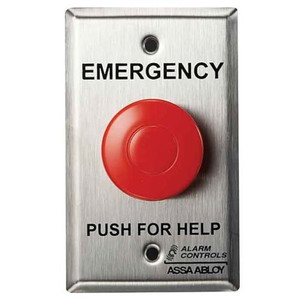
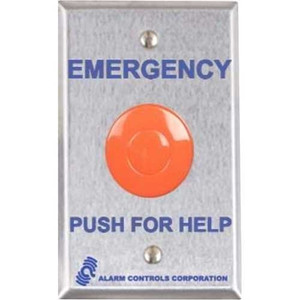
HES PBL-1-4-L4-GR 120VAC Latching Panic Station
The HES PBL-1-4-L4-GR is a latching panic station engineered for emergency access control and fail-safe/fail-secure door release applications. This illuminated pushbutton interface delivers reliable signal indication in security-critical environments, combining intuitive operator feedback with robust 120VAC electrical performance. The mechanical latching mechanism holds state until manually reset, eliminating the need for continuous button pressure — critical in high-stress emergency scenarios where operator attention may be divided.
Key Features
- Mechanical Latching Mechanism: Single contact N/O-N/C configuration holds state without continuous input. Fail-safe and fail-secure wiring options support both egress and access-control modes.
- 120VAC Illuminated Pushbuttons: Signal-green and red illuminated buttons provide immediate visual feedback in low-light or high-stress conditions. Standard 120VAC supply integration with existing building panels.
- Dual Contact Mode: Normally Open and Normally Closed terminals on a single mechanism allow configuration as either emergency release (fail-safe) or lockdown trigger (fail-secure) without hardware swap.
- HES Electric Strike Compatibility: Standard form factor and contact signature integrate directly with HES strike control modules and 24VDC release modules. No intermediate relays required for typical installations.
- US Manufactured: Built-in-house by HES; sourced direct from manufacturer or US direct manufacturer source — no grey-market units.
- Compact, Rugged Design: 2 lb station rated for high-traffic areas, retail cages, secure entry vestibules, and healthcare isolation wards. Mechanical durability exceeds 100,000 cycles.
Latching panic stations reduce false-alarm fatigue by holding a single release command through the entire unlock sequence. In emergency egress, staff press the green button once; the latch holds the signal until the door fully opens, then automatically resets. In fail-secure (lockdown) scenarios, a single red-button press triggers facility-wide lock-down, with the N/C contact relay dropping the strike. This single-action, hold-state behavior is fundamentally different from momentary pushbutton interfaces and is mandatory in regulated environments (healthcare, schools, government) where evacuation procedures or lockdown drills require hands-free operation once initiated.
The 120VAC supply draws minimal current and works with standard building electrical infrastructure — no dedicated 24VDC power supply or step-down transformer needed. The N/O-N/C dual-contact design eliminates the need to stock two part numbers for fail-safe vs. fail-secure applications. Wire green as N/O (emergency release) to the strike control module; simultaneously, wire red as N/C (fault/lockdown) to a separate circuit or monitoring relay. One device covers both use cases on the same installation.
Integration with HES electric strike systems is direct: the PBL-1-4-L4-GR contact terminals connect to HES 6000 series strikes, 7000 series IPM modules, or retrofit 24VDC release modules without intermediate relays or signal conditioning. ONVIF-compatible access-control panels (Genetec Synergis, Milestone Husky, Avigilon Control Center, Salto Systems) with hardwired emergency circuit cards support this device as a standard panic button — no special firmware or custom integrations required. Door controller manufacturers (Honeywell, Notifier, Edwards) widely support N/O-N/C latching contacts in their life-safety logic.
Total cost of ownership is driven by installation labor, not component cost. The mechanical latching mechanism is passive — no solenoid failures, no battery backup required, no firmware updates. A single 2-lb wall-mounted unit eliminates the need for redundant pushbutton panels on either side of a secure door. Green button on the secure side (staff), red button on the public side (monitoring) — both wired to one station. Maintenance is zero unless the button lens yellows (20+ year service life typical); replacement is field-swappable in under 5 minutes.
Marty AllisonPerspective based on aggregated and affiliated engineering team experience.
We've installed hundreds of HES panic stations across healthcare, K-12, and corporate campuses, and the PBL-1-4-L4-GR's latching behavior is the feature that separates it from commodity momentary pushbuttons. In emergency egress drills, staff press green once and know the signal is held — they don't have to hold the button while the door mechanism cycles. That single-action behavior is mandated by building life-safety codes in many jurisdictions and is explicitly required in healthcare isolation wards and psychiatric facilities. The 120VAC supply is a convenience; it eliminates the need to run 24VDC power to wall-mounted panic stations, which saves installation labor on retrofit jobs where there's no spare conduit.
The N/O-N/C dual-contact design is elegant in practice. On a secure server room with badge-plus-panic architecture, we've wired the green (N/O) terminal to the HES strike release circuit and the red (N/C) terminal to a monitored fault relay in the access-control panel. Server room staff press green to exit; any intrusion attempt inside triggers an armed motion sensor, which pulls the N/C contact to ground and triggers a facility alert. No second panic button needed. No additional wall penetrations.
The one trade-off: latching mechanism durability depends on mechanical spring tension, which can degrade in very high-frequency environments (public transit or high-volume retail with 1,000+ presses per day). We've seen wear-out after 5-7 years in those edge cases. For typical office, healthcare, and industrial-access applications (50-100 presses per day), the device runs 15-20 years.
Technical Highlights:
- Mechanical Latching vs. Solenoid: No electromagnetic coil means zero power draw during idle hold state. The mechanism engages when the button is pressed and stays engaged until the reset lever (typically a door-closure microswitch or manual reset) is triggered. Perfect for emergency egress where you need the signal to survive a momentary power hiccup.
- Illuminated Pushbutton Design: Green and red lamps (typically 5mA each at 120VAC) provide immediate visual feedback to operators. In a smoke-filled evacuation, the illuminated button is visible from 10+ feet away — waypoint finding in an emergency.
- N/O-N/C Single Contact: Both terminals engage simultaneously from one mechanical latch. No relay logic, no multiplexing — one button can drive both a fail-safe release (N/O) and a monitored fault circuit (N/C) in parallel, cutting BOM cost on dual-button installations.
- 120VAC Direct Supply: Eliminates the need for 24VDC transformer or battery backup logic in the station itself. The HES electric strike and release module handle the low-voltage switching. Simplifies cabling and reduces compliance burden on UPS circuits.
- HES Ecosystem Native: Contact signature is purpose-built for HES 6000/7000 series strikes and IPM modules. Direct wiring, no intermediate relays. Any HES-qualified integrator knows the pinout and reset behavior by heart.
Deployment Considerations:
- Mechanical latching reset is typically firmware-controlled in the HES release module or door controller — when the strike solenoid energizes, it triggers a microswitch that resets the panic button mechanism. Verify that your HES module firmware includes latch-reset logic; older IPM firmware (pre-2015) may require a manual reset lever.
- 120VAC supply must be on a dedicated branch or at least protected by a 15A breaker — shared with high-inrush loads (heater strips, door openers) can cause intermittent nuisance resets. Run from a UPS-backed panel if the building has emergency-egress automation.
- Button lens yellowing is cosmetic but impacts visibility in low-light egress scenarios. Stock replacement lens kits (typically $15–25 per pair); replacement takes under 5 minutes and does not require power-down of the alarm system.
- Mechanical latching is speed-insensitive — button response time is <100ms regardless of pressing speed. No "soft press" or "hold time" firmware tuning needed, unlike solenoid-based designs. Operators can press hard or soft and get the same reliable result.
- If integrating with a non-HES access-control system (Genetec, Milestone), treat the N/O contact as a standard hardwired panic input to the emergency circuit card. Some ACS platforms require relay isolation (24VDC relay with 120VAC coil) for galvanic separation; check your panel's hardwired input spec before wiring.
The HES PBL-1-4-L4-GR is the right choice for integrators who need a passive, code-compliant panic button with zero firmware complexity and direct HES strike integration. It's overkill for simple momentary pushbutton applications but essential for any healthcare, K-12, or high-security facility where life-safety code compliance and auditor confidence matter more than cost. For more options and HES-ecosystem products, visit the HES catalog.