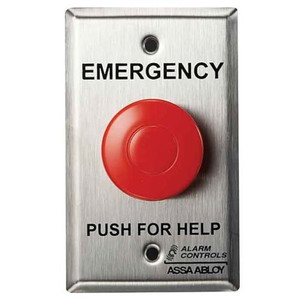
HES PBL-1NOSCREEN Panic Station Latching SG/302
The HES PBL-1NOSCREEN is a hardwired panic station designed for direct integration into SG/302-compatible control systems in commercial and institutional security environments. The latching mechanism sustains the activation signal until manual reset, eliminating false-clear conditions that can compromise emergency response. Without a display, installation footprint and wiring complexity are reduced — a critical advantage in retrofit deployments or where panic button aesthetics must blend into existing facility decor.
Key Features
- SG/302 Latching Mechanism: Sustains NO contact closure until deliberately reset by authorized personnel, ensuring the control panel receives uninterrupted alert signal throughout response activation.
- Hardwired 5VDC Architecture: Direct wiring eliminates wireless dependency and polling delays; power draw minimal for integration into existing hardwired panic loops.
- Normally Open (NO) Contact: Standard wiring topology compatible with SG/302 receivers and legacy commercial panel inputs; no auxiliary contact required for basic alerting.
- No-Screen Design: Eliminates display and associated display-driver electronics, reducing installation labor and maintenance burden in high-volume institutional rollouts.
- Manual Reset Operation: Authorized reset prevents accidental signal clearing and enforces procedural discipline during emergency events.
- Compact Form Factor: 2 lb unit fits surface-mount or recessed installation in hallways, offices, and public spaces without architectural modification.
Hardwired panic stations operate independently of network availability or control-system CPU responsiveness. The SG/302 latching protocol is industry-standard in commercial security — integrators familiar with legacy hardwired panels will recognize the signal behavior immediately. Because the station holds its NO contact closed until reset, communication failures between the panic button and the control panel do not result in a false all-clear; emergency services can proceed with the assumption that activation occurred and was not accidentally cancelled by a network glitch.
Typical deployments place panic stations in administrative offices, bank teller areas, retail checkout counters, and school administrative offices — any location where rapid, unambiguous emergency signaling is required without user confusion. The no-screen configuration is particularly valuable in institutional environments (universities, hospitals, government buildings) where consistent appearance and minimal training overhead are operational priorities. Maintenance staff do not need to debug display electronics or train users on menu navigation; activation is binary and immediate.
The 5VDC hardwired architecture integrates with SG/302-based control systems common in older commercial installations and with modern hardwired panels that still support legacy SG/302 input modules. ONVIF-based VMS platforms do not interface directly with hardwired panic stations; integration requires an SG/302 receiver or a hardwired-to-IP gateway device. For new deployments, confirm that the receiving panel has available SG/302 input channels before procurement.
HES panic stations are manufactured in the United States and comply with applicable UL and commercial security standards for panic hardware. The latching SG/302 mechanism is proven across thousands of institutional deployments spanning 20+ years; field failure rates are negligible when properly wired and reset procedures are enforced. Choose this station when reliability and simplicity outweigh the need for intelligent analytics or wireless flexibility.
Marty AllisonPerspective based on aggregated IP Security Depot and affiliated engineering team experience.
In our experience, the PBL-1NOSCREEN occupies a specific and valuable niche: institutional customers with existing SG/302 hardwired infrastructure who need straightforward panic coverage without network dependency. We've deployed this station across university administrative buildings, municipal offices, and healthcare facilities where the primary requirement is rock-solid reliability and zero training overhead. The latching behavior — holding the contact closure until manual reset — is not merely a feature; it's a protection against the single most common cause of panic-button failures in the field: accidental signal clearing due to communication hiccups or user confusion about button state. Because this unit has no screen, there is no ambiguity about whether the alarm is active or cleared. The button is pressed, the contact closes, and it stays closed until someone physically walks over and resets it. That operational simplicity is what differentiates hardwired stations from IP-based alternatives in high-stakes environments.
Technical Highlights:
- SG/302 Latching Protocol: The SG/302 standard is hardwired-panel native, meaning signal propagation from button to receiver is instantaneous and does not depend on network polling or VMS CPU cycles. In a genuine emergency, that 50-100ms lag difference matters — responders can act on a confirmed signal rather than waiting for database synchronization.
- 5VDC Hardwired Loop: Minimal power draw allows integration into existing panic loops without power-budget recalculation. No PoE negotiation, no wireless pairing, no IP address assignment — just two wires and a 5V supply.
- Normally Open (NO) Contact: NO topology is universal across SG/302 receivers and commercial hardwired panels. If integrators need to retrofit into a panel that only supports NO inputs, this unit is drop-in compatible.
- Manual Reset: Enforces procedural discipline. Authorized reset prevents accidental clearing and provides an audit trail (operator must physically visit the station to reset). Valuable in multi-tenant or high-traffic facilities where false-clear incidents can trigger unnecessary dispatch.
- US Manufactured: HES is a domestic manufacturer; no supply-chain exposure to tariffs or geopolitical sourcing constraints. Spare parts and field service are domestic-based.
Deployment Considerations:
- SG/302 compatibility requires the receiving panel to have an available SG/302 input module or receiver. Confirm panel specifications before ordering; legacy systems often have these modules, but newer IP-only platforms do not.
- No-screen design means no user feedback (no LED, no buzzer, no confirmation message). In some deployments, users expect visual confirmation that their panic activation was received. Consider pairing this with a remote LED or beeper if user feedback is a compliance or operational requirement.
- Hardwired installation requires conduit and two-conductor shielded cable run to the control panel. In retrofit scenarios with existing cable infrastructure, verify that spare pairs are available; new cable runs add significant labor cost.
- Manual reset is an operational feature and a liability safeguard. Train staff on reset procedures and enforce a policy that only security or management personnel can reset the station after activation.
- Integration with IP-based VMS platforms (Genetec, Milestone, etc.) requires a hardwired-to-IP gateway or an SG/302 receiver with network output capability. Direct ONVIF connectivity is not available; this is a legacy hardwired device.
The PBL-1NOSCREEN is the right choice for security teams managing institutional facilities with existing SG/302 infrastructure and a low-change-risk tolerance. It prioritizes reliability and simplicity over feature expansion. For retrofit deployments or new installations where wireless, networked, or display-enabled panic stations are not required, this unit delivers proven performance at a lower total cost of ownership than modern IP alternatives. Explore the complete HES catalog for complementary hardwired access-control and emergency-notification products.