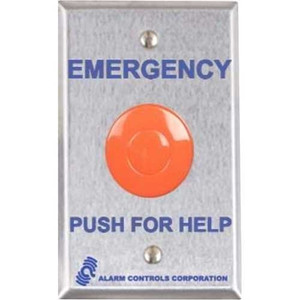
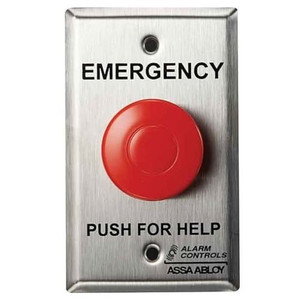
HES PBL-1-4-GR Latch Panic Button Dual Contact
The HES PBL-1-4-GR is a latch-action panic button designed for emergency response integration in access control and alarm systems. Its dual-contact design—one normally open (N/O) and one normally closed (N/C)—enables simultaneous activation of multiple response pathways: one circuit can trigger an alarm while the other confirms button press to a monitoring system. The latch mechanism holds the signal active until manual reset, ensuring responders receive persistent notification even after release. Finished in high-visibility red with a protective guard and available in wall or panel mount configurations, this button is purpose-built for workplace violence protocols, facility emergency drills, and security system redundancy.
Key Features
- Dual Contact Output: 1 N/O + 1 N/C contact pair. Simultaneous activation supports independent alarm and confirmation signaling without relay logic.
- Latch-Action Mechanism: Signal persists after button release until manual reset. Prevents signal loss during emergency response coordination.
- High-Visibility Red with Guard: Protective shroud reduces accidental activation while maintaining tactile emergency access under stress.
- Wall and Panel Mount: Flexible installation—wall-mounted for reception areas and panic zones, panel-mount for control room integration.
- HES and Third-Party Compatibility: Works with HES access control systems and certified alarm panels supporting dry-contact inputs.
- Compact Mini Form Factor: Space-efficient design for tight mounting locations without sacrificing durability.
The dual-contact architecture is the operational differentiator here. In workplace violence or active threat scenarios, you need both an immediate alarm signal (N/O contact closing a siren circuit) and a confirmation signal (N/C contact opening a normal-state circuit) that reaches a monitoring station or central panel. A single-contact button forces you to choose one pathway; the PBL-1-4-GR eliminates that trade-off. The latch mechanism is equally critical—panic buttons in high-stress events are often held longer than intended, or pressed multiple times. A latching design sustains the alert signal through the entire response window, preventing responders from missing a critical message because the button was released too early.
Deployment contexts vary widely: corporate security teams position these at reception desks or in manager offices; hospitals place them in psychiatric and emergency departments; financial institutions mount them in teller areas and vault antechambers; retail loss-prevention teams integrate them into back-of-house or cash office spaces. In each case, the button must be instantly recognizable under duress—the red finish and guard accomplish that—and it must integrate cleanly with existing alarm logic without requiring a separate relay panel. The dual-contact output handles both HES native systems and third-party panels (Honeywell, Bosch, ADT) that accept dry-contact inputs, which simplifies procurement and reduces spare-parts overhead in heterogeneous security environments.
Integration is straightforward: connect the N/O contact to an alarm input (siren trigger or central station signal) and the N/C contact to a confirmation input on your monitoring panel. Most certified alarm panels and HES control units provide at least two dedicated input zones for panic buttons, so wiring is typically one four-conductor cable per button. Reset is manual—someone with access to the button location presses it again (or triggers a system reset) to return it to ready state. This intentional manual reset prevents accidental re-arming and ensures that any button press during an emergency is logged and requires explicit acknowledgment by security staff.
Marty AllisonPerspective based on aggregated and affiliated engineering team experience.
We've installed panic buttons across corporate, healthcare, and retail deployments, and the PBL-1-4-GR's dual-contact design solves a persistent integration headache. Most single-contact panic buttons force you to choose between an immediate alarm output or a confirmation signal—this button gives you both simultaneously without additional relay logic. In a workplace violence scenario, you need the alarm to sound instantly while the monitoring panel also captures proof that the button was pressed. The latch mechanism is equally pragmatic: in high-stress situations, button presses are often held or repeated; a momentary contact risks losing the signal entirely. The latching design persists through that confusion and ensures responders get a clean, unambiguous alert. The protective guard is thoughtful too—it prevents accidental activation from a guest or contractor leaning against a wall, which we've seen twice at retail sites. The high-visibility red is instantly recognizable even under poor lighting or in a panic state. On integration, the button plays well with HES native systems and also accepts dry-contact inputs from third-party alarm panels (Honeywell, Bosch, DSC), which matters in larger enterprises where security infrastructure is mixed. One caveat: verify your panel's input impedance and contact-rating specs before wiring. Some older alarm panels have contact inputs rated for 100mA max at 12V; the PBL-1-4-GR is rated for standard industrial loads, but if your panel has unusual contact specs, you may need a relay buffer. Installation is straightforward—wall-mount or panel-mount, four-conductor cable, and a manual reset acknowledgment from security staff. The reset mechanism is intentional: it prevents accidental re-arming and logs exactly when the button was cleared, which is valuable for post-incident review.
Technical Highlights:
- Dual Contact (N/O + N/C): Eliminates the need for external relay logic to drive both alarm and confirmation circuits. One button press triggers simultaneous pathways—faster response, fewer failure points.
- Latch-Action with Manual Reset: Signal persists after release until manually reset by security staff. Critical for high-stress scenarios where button press duration is unpredictable; ensures no signal loss during the response window.
- High-Visibility Red + Guard: Protective shroud reduces accidental activation (we've seen false-alarms from people leaning on unguarded buttons), while red finish ensures instant recognition under poor visibility or panic conditions.
- Wall and Panel Mount Flexibility: Accommodates both reception-area and control-room installations without adapter plates. Simplifies retrofit into existing access-control cabinets or as a standalone wall-mounted emergency station.
- HES and Third-Party Certified: Works with HES native systems and dry-contact-input alarm panels from Honeywell, Bosch, DSC. Reduces procurement lock-in and simplifies maintenance in mixed-vendor environments.
Deployment Considerations:
- Verify panel contact-input specifications (voltage, impedance, max current) before final integration. Older alarm panels may require a relay buffer if contact specs are non-standard.
- Train security staff on manual reset procedure. The latch mechanism is intentionally persistent; some operators expect momentary buttons and may not realize the button requires explicit reset.
- Position the button within arm's reach of staff in the protected zone (reception, manager office, teller area) but not so accessible that a hostile actor can activate it before a breach occurs.
- Use a four-conductor cable for N/O and N/C circuits; avoid shared ground paths if the alarm and confirmation circuits feed different system branches (separate power supplies, different zones). Isolation prevents cross-talk.
- Log every button reset in your access-control audit trail. This creates a clear timeline for post-incident review and helps distinguish between drills, accidental presses, and genuine emergencies.
The PBL-1-4-GR is the right choice for any security deployment where you need both immediate alarm output and persistent confirmation signaling without additional relay hardware. Integrators and end-user security teams with heterogeneous panel ecosystems appreciate the HES/third-party compatibility. For detailed integration specs and compatibility confirmation, consult the HES catalog.