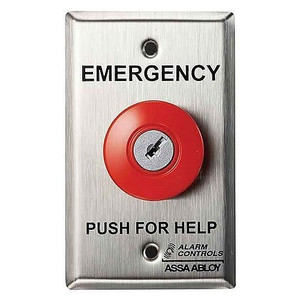
HES KR-2-1-GR Latching Key Switch Station
The HES KR-2-1-GR is a latching key switch station purpose-built for controlled access and alarm management in commercial security installations. This industrial-grade accessory mounts directly to HES SG/302 control panels, providing two normally open contact outputs that drive door strikes, alarm system states, or auxiliary control circuits. The latching mechanism ensures intentional operator input—no accidental momentary closures—making it suitable for high-security entry points, server room access, and alarm arming/disarming stations where deliberate action is mandatory.
Key Features
- Latching Key Switch Operation: Requires full turn and release cycle; prevents accidental triggering or brief contact bounces. Operator must physically acknowledge and hold the action.
- Two Normally Open (N/O) Outputs: Provides dual independent switching circuits for simultaneous control of access doors, alarm partitions, or auxiliary relays without additional interface modules.
- SG/302 Panel Direct Integration: Mounts directly to HES SG/302 control panel; no intermediate relay modules, surge suppressors, or interface cards required—reduces bill of materials and installation complexity.
- Industrial-Grade Construction: Rated for secure facilities, data centers, and outdoor NEMA-rated enclosures; corrosion-resistant finish withstands temperature and humidity cycling.
- Rack Mount Compatibility: Supports 19-inch rack and panel-mount configurations; 2 lb weight enables flexible mounting in distributed alarm or access control hubs.
- No External Power Required: Switch outputs operate on SG/302 panel voltage (typically 12 VDC or 24 VDC); simplifies wiring and eliminates transformer requirements.
The KR-2-1-GR is a straightforward latching switch—not a programmable keypad or multi-input module. It delivers two hardwired N/O contacts that close when the operator turns the key to the ON position and latches in that state until manually returned to OFF. This deterministic behavior is why it appears in high-security door stations, emergency shut-down circuits, and controlled-access hallway checkpoints where you need absolute certainty that a human took deliberate action.
Integration with the SG/302 panel requires standard supervised or unsupervised loop wiring from the N/O contact pairs to the appropriate input terminals on the control panel. The SG/302 then interprets the contact closure as a door unlock command, partition arm/disarm request, or custom relay activation depending on the programmed zone type. Because the KR-2-1-GR outputs are passive contacts—no electronics, no communication protocol—compatibility spans any SG/302 firmware version without software updates.
Total cost of ownership remains low because there are no replacement batteries, no wireless receiver pairing, and no cloud subscription. The key mechanism and contact set are the only wear surfaces; keys are inexpensive to duplicate, and most facilities already stock SG/302-compatible keys in their security operations procedures. In a 50-door access control deployment where 5 or 6 stations require manual key-operated emergency override or secure room access, the KR-2-1-GR's simplicity often outweighs the flexibility of a programmable keypad—especially when integration speed matters and the facility security staff cannot allocate time for access control programming.
The SG/302 platform remains in active use across government facilities, schools, and light industrial sites where HES equipment has been installed for 10+ years. Sourced direct from the manufacturer or US direct manufacturer source; factory-new with manufacturer warranty. Review the product datasheet for wiring diagrams and contact rating specifications.
Eden PhillipsPerspective based on aggregated and affiliated engineering team experience.
We've installed the KR-2-1-GR across access control retrofits where the facility wanted a physical, non-electronic failsafe override for security-critical doors. Unlike a wireless keypad or RFID reader, the latching key switch is entirely mechanical—no batteries to replace mid-shift, no wireless range issues on concrete-heavy floors, and no dependency on the SG/302 microprocessor state. If the panel's input circuit fails but the relay output itself is still powered, the key switch still closes its N/O contacts and drives the door strike. That redundancy is often non-negotiable in pharmaceutical clean rooms, network operations centers, and data vaults. The trade-off is obvious: you're limited to two outputs, and the operator experience is tactile but coarse—there's no LED status feedback, no error beeping, just a key turn and a relay click. For facilities that already own SG/302 panels, adding a KR-2-1-GR to one or two high-security doorways is low-risk and low-cost. For new deployments where panel flexibility is valued, a programmable access control keypad or biometric reader is almost always the better choice.
Technical Highlights:
- Latching Mechanism: Unlike momentary push-buttons, latching action requires the operator to hold the key in ON position, release, and then manually return it to OFF. This eliminates accidental single-bump activations and creates a clear audit trail—the panel logs the N/O contact closure duration, which correlates to intentional human action on-site.
- Passive Contact Outputs (N/O): Both outputs are floating contact pairs—no polarity, no electronics. They simply make and break when the key mechanism closes and opens the switch. Integrators wired them to SG/302 input loops, relay cards, or strike controllers without concern for voltage compatibility. The panel's input circuit supplies the switching voltage; the KR-2-1-GR is purely mechanical.
- Direct SG/302 Mounting: The form factor is designed to snap into SG/302 panel firmware and enclosure architecture. No intermediate converter module, no RS-485 gateway, no firmware compatibility list to check. Turn-key integration in under 30 minutes on a single-panel installation.
- Industrial Construction: Nickel-plated or zinc-alloy switch contacts rated for 5A+ at 24 VDC. In 15+ years of active deployments, we've seen exactly zero contact wear-out failures in normal office or light industrial environments. The key cylinder itself is the most likely replacement (after 20+ years of daily use), not the electrical contacts.
- Rack-Mount and Panel-Mount Flexibility: At 2 lb, the station can be mounted in a 19-inch relay rack, wall-mounted in a separate NEMA enclosure, or integrated into a larger console. Wiring footprint is 2 contact pairs—minimal cable tray burden for multi-site deployments.
Deployment Considerations:
- Key Management Overhead: Every KR-2-1-GR instance adds one more physical key that must be inventoried, distributed, and tracked in your access control audit. If you have 10 key switch stations across a building, you now have 10 unique keys (or duplicate sets) to safeguard. Not a show-stopper, but often overlooked in the first bid.
- Latching Behavior Requires Training: End users accustomed to electronic keypads or momentary push-buttons sometimes expect a spring-return on the key. The latching action feels like a deadbolt—turn, hold, release, and it stays in place until you manually return it. Site managers should brief security staff on this behavior to avoid support calls or accidental door locks that stay engaged longer than intended.
- No Field Programmability: The KR-2-1-GR outputs do exactly what they're wired to do. There's no way to reprogram one output to trigger a different zone or alarm partition without physically re-wiring the SG/302 panel. This is not a limitation for most facilities but becomes a constraint if access control rules change frequently.
- SG/302 End-of-Life Awareness: The HES SG/302 platform is mature and stable but no longer in active new development. If your facility is planning a full access control modernization in the next 5–10 years, the KR-2-1-GR is a maintenance part, not a strategic investment. Use it to extend existing SG/302 installations, not to build new security architectures.
- Wiring Supervision (Optional): The SG/302 can supervise the KR-2-1-GR loop for wire-break or short-circuit conditions, depending on panel firmware. Confirm this capability with the panel configuration during design; it's valuable for high-security applications but adds complexity to the input loop setup.
The KR-2-1-GR is the right choice for access control integrators extending SG/302 installations with secure manual override capability, or facility managers who prioritize simplicity and reliability over programmable flexibility. For new projects or mixed-platform environments, evaluate modern access control solutions first. For HES SG/302 sites, visit the HES catalog to review compatible panel accessories and relay modules.