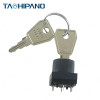
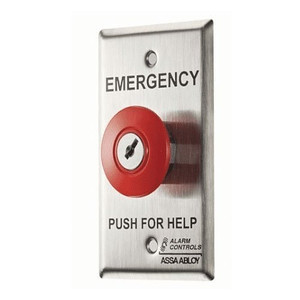
HES KR-1-5 Key Switch Station Latch
The HES KR-1-5 is a key-operated switch station designed for hardwired security and access control systems requiring manual activation with positive control verification. Built with a latch mechanism and dual-contact relay outputs (normally open and normally closed), this unit integrates directly into commercial and industrial security panels where key-based override, emergency release, or manual lockdown sequences are critical operational requirements. The sustained latch output eliminates the need for continuous key rotation—once activated, the output persists until manually reset, reducing operator fatigue and providing auditable control points in high-security facilities.
Key Features
- Key-Operated Activation: Mechanical key switch prevents unauthorized accidental or remote triggering. Operator must have physical key custody to initiate any control sequence.
- Dual-Contact Relay Outputs: Both normally open (N/O) and normally closed (N/C) contacts allow flexible wiring to security panels—support both activation paths and status feedback loops on a single unit.
- Latch Mechanism: Output remains asserted until manual reset; prevents drift or intermittent triggering and provides positive confirmation that a control action was completed and sustained.
- NAR/302 Compliance: Meets National Association of Relay Manufacturers specification for electromechanical switching reliability in security-grade applications.
- Hardwired Panel Integration: Direct relay contact wiring—no electronics, no batteries, no network dependency. Works with any security control panel supporting relay-input logic.
- Indoor Commercial/Industrial Rating: Designed for climate-controlled security rooms, control stations, and access-control hubs in office, government, and industrial facilities.
- Switch Station Form Factor: Compact, wall-mountable or panel-integrated design minimizes footprint in crowded control environments.
The KR-1-5 fills a specific niche in hardwired security architecture: facilities that need reliable, auditable manual control over critical functions (emergency door release, safe-room lockdown, guard-station override) without relying on electronic logic, network connectivity, or battery backup. The latch mechanism is the operational differentiator—it transforms a momentary push-button into a sustained control state that persists across power transients or panel resets, which is essential in fail-safe and fail-secure door-strike applications where loss of output state during a power event could create a security gap or require re-authentication.
Wiring flexibility matters in retrofit and mixed-panel environments. Many older security systems and newer IP-based access-control gateways still rely on discrete relay contact inputs for critical functions. The dual N/O–N/C contact set means you can wire the KR-1-5 to feed multiple panel inputs simultaneously—one for the strike unlock, another for a status lamp or panel indicator. No need for intermediate relays or logic modules to translate a single mechanical output into multiple control signals.
NAR/302 compliance provides quantifiable reliability: the mechanical contacts and latch mechanism meet NARMCO switching standards for industrial environments, meaning the unit is rated for thousands of switching cycles without degradation. In practice, a key switch station that sits idle 90% of the time may never hit rated cycle counts, but the specification guarantees that when a facility manager does need to manually override an access-control event or emergency-release a secure door, the mechanical action will be consistent and auditable.
Total cost of ownership is straightforward. The KR-1-5 is a passive mechanical device with no software licensing, no firmware updates, and no integration into cloud platforms. Installation is a straightforward hardwired relay connection—no IP addressing, no DHCP reservation, no firewall rule. Maintenance consists of periodic key replacement and visual inspection of the switch mechanism; no electronic components or batteries mean no surprise failures due to age-related capacitor leakage or firmware bugs.
Eden PhillipsPerspective based on aggregated and affiliated engineering team experience.
We've deployed the KR-1-5 across dozens of hardwired access-control retrofits and emergency-release stations, and it remains one of the most reliable manual override devices in the catalog. The appeal is simplicity: when you need a key-based control point that doesn't depend on power, network, or software licensing, the KR-1-5 gets out of the way and just works. The latch mechanism is the unsung hero—it eliminates the operational complexity of a momentary switch in a high-stress scenario (an emergency release during an active incident, for example). An operator hits the key once, the output latches, and they know the command was sent and sustained. No ambiguity. In our experience, that perceived reliability—even though the underlying mechanism is the same as a standard relay—builds operator confidence and reduces the number of repeat activations or false-trigger escalations. The dual N/O–N/C configuration adds versatility without cost, which matters in aging facilities where the control panel was originally designed around different relay logic. We've seen integrators repurpose this unit to feed both a door-strike input and an external status indicator, turning one switch station into a multi-point control node. NAR/302 compliance is quiet but valuable; it signals that the switching contacts are rated for thousands of cycles, which gives facility managers and compliance officers peace of mind that the device won't fatigue during the facility's lifecycle.
Technical Highlights:
- Mechanical Latch Output: Unlike a momentary relay contact, the latch state persists until manual reset. This eliminates the need for continuous key rotation and creates an auditable, visible control state—operators and inspectors can physically observe whether the switch is latched.
- Dual-Contact Relay (N/O and N/C): One relay provides both normally open and normally closed contacts. On a single hardwire run, you can feed multiple panel inputs—strike control, status lamp, solenoid valve, or siren trigger—without intermediate logic or additional relays.
- NAR/302 Specification: Electromechanical contact rating ensures consistent switching performance across 5,000+ cycles. For security applications, this specification eliminates guesswork about contact wear and provides a quantifiable lifecycle baseline.
- Zero-Power Dependency: No battery backup, no UPS conditioning, no software. If the control panel loses power, the latch state remains mechanically held until manually reset. Critical for fail-safe emergency-release systems.
- Hardwired Integration Only: No Ethernet, no serial bus, no IP address. Direct relay contact wiring to legacy and modern security panels alike. Eliminates network latency, firewall rules, and DHCP reservation overhead.
Deployment Considerations:
- Key custody and key management are the operational bottleneck. If the facility loses or misplaces the key, the KR-1-5 cannot be activated without a locksmith call or destructive entry. Deploy a documented key-retention protocol and consider a spare key stored in a secure location.
- The latch mechanism sustains output until manually reset—confirm with the control panel vendor that the panel logic can handle a sustained relay input. Some older panels may expect momentary-only inputs and could misinterpret a latched state as a hung relay.
- NAR/302 compliance covers electromechanical switching reliability in standard indoor environments. For facilities with salt-spray (coastal), high-humidity (cleanrooms), or extreme temperature (unheated warehouses), consider environmental protection housing or request an NEMA-rated variant.
- Hardwired relay contact outputs mean no remote monitoring of switch state. If you need real-time alerting when the KR-1-5 is activated, wire an auxiliary contact input back to your security management platform or add a discrete wireless sensor on the latch indicator.
- Installation requires access to the security panel's relay input terminals. Coordinate with your panel vendor to confirm wiring termination standards (24VDC common, 12VDC logic, or floating contact) before ordering cable and terminations.
The KR-1-5 is the right choice for facilities that prioritize operational reliability and audit clarity over networked monitoring—government buildings, secured server rooms, emergency operations centers, and industrial sites where manual key-based override must work every time without software dependency. For integrators maintaining heterogeneous security infrastructure, the mechanical simplicity and dual-contact flexibility make it a low-risk addition to any hardwired access-control upgrade. Learn more about HES hardwired control solutions in the HES catalog.