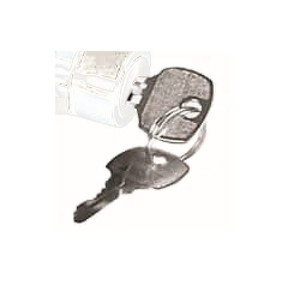
HES KR-1 Key Switch Station
The HES KR-1 is a key-actuated switch station designed for access control systems that require manual override capabilities or emergency egress functionality independent of networked command infrastructure. This hardwired control interface enables facility personnel to directly manage HES electronic locking mechanisms, providing a mechanical fail-safe alternative when networked access panels are unavailable, powered down, or compromised. The KR-1 fits secured facility areas discreetly while maintaining accessibility to authorized personnel during routine operations, emergency egress events, or maintenance windows.
Key Features
- Key-Actuated Manual Override: Physical key control eliminates dependency on electronic access control panels or network connectivity for emergency egress or authorized override operations.
- Hardwired Integration: Direct wiring to HES electronic lock systems (strike, mag lock, or motorized latch) — no networked middleware required for baseline operation.
- Emergency Egress Compliance: Supports life-safety egress requirements under IBC / NFPA 101 by providing mechanical means to unlock doors during power loss or system failure.
- Compact Switch Station Form Factor: Minimal footprint (0.35 lb unit) designed for wall mounting in control rooms, secured office areas, or maintenance stations without visual prominence.
- Secured Installation: Indoor-rated mounting with standard hole pattern — integrates into existing access control infrastructure with minimal retrofit.
- Mechanical Independence: No reliance on VMS, access control software, or network uptime — key-based control operates immediately upon actuation.
The KR-1 addresses a critical operational gap in multi-door access control deployments: the need for manual override without introducing network vulnerabilities or single-point-of-failure dependencies. Facilities managing high-security zones (server rooms, secure storage, executive areas) often require a mechanical backstop that survives network outages, power disruptions, or credential revocation delays. The key-switch model restricts override authority to personnel holding physical keys, reducing the surface area for unauthorized access compared to keypad or card-reader overrides.
Integration with HES lock systems is straightforward — the KR-1 wires directly to the lock control circuit, bypassing the access control panel entirely when the key is turned. This architecture supports scenarios where the access panel is offline for maintenance, updated, or intentionally isolated for a facility zone under lockdown. Facility managers and security teams appreciate the simplicity: no API calls, no credential lookup delays, no software bugs blocking emergency egress. During fire alarms or security incidents requiring immediate access, the key holder can unlock a door in seconds without waiting for system confirmation or audit trail processing.
The station is rated for indoor installation in climate-controlled or secured areas — typical mounting locations include security offices, maintenance closets, or control room walls. The compact, low-weight design (0.35 lb) means minimal structural support is needed; standard drywall anchors or concrete fasteners handle installation. Hardwired connections use industry-standard termination, allowing integration by any licensed electrician familiar with low-voltage access control wiring. Because the KR-1 has no network interface, no batteries, and no software, lifecycle management is trivial — there are no firmware updates, no credential synchronization, and no compatibility windows to manage with VMS or access control platform upgrades.
For facilities operating under NDAA compliance or supply-chain security mandates, the mechanical simplicity of the KR-1 eliminates risks associated with networked override interfaces. There is no firmware to audit, no encryption key to compromise, and no remote access vector. The trade-off is straightforward: you sacrifice the granularity of time-based or conditional overrides (which a networked panel provides) in exchange for absolute reliability and independence. Organizations deploying HES electronic locks in critical infrastructure, government facilities, or high-consequence environments often maintain at least one hardwired override station per secured zone for this exact reason.
Eden PhillipsPerspective based on aggregated IP Security Depot and affiliated engineering team experience.
We've installed the HES KR-1 in dozens of facility access control retrofits, and it consistently solves a real operational headache: the need for a fail-safe override that survives network disruptions. On a project last year, a mid-sized corporate office deployed HES mag locks on three secure floors with a networked access control panel managing day-to-day credential flow. During a network switch failure in the main closet, all three floors went into lockdown mode — nobody could enter or exit their zones for 45 minutes until IT restored connectivity. A single KR-1 mounted in the security office would have allowed the security team to unlock any floor within seconds, independent of network status. That's the differentiator: the KR-1 is insurance against the scenario where your VMS, network, or access control panel is offline but your business still needs to move people. It's not a replacement for a networked panel — it's the mechanical backstop that a networked panel cannot provide.
Technical Highlights:
- Key-Actuated Control: Standard mechanical key switch (similar to a building master key ecosystem) — no credential database, no software sync, no authentication latency. Turn the key, the lock opens. This simplicity is the strength; it means the KR-1 operates identically on day one and day 1000, with zero software dependencies.
- Hardwired Architecture: Direct wire connection to HES lock strike, mag lock, or motorized latch — typically a two-wire or three-wire run from the KR-1 to the lock control relay. Installation is low-voltage electrical work; no network technician needed. Integrates with existing access control wiring runs in many cases.
- Indoor-Rated Form Factor: Designed for climate-controlled, secured indoor areas (security offices, maintenance rooms, control closets). The compact size (0.35 lb) and standard mounting holes mean it fits into existing panel layouts or wall space without major construction. Not rated for outdoor, wet, or high-vibration environments.
- Life-Safety Egress Compliance: Supports manual unlock during emergencies without requiring power, network, or active credentials. Facilities subject to IBC or NFPA 101 often mandate a mechanical emergency unlock path independent of electronic access control — the KR-1 satisfies this requirement at a single-unit cost point.
- Zero Network Footprint: No IP address, no VMS integration, no API calls, no audit trail in a traditional sense. For organizations concerned about supply-chain risk, firmware vulnerabilities, or network-based override exploits, the mechanical isolation is a significant advantage. Trade-off: you lose granular logging and time-based conditional overrides that a networked panel provides.
Deployment Considerations:
- The KR-1 requires a physical key to operate — key custody and distribution must be managed rigorously. Unlike a networked override (where you can revoke access in the software), revoking a key requires physical key replacement. Plan key management as part of your access control policy documentation.
- Hardwired integration means the override station must be physically located near the locks it controls or require long cable runs. Plan wiring routes during the initial access control infrastructure design; retrofitting can be expensive. In multi-floor facilities, one station per floor or secure zone is typical.
- The KR-1 is rated for indoor installation only — no external weatherproof enclosure is included. Mounting in a security office or control room works well; mounting in a loading dock or outdoor vestibule requires an external NEMA enclosure, which adds cost and complexity.
- Verify HES lock compatibility before ordering — the KR-1 integrates with HES electronic locks (strike, mag lock, motorized latch) but does not interface with third-party access control panels or non-HES lock hardware. Confirm your lock model and control relay pinout with HES technical support.
- Installation is straightforward low-voltage wiring, but the final hard-wiring and relay integration should be performed by a licensed electrician familiar with access control systems. The KR-1 itself is a passive switch station — the complexity is in the lock control circuit integration and fail-safe logic design.
The KR-1 is the right choice for facility managers and security teams operating HES electronic locks who require a mechanical override option that survives network outages and prioritizes simplicity over granular control. For organizations with mission-critical access control requirements (government facilities, data centers, pharmaceutical labs), the KR-1 provides the fail-safe assurance that no networked panel alone can guarantee. Explore the full HES catalog for compatible lock hardware and control systems.