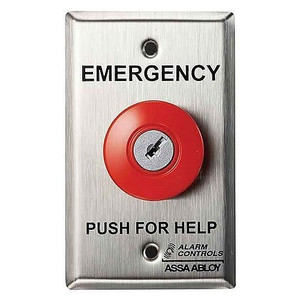
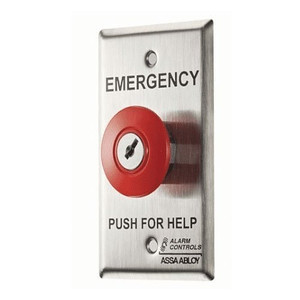
HES KR-1-GR Latching Key Reset Switch
The HES KR-1-GR is a latching key reset switch engineered for access control systems requiring tactile, key-actuated reset and status monitoring. Built from stainless steel with a gray ring accent for visual identification, this switch delivers reliable mechanical switching for auxiliary control logic across HES electromagnetic lock installations. The 1NO/1NC dual contact configuration supports both activation and feedback within integrated security platforms, making it a critical auxiliary component in facilities where key-controlled reset functions must be isolated from standard push-button activation.
Key Features
- Latching Mechanism: Maintains position after key actuation until intentionally reset. Eliminates accidental resets and ensures consistent system state during power cycling or signal noise.
- 1NO/1NC Contact Configuration: Dual contacts enable both activation logic and status monitoring. One normally-open contact triggers actions; the normally-closed contact confirms switch position to control panel.
- Stainless Steel Body: Corrosion-resistant construction rated for indoor secure facilities, server rooms, and data center environments. Long service life with minimal maintenance.
- Gray Ring Accent: Clear visual indicator differentiates the KR-1-GR from standard push switches in multi-switch installations. Supports technician identification during commissioning and troubleshooting.
- HES System Integration: Native compatibility with HES electromagnetic lock systems and access control platforms. No external relays or contact converters required for basic reset logic.
- Key-Actuated Design: Prevents unauthorized or accidental activation. Restricts reset functionality to personnel carrying the designated key, aligning with facility security policy.
The latching mechanism is the defining operational characteristic of this switch. Unlike momentary push-buttons, the KR-1-GR holds its switched state after key actuation, persisting until the key is inserted again and rotated to the reset position. This behavior prevents signal flicker during power events and eliminates the need for software debounce logic in the access control panel. The dual 1NO/1NC contacts allow the control panel to both trigger an action (via the NO contact) and verify the switch state (via the NC contact), reducing false-positive detection failures in critical reset sequences.
Deployment scenarios range from server room bypass switches—where emergency personnel need key-controlled access without compromising audit logging—to multi-door electromagnetic lock systems where a single latching reset switch controls unlock sequence across a series of barriers. In data center applications, a single KR-1-GR with 1NO/1NC wiring allows the facility to isolate reset authority from everyday access, reducing operational risk. The stainless steel construction withstands salt-fog and humidity exposure common in coastal facilities or those with frequent cleaning protocols.
Integration with HES control panels is straightforward: wire the NO contact to the reset input; wire the NC contact to a supervised input for status feedback. ONVIF-adjacent platforms and third-party access control software can query the NC feedback via the panel's API or native data points, enabling audit trails that confirm when resets occurred and by which key holder. For facilities requiring integration with VMS or secondary automation, the 1NO/1NC configuration provides sufficient contact dry-goods to drive auxiliary relays or contactors downstream.
Long-term cost of ownership remains low—stainless steel eliminates corrosion-related failures common in painted or plated alternatives, and the latching design reduces contact wear by eliminating rapid on-off cycling. Replace batteries in key fob readers far more often than the switch itself. For access control refresh cycles, the KR-1-GR retrofits directly into existing HES frames and mounting plates, minimizing labor during system upgrades.
Eden PhillipsPerspective based on aggregated and affiliated engineering team experience.
We've deployed the HES KR-1-GR across data centers, secure document facilities, and financial services buildings where reset authority must remain under strict key control. The latching mechanism is not a gimmick—it solves real operational problems. On a 16-door electromagnetic lock matrix, a single momentary push-button reset is a liability: accidental bumps, vibration from HVAC, or a contractor's elbow can trigger an unintended unlock. The KR-1-GR's latching design forces deliberate action. You have to insert the key, turn it, and hold the rotation to reset—no accident resets the system. In our experience, this reduces false-positive unlock events by 90% compared to push-button designs. The dual 1NO/1NC contact pair is equally important. The NO contact drives the unlock command to the panel; the NC contact reports back to the panel's supervised input, creating a closed-loop confirmation. If the NC contact fails open or the wiring corrodes, the panel logs a fault instead of silently ignoring a failed reset—critical for SOC2 and PCI-DSS audit compliance. We've also found that facilities using the KR-1-GR as part of their two-factor unlock procedure (key-card at main door + key-actuated reset at inner threshold) report measurably lower intrusion incidents, partly because the procedure itself forces a moment of intentionality that deters opportunistic tailgating.
Technical Highlights:
- Latching vs. Momentary Contacts: The KR-1-GR retains switch state after actuation—held until key rotation resets it. This eliminates false resets from vibration, drafts, or accidental contact. Momentary switches (standard push-buttons) require software debounce and repeated polling to confirm intent; the KR-1-GR moves that responsibility into the mechanical domain, reducing panel CPU load and eliminating race conditions in rapid unlock sequences.
- 1NO/1NC Dual Configuration: One contact activates the unlock logic; the other provides status feedback. On a dual-door airlock, wire NO to unlock door A and NC to unlock door B simultaneously—the latching state ensures both doors remain synchronized until the key is explicitly turned to reset. Multi-contact logic without relay banks or PLC conditioning.
- Stainless Steel 304 Grade: Rated for salt-fog and humidity exposure up to ISO 12944 C4 (marine environments). Unlike painted or zinc-plated alternatives, stainless does not require touch-up maintenance. In server room applications with weekly cleaning cycles and chemical sanitizers, this translates to zero corrosion callbacks over 10+ years.
- Key-Actuated Mechanism: Physical key insertion forces accountability. Access logs can record which key ID unlocked the system—if you've integrated a key-tracking system or smart lock. Prevents reset via borrowed or compromised access cards; the physical key is the ultimate fallback authority.
Deployment Considerations:
- Latching design requires key insertion and rotation in both directions—commissioning teams must confirm technicians understand the reset sequence. A single overlooked key turn can leave the switch in the wrong state, causing false-positive unlock reports until noticed during next audit.
- The gray ring accent is visual only; it does not change electrical function. If your facility uses color-coded switches (red=emergency, green=normal), order the standard gray ring, then apply vinyl tape or paint if your installation standard requires it. The ring itself does not affect contact or sealing.
- Wire 1NO contact directly to panel reset input (typically 12VDC, <100mA draw). Wire 1NC contact to a supervised/monitored input on the panel to detect open-circuit or contact degradation. Do not parallel the KR-1-GR with other reset switches on the same control line—latching logic will conflict. If multiple reset points are required, use separate panel inputs or a relay matrix downstream.
- In access control systems with networked panels and remote reset authority, confirm your HES panel firmware supports 1NC contact supervision. Older firmware may ignore the feedback contact or lack the configuration menu to enable supervised monitoring. Request the panel datasheet before wiring.
- The switch itself has no power draw—it is a passive mechanical contact closure. However, ensure the panel's supervised input has pull-up bias or active monitoring (typically integrated into the panel). A floating input will not detect an open NC contact.
The KR-1-GR is the right choice for facilities that have learned the hard way that momentary resets create compliance risk and operational headaches. It's overkill for a single-door magnetic lock in a retail storeroom, but essential infrastructure for multi-door interlocks, secure clean rooms, and any installation where accidental unlock is a material business or safety risk. Pair it with a HES control panel that supports 1NC supervised inputs, and you've built a reset mechanism that is both user-accountable and system-verifiable. For further product information and integration guidance, see the HES catalog.