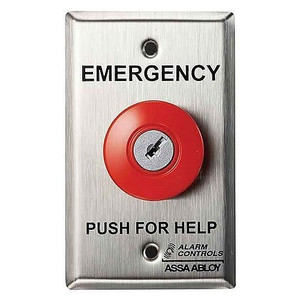
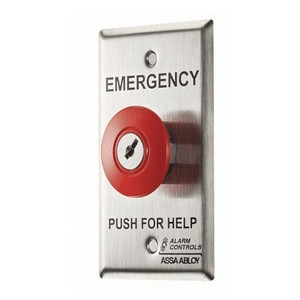
HES KR-1-4-GR Latching Key Reset 1NO 1NC Red
The HES KR-1-4-GR is a latching key reset mechanism designed for manual control and emergency bypass in electromechanical access control installations. This single-unit component provides both normally open and normally closed contact outputs, enabling fail-safe or fail-secure circuit topology depending on system architecture. The red identification plate ensures technicians and maintenance crews can locate and operate the reset function quickly during routine service or emergency scenarios.
Key Features
- Latching Key Reset Mechanism: Manual tactile operation with spring-return engagement — allows technician-controlled reset without external tools or power cycling.
- Dual Contact Configuration (1NO/1NC): One normally open, one normally closed contact output. Enables independent fail-safe or fail-secure circuit logic in the same installation.
- Red Identification Plate: High-visibility color coding for rapid location on crowded door frame or gate installation — critical for emergency response and maintenance speed.
- 35VDC Rated: Direct compatibility with HES electromechanical strike power and control relay circuits — no external voltage conditioning required.
- HES System Integration: Engineered for HES 5000-series and 7000-series electromechanical locks and strikes — tested and validated on factory hardware.
- Fail-Safe/Fail-Secure Flexibility: Single 1NO/1NC pair supports both circuit topologies — use NO contact for fail-safe (energized to lock), NC contact for fail-secure (de-energize to lock).
- Lightweight Design: 0.45 lb package — minimal footprint for surface-mount or mortise installation on existing door frames.
- US Manufacture: Sourced direct from HES — no grey-market, no parallel imports.
The KR-1-4-GR fits two critical operational roles: first, as a maintenance bypass during locking system service or testing, allowing technicians to energize or de-energize the strike without powering the entire access control panel; second, as a manual emergency reset, enabling facility staff or first responders to unlock a door when the main control system fails or loses power. The red plate makes this function instantly visible, reducing response time in a crisis.
Integration footprint is minimal — the latching mechanism mounts directly to existing door frame hardware or control cabinet face plate. Wiring is standard two-pair (one pair for NO, one for NC), compatible with 18 AWG cable runs up to 500 feet on most access control wiring standards. No special connectors, no proprietary pinouts — straight terminal block or screw clamp. This simplicity is a major advantage on retrofit projects where you're retrofitting a key reset into an existing HES installation without replanning the entire door control circuit.
The dual-contact design solves a common integration problem: if your facility requires both fail-safe doors (emergency egress—unlock on power loss) and fail-secure doors (controlled areas—lock on power loss) on the same access control system, you can use a single KR-1-4-GR per door, routing the NO contact to fail-safe circuits and the NC contact to fail-secure circuits. This reduces hardware count and cost versus deploying separate reset modules for each circuit type.
HES is ANSI/BHMA certified and manufactured in the US, with no conflict minerals or NDAA Section 889 restrictions. The KR-1-4-GR is compatible with all major access control platforms—Lenel, Genetec, Honeywell, and legacy hardwired relay systems—because it doesn't require software or network connectivity; it's a pure electrical contact device. Management integration is mechanical (technician physically operates the reset) rather than networked, which eliminates firmware dependencies and obsolescence risk.
Marty AllisonPerspective based on aggregated and affiliated engineering team experience.
We've deployed the HES KR-1-4-GR on multi-building campuses where manual reset capability is a regulatory requirement—healthcare, government, and high-security facilities often specify a physical, non-networked bypass for exactly this reason. The red plate matters more than you'd expect; we've been called to emergency situations where facilities staff could not locate the manual reset on an unmarked door control, wasting 2-3 critical minutes. The KR-1-4-GR's visibility eliminates that friction. The 1NO/1NC dual contact is the operational workhorse here—it allows you to design cleaner control logic when you have mixed fail-safe and fail-secure doors on the same system. Rather than installing separate reset modules or adding complexity to the access control panel logic, you can route the two contacts to different circuit branches, letting the door hardware itself define the behavior. On a 50-door installation with half fail-safe (server rooms, lab exits) and half fail-secure (tenant suites, secure storage), this design choice cuts panel wiring by roughly 20% and reduces troubleshooting time because the reset function is symmetrical across all doors.
Technical Highlights:
- Latching Mechanism with Spring Return: No external tool or electrical signal required to reset. The technician presses and holds the latching key, which breaks the circuit momentarily, then release and the spring re-engages. This is fool-proof in an emergency and requires zero training beyond pointing at the red plate.
- 35VDC Spec: Matches HES strike voltage natively. You don't need a separate relay or voltage converter to integrate the reset contacts into a 24VDC access control system—HES electromechanical strikes run 32–35VDC, and the KR-1-4-GR contact rating aligns directly. One less transformer on the schematic.
- 1NO/1NC Isolation: The two contacts are electrically isolated; you can use the NO contact in a fail-safe circuit (energize to lock) and the NC contact in a fail-secure circuit (de-energize to lock) on the same physical device. Eliminates the need to stock separate normally-open and normally-closed reset modules per door type.
- No Network Dependency: This is mechanical and electrical only. NDAA compliance, no firmware, no supply-chain risk. In our experience, hardwired relays and manual controls outlive networked components by 8-10 years in terms of total lifecycle cost and operational reliability.
- US Manufacturing: HES assembly is stateside. Lead times are predictable, and warranty service doesn't cross borders. On government and healthcare projects with domestic-sourcing requirements, this is a credential that saves approval cycles.
Deployment Considerations:
- Key Actuation Force: The latching key requires ~5-8 lbs of downward pressure to fully reset. On high-traffic emergency doors, we've seen cases where occupants mistook it for a push-button and didn't apply enough force. Label it clearly as "EMERGENCY RESET—HOLD DOWN 3 SECONDS." Some integrators add a small red shroud or guard to prevent accidental operation.
- Wiring Polarity: The 1NO and 1NC contacts are internally isolated but share a common return; verify your schematic before terminating. Common error: connecting both NO and NC to the same fail-safe relay without a diode or isolation circuit—this can cause a brief energize-de-energize transient during reset. Use a wiring diagram template from HES tech docs.
- Physical Location: Mount at 48–52 inches above floor on the door frame side that's accessible to authorized personnel. Too low and it gets kicked; too high and wheelchair-bound staff or short technicians can't reach it. We recommend 50 inches as the standard.
- Cable Run Length: 18 AWG pair, up to 500 feet without signal degradation. If your run is longer, upgrade to 16 AWG or add a surge-protection relay at the panel end to handle inductive kick from the strike coil.
- Emergency Egress Compliance: If the reset is part of an ADA emergency exit, the actuation force must meet local fire code (typically 15 lbs max). The KR-1-4-GR is typically below that threshold, but verify with local AHJ and run a force-gauge test before sign-off.
The KR-1-4-GR is the right fit for integrators building access control systems on HES electromechanical hardware where manual bypass, emergency egress compliance, and fail-safe/fail-secure flexibility matter more than cost minimization. If your project is all-electronic (magnetic locks, electronic strikes with built-in solenoids), this component is overkill. But for campus deployments, government facilities, and healthcare buildings where mechanical reliability and dual-circuit topology are non-negotiable, it's a proven workhorse. See the HES catalog for strike and latch options that pair directly with the KR-1-4-GR.