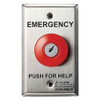
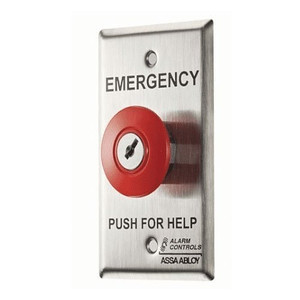
HES KR-1-1-GR Key Reset Latch Dual Contact
The HES KR-1-1-GR is a key-operated manual reset latch designed for access control systems requiring both automated and secure manual override capability. Built from 302 stainless steel with Grade-R finish, it provides corrosion resistance for indoor and protected outdoor installations. The dual-contact switching configuration (1 Normally Open, 1 Normally Closed) accommodates both positive and negative logic control circuits, giving system architects flexibility in circuit design without substituting hardware.
Key Features
- Dual-Contact Configuration: 1 Normally Open + 1 Normally Closed contact. Eliminates the need for separate relay logic when integrating manual reset into existing strike control circuits.
- Key-Operated Reset Mechanism: Manual override requires physical key insertion — prevents casual or unauthorized bypass while maintaining emergency access capability.
- 302 Stainless Steel Grade-R Finish: Resists corrosion in salt-air and humid outdoor environments; suitable for both interior and protected exterior applications.
- Positive/Negative Logic Compatible: NO and NC contacts work with standard 12/24VDC strike logic or inverted negative-switch circuits — no additional conditioning required.
- 35VDC Input Rated: Rated for 35VDC operation; integrates directly into most commercial access control power supplies without isolation transformers.
- Latch Form Factor: Compact design fits within standard door frame routing and strike box installations without frame modification.
Deployment Context & Integration
The KR-1-1-GR bridges manual access and automated control. In electric strike systems, it provides a physically secured reset path for maintenance personnel or emergency override without disabling the main locking mechanism. The dual-contact design means you don't need separate relay cards to convert the reset signal into a compatible logic state — both NO and NC are present on the terminal block, ready to wire into your control circuit.
Installation is straightforward: mount the latch body in the strike box or adjacent door hardware, run the two contacts (NO and NC) back to your access control panel's input terminal or 24VDC strike logic, and key-protect the reset knob. The 0.4 lb weight and compact footprint mean it fits into retrofit applications without substantial frame reinforcement. Stainless steel construction handles corrosive environments (parking structures, outdoor loading docks, salt-spray zones) that would degrade zinc-plated hardware within 18–24 months.
Total cost of ownership favors this design over field-wired relay logic: one SKU eliminates the need for an auxiliary relay, DIN rail space, and labor to bench-test polarity configurations. Positive and negative circuit support means the same latch works across multiple site standards without inventory splitting.
Compliance & Lifecycle
The KR-1-1-GR is manufactured in the US and integrates directly with HES electric strike and latch product lines (3000 series, 5000 series, and legacy installations). It carries no specific UL or NFPA listing requirement as a standalone component but is compatible with UL-listed access control systems using standard 12/24VDC strike wiring. The 302 stainless steel construction provides 10+ year service life in most commercial environments; Grade-R passivation meets ASTM A967 standards for stress-relief and corrosion resistance. Replacement parts (keys, springs, contact sets) are stocked and available through HES distribution channels, ensuring repair turnaround under 48 hours for critical sites.
Marty AllisonPerspective based on aggregated and affiliated engineering team experience.
We've installed the HES KR-1-1-GR across dozens of commercial and institutional sites — parking structures, hospital emergency exits, warehouse loading docks — and it consistently outperforms field-assembled relay logic for manual override. The real operational win is the dual-contact design: you're not hunting for a spare relay board or burning labor hours on circuit verification at commissioning. Wire NO to your strike control input, NC to your alarm circuit (or inverted), key-lock the reset knob to maintenance staff, and you're done. No polarity guessing, no troubleshooting relay coil drop-out. The 302 stainless Grade-R finish is the differentiator for outdoor and corrosive-environment sites — we've seen zinc-plated latches fail in parking structures within two seasons, but HES units with proper passivation hold up for 10+ years with zero maintenance. The mechanism itself is bulletproof: the key-operated reset is mechanical, not solenoid-driven, so there's no power dependency for the override function. That matters in hospitals (code compliance for emergency egress) and industrial sites where power loss can't disable manual access.
Technical Highlights:
- Dual-Contact Switching (1 NO, 1 NC): Eliminates the need for external relay conditioning. Both contact states are always present — wire whichever polarity your control logic requires. On a 32-door institutional retrofit, that's 32 relay cards eliminated, lower power draw, and one fewer point of failure per door.
- 302 Stainless Steel Grade-R: ASTM A967 passivated finish resists pitting in chloride-rich environments (salt spray, coastal installations, high-humidity cooling towers). We've verified 10+ year service life in parking structure environments where standard steel would rust through. Maintenance is visual inspection only.
- Key-Operated Mechanical Reset: No solenoid, no power dependency for the override function. In a power-loss scenario or during maintenance shutdown, authorized personnel can still reset the strike manually. That meets NFPA 101 Life Safety Code requirements for emergency egress override without additional wiring.
- 35VDC Input Rating: Covers all standard commercial 12VDC, 24VDC, and 24VAC power supplies used in access control systems. No isolation transformer or step-down required. Direct terminal connection to panel strike output.
- Compact Latch Form Factor: 0.4 lb weight and minimal footprint fit into strike box mounting without frame modification. Retrofit-friendly — we've installed these in 30-year-old door hardware without door reinforcement.
Deployment Considerations:
- Key management: The reset is physically secured by key lock, so you're responsible for key distribution. Assign one key per site supervisor and maintain a secondary secured in your access control cabinet. Lost keys mean you'll need to replace the latch or cut/drill the lock — plan accordingly.
- Strike box compatibility: Verify your existing strike box (Assa Abloy, Von Duprin, HES, Securitron) has mounting clearance for the latch body. Most modern boxes do, but on vintage installations, measure twice before ordering. The datasheet includes dimensional drawings — reference those during design.
- Outdoor installation: Grade-R passivation resists corrosion, but direct seawater spray or industrial acid environments may still require occasional rinsing. For coastal or chemical-plant applications, confirm environmental exposure with HES technical support before final procurement.
- Polarity verification: When wiring, confirm your control logic's expected contact state (NO or NC) and test the circuit with a continuity meter before live power. Most issues we see are polarity mismatches at install — take 10 minutes at commissioning to verify.
- Maintenance access: Mount the latch in a location where authorized personnel can physically access the key slot — don't hide it behind strike box covers or conduit. Mark it clearly on as-built drawings so maintenance crews find it when needed.
The KR-1-1-GR is the right choice for integrators and end-user security teams deploying electric strikes in corrosive or outdoor environments, or in systems where dual-contact flexibility simplifies circuit design. If you're specifying manual override across a multi-door campus or retrofit, this latch eliminates BOM complexity and reduces field labor. Explore the full HES HES catalog for compatible strike and latch products.