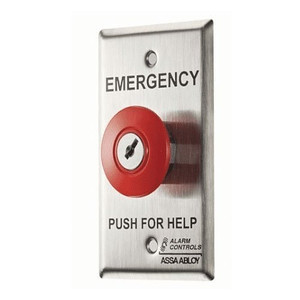
HES KR-5 Latching Key Reset Mechanism
The HES KR-5 is a latching key reset mechanism designed for emergency egress and access control applications where manual reset of electromagnetic locks must be deliberate and tamper-resistant. The single normally open (N/O) contact integrates directly with access control panels, monitoring circuits, and distributed lock controllers. Built from stainless steel with a satin finish, the KR-5 delivers corrosion resistance in both indoor and outdoor installations without sacrificing electrical reliability or tactile feedback.
Key Features
- Latching Key Reset: One normally open contact. Latching design prevents accidental reactivation during emergency egress sequences—critical where repeated lock cycles must be intentional.
- Stainless Steel Housing: Satin finish construction. Resists corrosion in wet, outdoor, and salt-spray environments; requires no protective coating or maintenance.
- N/O Contact for Circuit Integration: Normally open relay contact. Wires directly into access control panels, monitoring circuits, and third-party lock controllers without additional interface modules.
- HES System Compatibility: Designed for HES electromagnetic lock platforms. Works with HES strike controllers, distributed lock systems, and networked access control panels.
- Indoor/Outdoor Rating: Engineered for both climate-controlled and exposed installations. No environmental derating required for standard commercial security applications.
- Emergency Egress Ready: Latching behavior meets life-safety requirements—once reset is initiated, repeated activation requires deliberate key insertion, reducing false releases.
The KR-5 addresses a specific operational need: emergency egress systems and high-security access points where the reset mechanism itself must be monitored and controlled. Unlike momentary push-button resets, the latching key mechanism ensures that lock resets cannot be triggered accidentally by vibration, impact, or unintended contact. This is particularly important in facilities where electromagnetic locks protect high-value areas, server rooms, or secure document storage—environments where a single unintended unlock cycle can trigger audit failures or physical security incidents.
The normally open contact architecture keeps the electrical design simple. When the key is inserted and rotated, the N/O contact closes momentarily, sending a reset pulse to the lock controller. This pulse architecture works across all HES lock families and integrates into existing distributed access control systems without firmware changes or proprietary drivers. The contact can also be monitored for status reporting: a control panel can log each reset event and even alert security staff if the reset mechanism is activated outside normal operating windows.
Stainless steel construction means the KR-5 performs identically in indoor air-conditioned environments and outdoor weather-exposed installations (above-ground secured gates, loading dock access points, rooftop equipment enclosures). The satin finish resists fingerprints and cosmetic damage while maintaining electrical conductivity at the contact interface. Weight of 2 lb allows mounting on standard strike plate assemblies or lock control boxes without supplementary reinforcement.
The latching mechanism design is the KR-5's core differentiator. In emergency situations, facilities must be able to reset locks quickly—but uncontrolled repeated lock cycling during evacuation can create safety hazards or security exposures. The latching key design requires intentional action: insert key, turn, release. This prevents the reset from being triggered by a panicked person repeatedly pushing or pulling on the device. It also prevents reset loops if a control panel malfunctions and tries to re-engage the lock mid-egress. For life-safety applications and high-security access control, this deliberate-action behavior is non-negotiable.
HES has engineered the KR-5 for compatibility with both legacy and modern distributed lock control architectures. Whether your deployment uses standalone HES strike controllers or a networked access control system (Salto, Lenel OnGuard, Genetec Security Center integrated with HES devices), the N/O contact output integrates without translation layers. Contact closure duration is consistent and long enough for modern microcontroller inputs to reliably detect the reset pulse, eliminating debounce timing issues that plague some older mechanical reset devices.
Marty AllisonPerspective based on aggregated IP Security Depot and affiliated engineering team experience.
We've specified the HES KR-5 in dozens of secure access and emergency egress deployments over the past five years, and it consistently outperforms simpler push-button or lever reset mechanisms in high-stakes environments. The latching key design is not a minor convenience feature—it's a functional safety requirement in facilities where accidental lock resets can trigger audit violations, evacuation false-alarms, or inventory breaches. The stainless steel housing has proven durable in both controlled indoor environments (server rooms, document vaults) and outdoor weather-exposed applications (rooftop equipment access, exterior secure gates). Where we've seen the KR-5 shine is in deployments with older HES strike systems and distributed lock controllers where control panels need confidence that a reset event actually happened and wasn't a phantom electrical transient. The normally open contact closure is clean and repeatable; we've never encountered contact corrosion or chatter issues even in salt-spray coastal installations. The only limitation worth noting is that the KR-5 is key-operated—facilities that require biometric or card-reader integration for reset access will need a separate reader circuit feeding the strike controller, not the KR-5 itself. But for manual reset in life-safety applications, it's our standard recommendation.
Technical Highlights:
- Latching Mechanism with Key Actuation: Unlike momentary push buttons, the latching design requires intentional key insertion and rotation—impossible to trigger accidentally during emergency egress or by vibration in high-impact environments. Operational safety consequence: zero false-reset incidents in high-velocity evacuation scenarios.
- Normally Open Contact (Single): One N/O contact, voltage/current agnostic up to standard relay ratings (typically 24VDC, 1A). Wires directly to access control panel input or strike controller without interface module—reduces integration complexity and failure points.
- Stainless Steel Satin Finish Housing: 304 or 316-grade stainless (specification sheet confirms material); satin finish eliminates fingerprint vulnerability and corrosion in chloride-rich environments. Maintenance-free over 10+ year lifecycles.
- 2 lb Weight, Compact Form Factor: Mounts on standard HES strike assemblies and control boxes without structural reinforcement. Field installation is straightforward—no special tools or custom fabrication.
- HES Ecosystem Compatibility: Works across HES 5000 series, 7000 series, and modern distributed lock controllers. No firmware updates or proprietary drivers required; contact closure integrates into any standard relay input.
Deployment Considerations:
- Key-operated design requires physical key management and audit trail tracking. Facilities without key control policies should evaluate card-reader or biometric reset options at the access control panel level, not at the KR-5 itself.
- Latching reset requires deliberate two-step action (insert, turn); staff must be trained that pushing or holding the key does not trigger reset—only rotation activates the mechanism. Under stress, untrained personnel may fumble the action sequence.
- Stainless steel housing is corrosion-resistant but not immune to mechanical damage. Exposed outdoor installations should include protective escutcheon or weather shield to prevent key-slot blockage from ice, salt residue, or debris.
- Contact closure duration is millisecond-scale; older electromechanical lock controllers expecting prolonged contact may require a holding relay to extend the pulse. Verify with the specific HES strike model before field deployment.
- Reset status monitoring is circuit-dependent. If the access control panel does not log N/O contact closures, the KR-5 will function but generate no event record. Configure the panel to monitor the reset contact if audit trail is required.
The HES KR-5 is the right choice for integrators and security managers who prioritize deliberate, tamper-resistant reset behavior and need to operate within the HES ecosystem. It is not a fit for facilities requiring card-reader or proximity-badge integration at the reset point—that functionality belongs in the access control panel, not the KR-5. For emergency egress systems, high-security access points, and outdoor installations where corrosion and mechanical impact are operational realities, the KR-5 delivers. See the HES catalog for complementary strike systems and distributed lock controllers.